Convert between Expanded, Standard and Word Format of Decimals


- Grades
- Grade 5, Elementary
- Pages
- 16
- File type
- Answer key
- Included


- Subject
- Common Core, Math, Decimals
- Topic
- math, decimals
- Resource types
- Worksheets & Printables, Worksheets
- Answer key
- Included
- Standards
- 5.NBT.A.3
About this resource
What's inside this resource
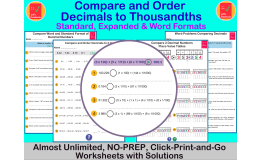
Understanding the base-ten number system and the concept of place value is strengthened by practicing conversions between different number formats, such as standard, expanded, and word forms. This process highlights the importance of each digit's position within a decimal number.
The expanded form of decimals shows the sum of the values of each digit in the number. Writing decimals in an expanded form means writing each number according to its place value. Using fractions in the expanded form of decimals shows the value each digit represents and connects decimals and fractions. By breaking down the numbers in this way, it helps students to visualize and understand how digits combine to form larger numbers.
To support this learning, this structured series of sets of worksheets consists of carefully sequenced practice materials that teachers can select based on student readiness. Each component builds upon previous knowledge:
Foundation Skills:
- Begin with expressing decimals in expanded fractional form as standard numbers
- Progress to converting expanded decimal form into standard notation
- Practice both skills with integrated exercises
Intermediate Concepts:
- Work backward from standard numbers to expanded fractional form
- Transform standard notation into expanded decimal representations
- Apply these skills with practical, real-world examples
Advanced Applications:
- Work with more complex multipliers to prepare for word problems
- Read and write numbers expressed in words (available in two difficulty levels)
Two regional variations exist for expressing numbers in words:
1. American style: "one hundred fifty-two"
2. British/Australian style: "one hundred and fifty-two"
How many Worksheets in each Set ?
Almost unlimited. At the click of a button all numbers are randomised, so the questions change every time. This will allow you to create as many new worksheets you will need for practice throughout the year (classwork, homework, revision, fillers etc) or even give small groups of students in your class different sets of questions either at the same level or differentiated. There will certainly be enough to ensure fluency in this topic.
As these worksheets need little explanation, they are ideal if you need to leave work for a replacement teacher.
Answers can be found on the second page of every worksheet, automatically generated when you create a new worksheet.
Note
These resources are PDF documents and work with the official Adobe Acrobat Reader on Windows or Mac computers with the randomising buttons also working via a touchscreen (PC or Mac) or on an Interactive Whiteboard.
More Resources on Decimals from Jeff's Notebooks
Related resources
More resources teachers may find useful
24 related resources were found using this product's title, contributor, categories and tags.

In the classroom
Teaching tips & learning objectives

Learning objectives
Convert a decimal number from expanded fractional or decimal notation into standard numeral form, and back
Read and write a decimal number in word form, using either the UK/Australia or USA convention for combining place values
Apply place-value understanding of decimals to real-world figures given to varying levels of precision

Teaching tips
Click the randomize button on each set to generate a fresh version of the worksheet for classwork, homework, or reassessment without preparing a new answer sheet by hand
Assign different randomized versions to students working in the same group so each has a unique worksheet, then have them check each other's work
Use Set 7 as a bridge lesson before assigning Sets 8 and 9, since it explains how place values combine into single word terms before students convert full numbers to words

Skills covered
Decimal place-value understanding — students expand a decimal into the sum of each digit's place value, in both fractional and decimal notation.
Standard/expanded form conversion — students convert fluently between expanded and standard numeral forms of a decimal in both directions.
Decimal-to-word conversion — students read and write decimals in word form, combining place values (e.g., tenths and hundredths into a single hundredths term) correctly.
Good to know
Questions teachers ask about this resource
Can new versions of the same worksheet be generated?
Yes — clicking the button on each set's page regenerates the numbers, creating a new, unique version of that worksheet each time, which is useful for repeated practice or giving each student in a group a different set.
Is the word-format convention the same everywhere?
No — Sets 8 and 9 are offered in two conventions: the UK/Australia format that includes 'and' between the hundreds and tens, and the USA format that omits it.

No reviews yet
Downloaded this resource? Tell other teachers how it went.
Curriculum
Standards, concepts & topics
Standards
 Standards
- 5.NBT.A.3 — Read, write, and compare decimals to thousandths. a. Read and write decimals to thousandths using base-ten numerals, number names, and expanded form, e.g., 347.392 = 3 × 100 + 4 × 10 + 7 × 1 + 3 × (1/10) + 9 × (1/100) + 2 × (1/1000). b. Compare two decimals to thousandths based on meanings of the digits in each place, using >, =, and < symbols to record the results of comparisons.
Core concepts
 Core concepts
Place value
Expanded form
Decimal notation
Word form
 Topics
Explore more
Categories this resource belongs to
Explore related searches
More to explore
You may also like