24 related resources

Crash Course Psychology #19: Monkeys and Morality
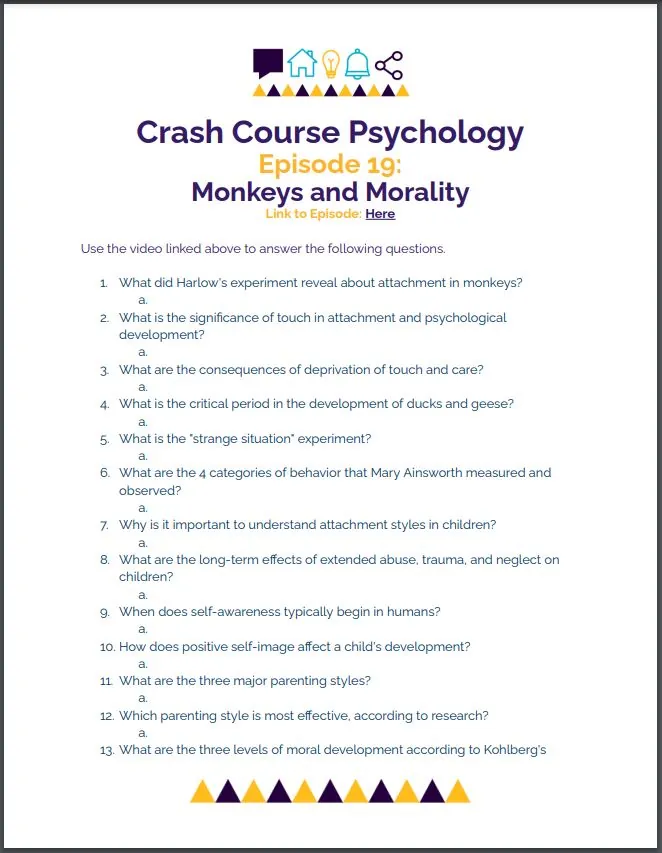
Fifteen short-answer questions guide students through the Crash Course Psychology episode on attachment research, parenting styles and Kohlberg's stages of moral development.
Grades
Grades 9–12, High School
Pages
2
File type
Zip

Updated Feb 21, 2024

Subject
Social Studies, Psychology
Topic
crash course, psychology
Resource types
Worksheets & Printables, Worksheets

About this resource

What's inside this resource

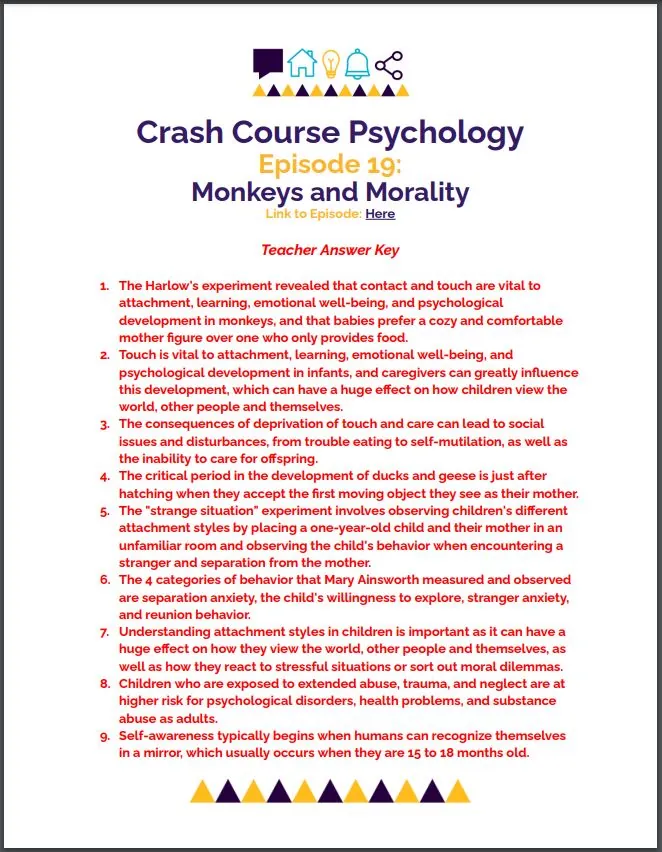
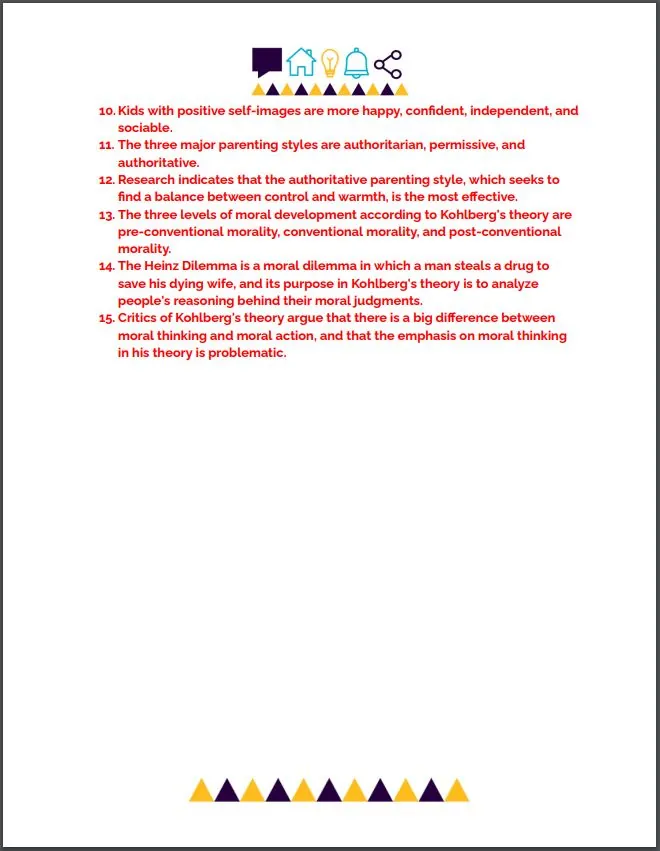
Fifteen short-answer questions follow a linked Crash Course Psychology video episode, moving from Harlow's monkey-attachment experiments and the "strange situation" test through the three major parenting styles and into Kohlberg's three levels of moral development, including the Heinz Dilemma. Each question provides a single blank line for a written response, so students watch the episode and record their own answers in complete sentences. A separate teacher answer key gives a full model answer for every question, covering topics such as what the critical period is for ducks and geese, when self-awareness typically begins, and what critics say about the gap between moral thinking and moral action. Both the student worksheet and the answer key are provided in matching Word and PDF versions.

Product description

From the author

Crash Course Psychology Video Worksheet: Monkeys and Morality provides educators with a 2-page digital worksheet to supplement Crash Course's popular Psychology video on monkeys and morality. Students will answer 15 critical thinking questions that analyze concepts from the video including Harlow's monkey experiments, attachment styles, parenting models, and Kohlberg's theory of moral development across the preconventional, conventional and postconventional levels. This informative worksheet explores the video in depth, enabling students to better understand the psychological concepts presented. It can be easily implemented as in-class work, group work, homework, or online assignments. The zip file includes a student worksheet and answer key for teacher reference.

In the classroom

Teaching tips & learning objectives

Learning objectives

  • Explain what Harlow's experiment and the "strange situation" experiment reveal about attachment.

  • Describe the three major parenting styles and identify which research finds most effective.

  • Outline Kohlberg's three levels of moral development and the purpose of the Heinz Dilemma.

  • Explain the long-term effects of touch deprivation, abuse, trauma and neglect on development.

Teaching tips

  • Play the linked Crash Course Psychology episode before assigning the worksheet, since every question is answered directly from the video's content.

  • Use the included teacher answer key to check written responses, since all 15 items call for full-sentence answers rather than single words.

  • Assign the Word version if you want to adapt question wording, or the PDF version for a ready-to-print copy.

Skills covered

  • Video-based note-taking — students answer 15 short-answer questions tied to specific claims made across the episode.

  • Summarizing psychological research — students explain Harlow's attachment experiment and the "strange situation" experiment in their own words.

  • Applying moral-development theory — students describe Kohlberg's three levels of moral development and the Heinz Dilemma's role in his theory.

  • Comparing parenting styles — students identify authoritarian, permissive and authoritative styles and note which research finds most effective.

Good to know

Questions teachers ask about this resource

Which psychology topics does the worksheet actually cover?

Three: Harlow's attachment research (including the "strange situation" experiment), the three parenting styles, and Kohlberg's stages of moral development via the Heinz Dilemma.

No reviews yet

Downloaded this resource? Tell other teachers how it went.

Resource details

Concepts & topics

Core concepts

  • attachment theory

  • parenting styles

  • moral development

  • Kohlberg

Explore more

Categories this resource belongs to

Explore related searches

More to explore

You may also like