Crash Course Psychology #35: Getting Help - Psychotherapy

- Grades
- Grades 7–12, Middle School, High School
- Pages
- 2
- File type
- Zip


- Subject
- Social Studies, History, Psychology
- Topic
- counseling, crash course
- Resource types
- Worksheets & Printables, Worksheets
About this resource
What's inside this resource
Product description
From the author
Related resources
More resources teachers may find useful
24 related resources were found using this product's title, contributor, categories and tags.
In the classroom
Teaching tips & learning objectives

Learning objectives
Identify and describe the four major schools of psychotherapy: psychodynamic, existential-humanistic, behavioral, and cognitive
Explain specific therapy techniques within each school, such as free association, client-centered therapy, counter-conditioning, and cognitive restructuring
Describe how group therapy and family therapy differ from individual therapy approaches

Teaching tips
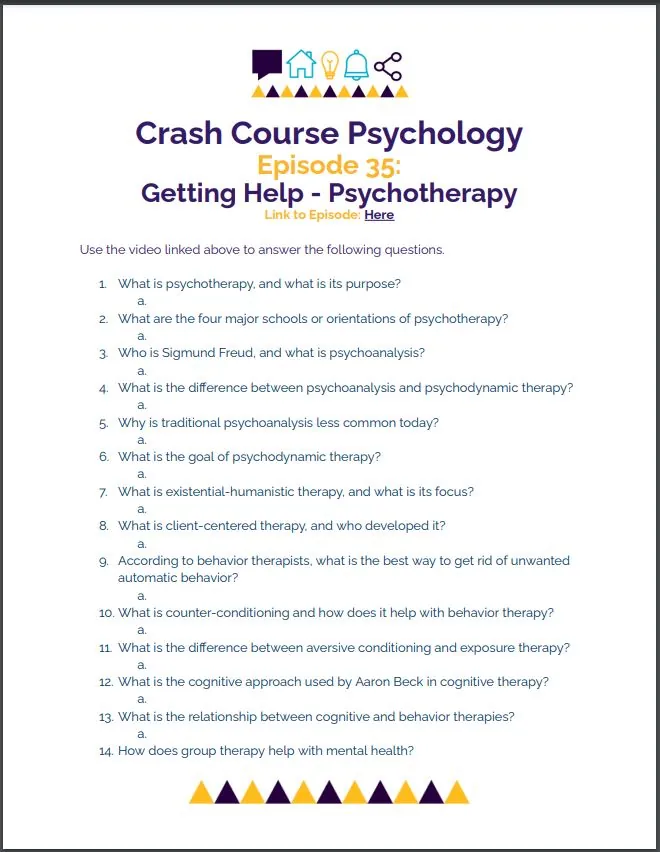
Have students watch the linked episode and answer questions in order, since the worksheet moves school-by-school (psychodynamic, then existential-humanistic, then behavioral, then cognitive) before covering group and family therapy
Use question 4 (psychoanalysis vs. psychodynamic therapy) as a checkpoint, since it's the worksheet's first direct compare-and-contrast question
Pair questions 9-11 (behavior therapy techniques) for a mini-discussion on how counter-conditioning, aversive conditioning, and exposure therapy differ in method but share a behaviorist foundation

Skills covered
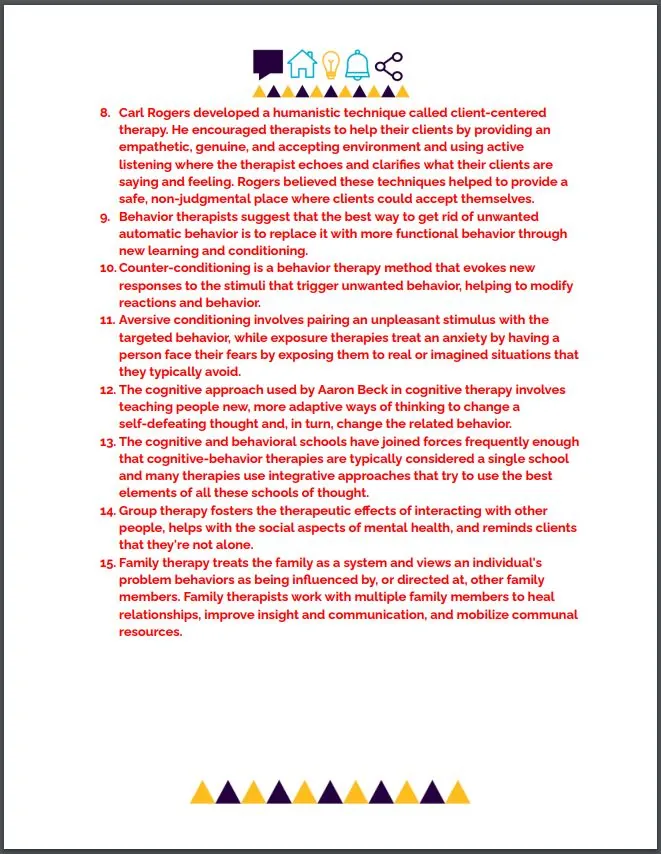
Video-based note-taking — students extract specific facts and definitions from Episode 35 to answer 15 short-answer questions on the four schools of psychotherapy.
Concept classification — students identify which of the four major schools of psychotherapy a given technique or therapist belongs to.
Comparative analysis — students distinguish related concepts such as psychoanalysis vs. psychodynamic therapy, and aversive conditioning vs. exposure therapy.
Good to know
Questions teachers ask about this resource
Which specific therapists and techniques does this worksheet cover?
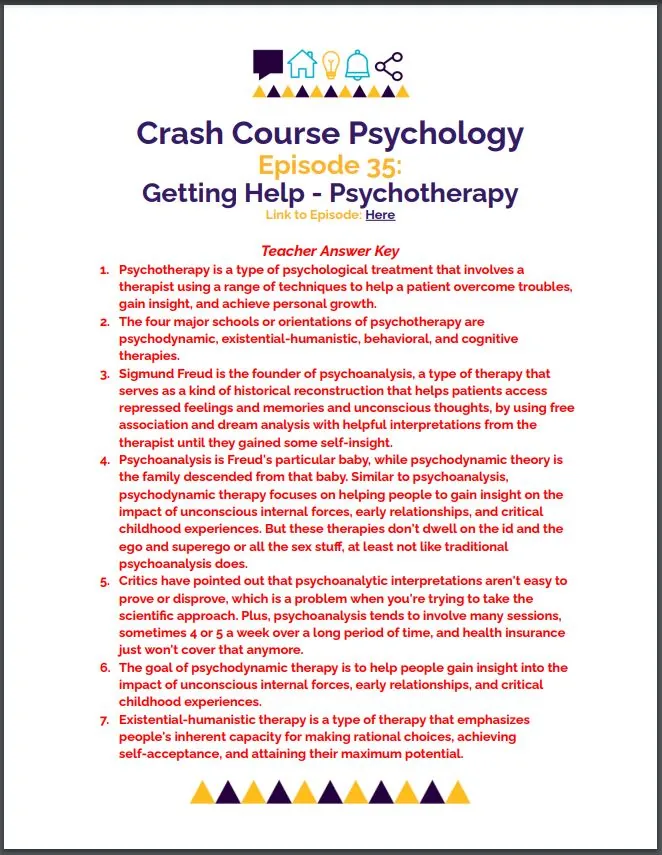
Sigmund Freud (psychoanalysis), Carl Rogers (client-centered therapy), and Aaron Beck (cognitive therapy), along with techniques including free association, counter-conditioning, aversive conditioning, exposure therapy, group therapy, and family therapy.

No reviews yet
Downloaded this resource? Tell other teachers how it went.
Resource details
Concepts & topics
Core concepts
 Core concepts
Four schools of psychotherapy
Psychoanalysis and psychodynamic therapy
Behavioral and cognitive therapy techniques
 Topics
Explore more
Categories this resource belongs to
Explore related searches
More to explore
You may also like