Crash Course Sociology #2: Major Sociological Paradigms Student Worksheet

- Grades
- Grades 9–12, High School
- Pages
- 2
- File type
- Zip


- Subject
- Social Studies, Sociology
- Topic
- social studies, sociology
- Resource types
- Worksheets & Printables, Worksheets
About this resource
What's inside this resource
Related resources
More resources teachers may find useful
24 related resources were found using this product's title, contributor, categories and tags.


In the classroom
Teaching tips & learning objectives

Learning objectives
Define a paradigm as a model of concepts and theories that frames a perspective on a topic such as the social world
Explain why raw facts like an unemployment rate or a person's height need interpretation, and why every scientific discipline makes assumptions about the world
Distinguish macro-level questions about large-scale structures (the transition from feudalism to capitalism) from micro-level questions about interaction between individuals, and explain how a micro question illuminates a macro pattern

Teaching tips
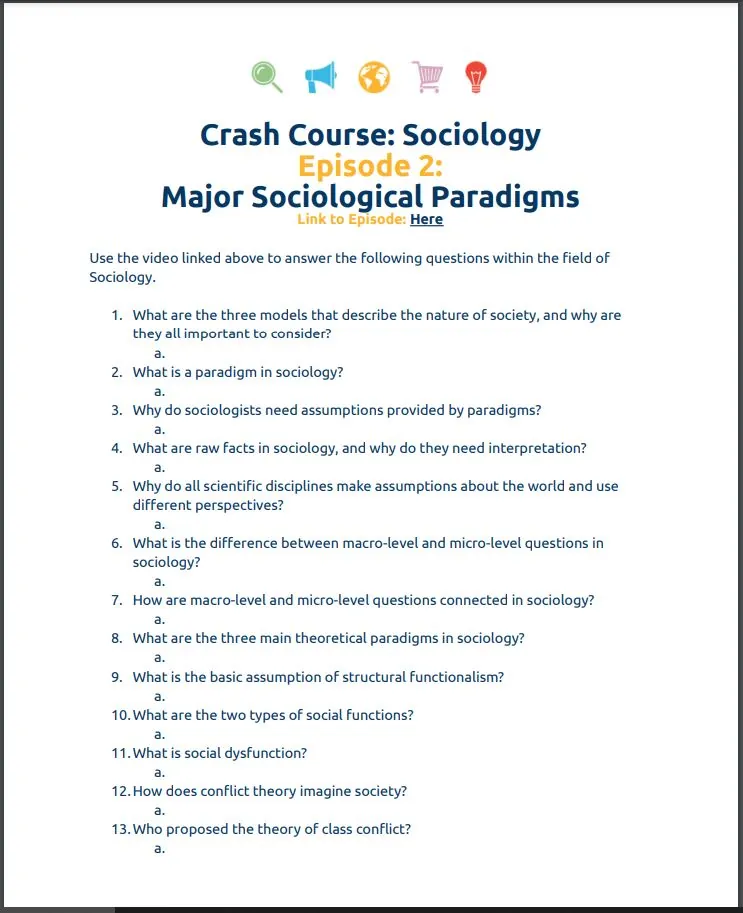
Play the linked episode once straight through before the sheets go out; every item is written to be answered from the video rather than from a textbook passage.
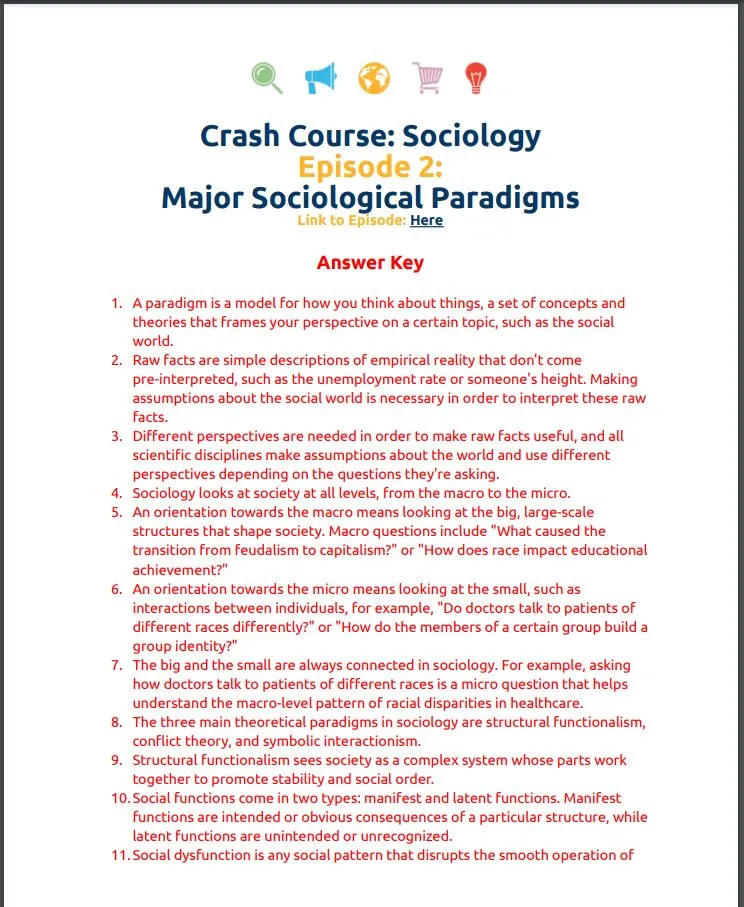
Items 6 and 7 are the pivot of the sheet - the key answers them with paired examples (feudalism to capitalism on the macro side, how doctors talk to patients of different races on the micro side), so pausing the video there puts the contrast in front of students while it is fresh.
Items 8 through 15 form a self-contained block on the three paradigms and work on their own as a next-day review or exit task once the episode has been watched. Revisit the starting ideas with these introductory sociology video questions before building on the topic.

Skills covered
Structured note-taking from video — students answer fifteen numbered questions directly from the linked Crash Course episode, writing each response in the lettered blank beneath the question.
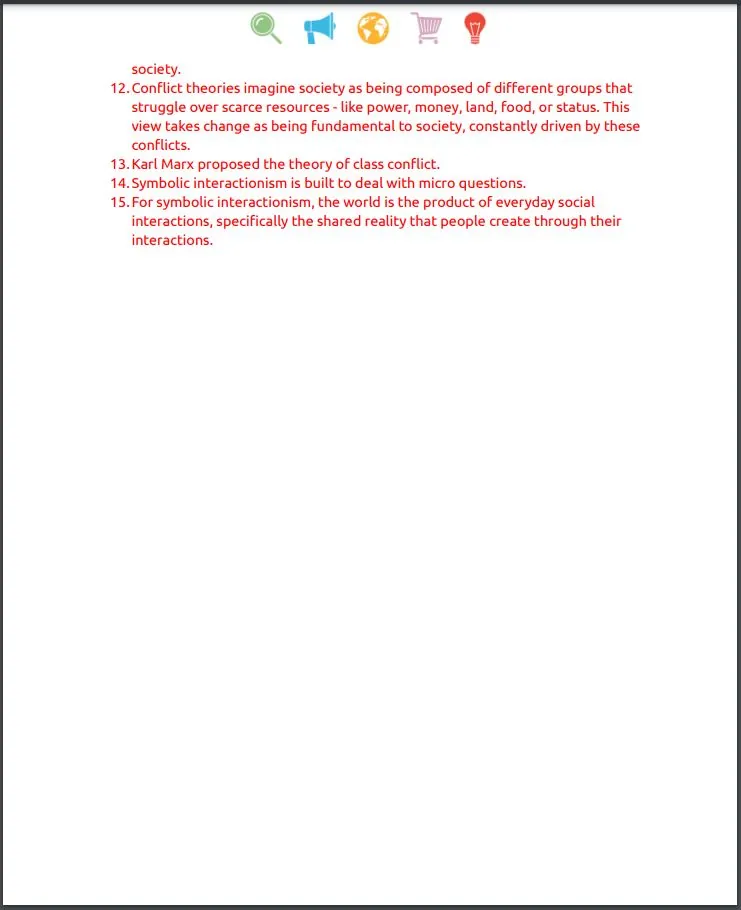
Comparing sociological paradigms — students state the basic assumption of structural functionalism, how conflict theory imagines society as groups struggling over scarce resources, and what symbolic interactionism is built to deal with.
Levels-of-analysis reasoning — students separate macro questions about large-scale structures from micro questions about individual interaction, then explain how the two are connected through an example such as racial disparities in healthcare.
Good to know
Questions teachers ask about this resource
What do students need in front of them before they start writing?
The episode itself. The sheet's header carries a "Link to Episode" line and the direction "Use the video linked above to answer the following questions within the field of Sociology," and each of the fifteen items is written to be answered from that viewing. The Crash Course video is a third-party YouTube release reached through that link rather than a part of the download.
Which sociological ground does the fifteen-item sequence actually cover?
It opens on the nature of sociological models - what a paradigm is, why raw facts such as an unemployment rate need interpretation, and why every discipline works from assumptions. Items 6 and 7 handle macro versus micro levels of analysis. Items 8 through 15 take the three paradigms in turn: structural functionalism with manifest and latent functions and social dysfunction, conflict theory and Karl Marx on class conflict, and symbolic interactionism as a micro-level approach to the shared reality people build through everyday interaction.
Do the fifteen worked responses line up item for item with the fifteen questions?
From item 8 onward they line up exactly - the three paradigms, structural functionalism, manifest and latent functions, dysfunction, conflict theory, Marx and symbolic interactionism each sit at the matching number. Across the opening seven items the worked responses cover the same material (paradigm, raw facts, assumptions, macro and micro orientation) but in a slightly different order from the questions, so that opening block is best reviewed as a set rather than strictly number by number.

No reviews yet
Downloaded this resource? Tell other teachers how it went.
Resource details
Concepts & topics
Core concepts
 Core concepts
Sociological paradigms
Structural functionalism
Conflict theory
Symbolic interactionism
Macro and micro analysis
 Topics
Explore more
Categories this resource belongs to
Explore related searches
More to explore
You may also like