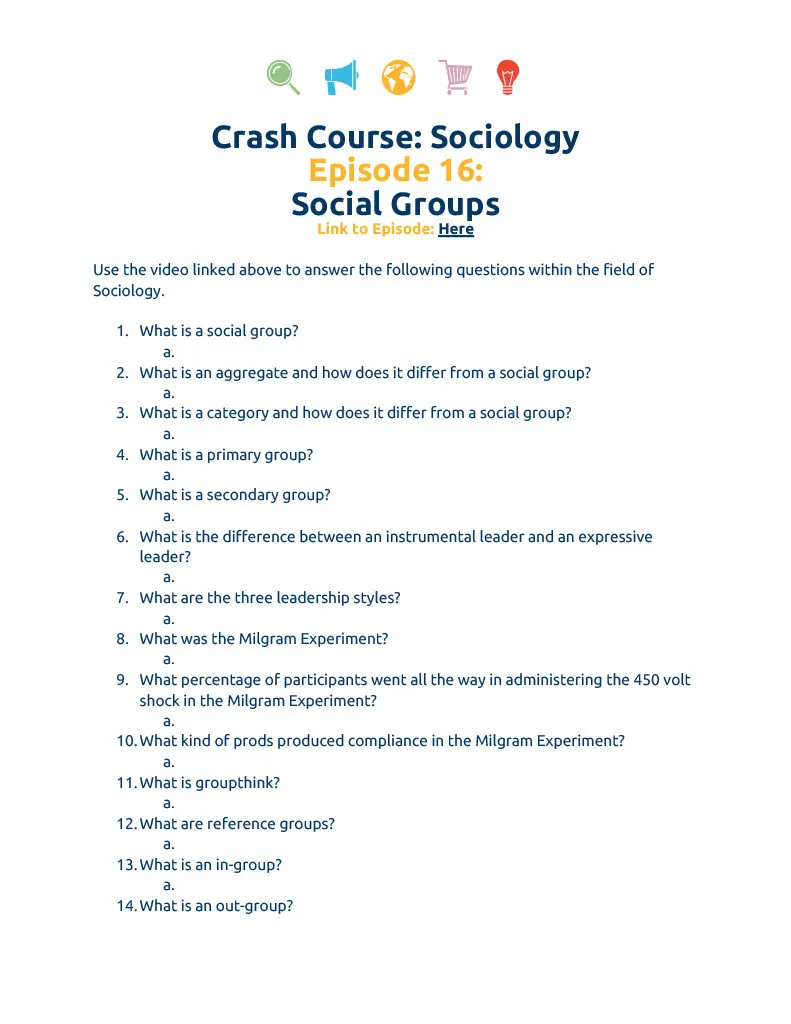
Crash Course Sociology Episode Worksheet | 16 - Social Groups

- Grades
- Grades 10–12
- Pages
- 4
- File type
- Microsoft Word
- Answer key
- Included


- Subject
- Sociology, Social Studies
- Topic
- Crash Course Videos, Crash Course Worksheet
- Resource types
- Activities, Worksheets
- Answer key
- Included
Product description
From the author
Related resources
More resources teachers may find useful
24 related resources were found using this product's title, contributor, categories and tags.


In the classroom
Teaching tips & learning objectives

Learning objectives
Define and distinguish related sociology terms: social group, aggregate, and category; primary and secondary groups; instrumental and expressive leaders; in-groups and out-groups.
Summarize the Milgram Experiment, including its purpose and its 65% compliance result.
Explain groupthink and the role of reference groups and social networks in shaping behavior.

Teaching tips
Have students watch the linked video once through, then a second time pausing to answer each question as its concept comes up.
The answer key's model answers are written as complete sentences, so they can double as a model for how students should phrase their own short answers.
Because several questions build on each other (aggregate vs. category vs. social group; instrumental vs. expressive leader), consider a quick pair-share discussion before moving to the Milgram Experiment questions.

Skills covered
Video-based comprehension — students extract and record definitions and facts while watching an instructional video.
Compare-and-contrast reasoning — several questions ask students to distinguish paired concepts (aggregate vs. category, instrumental vs. expressive leader, in-group vs. out-group).
Sociology vocabulary acquisition — students explain sociology terms and concepts including social groups, leadership, groupthink and social networks.

No reviews yet
Downloaded this resource? Tell other teachers how it went.
Resource details
Concepts & topics
Core concepts
 Core concepts
Social groups
Group dynamics
Leadership styles
The Milgram Experiment
Reference groups
 Topics
Explore more
Categories this resource belongs to
Explore related searches
More to explore
You may also like