Crash Course Sociology Episode Worksheet | 1 - What is Sociology?

- Grades
- Grades 10–12, High School
- File type
- Microsoft Word
- Editable
- Yes


- Subject
- Social Studies, Psychology
- Topic
- Crash Course Videos, Sociology Video
- Resource types
- Worksheets & Printables, Worksheets
- Editable
- Yes
About this resource
What's inside this resource
Product description
From the author
Related resources
More resources teachers may find useful
24 related resources were found using this product's title, contributor, categories and tags.


In the classroom
Teaching tips & learning objectives

Learning objectives
Define sociology and identify Auguste Comte's role in founding it as a discipline.
Explain the two parts of the sociological perspective: seeing the general in the particular and seeing the strange in the familiar.
Describe how social location — race, class, gender, and other categories — can shape and limit a person's choices.

Teaching tips
Share the video link printed at the top of the worksheet so students can watch (or re-watch) the episode before answering.
Use the separate answer-key document for self-checking or class discussion once responses are complete.
Each question has only a single lettered blank beneath it, so students needing more writing space should be directed to use separate paper.

Skills covered
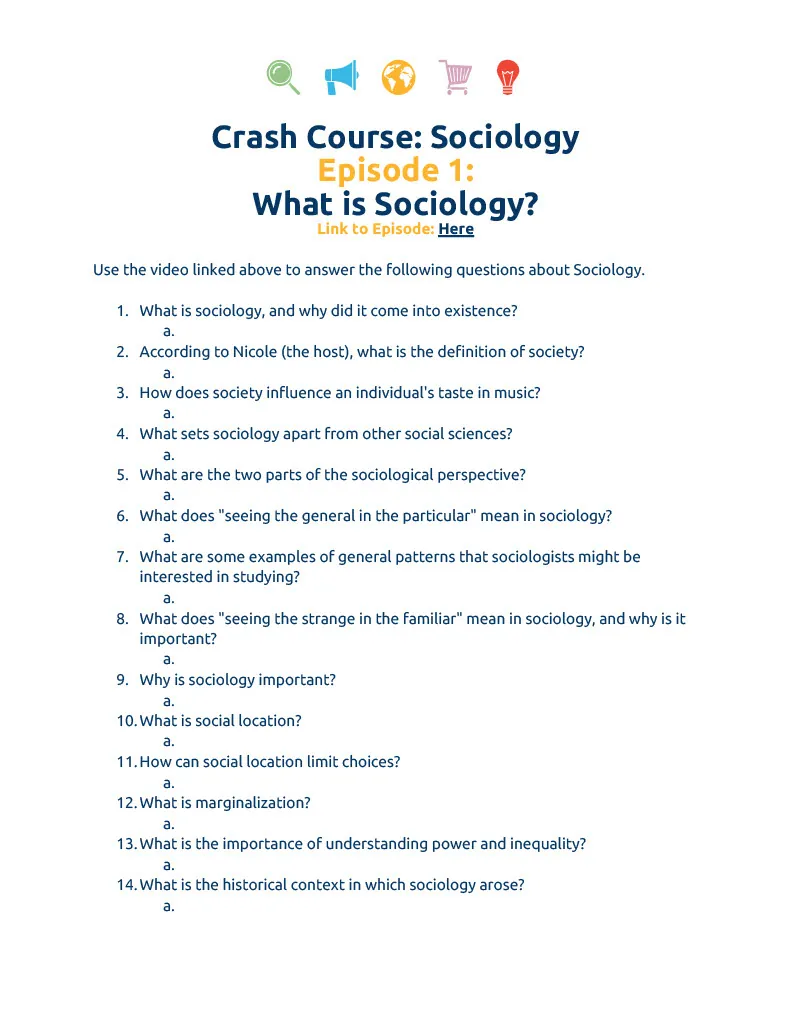
Video-based note-taking — students record written responses to 15 sequential comprehension questions while or after watching a linked video (pages 3-4).
Sociological vocabulary application — students define and apply terms such as 'social location,' 'marginalization,' and 'sociological perspective' in their own words (per the model answers on pages 1-2).
Pattern recognition in social behavior — students consider examples of general social patterns sociologists study, such as declining marriage rates (page 1).
Good to know
Questions teachers ask about this resource
How is the worksheet formatted for students to record their answers?
Each of the 15 questions has a single lettered blank beneath it for a written response, formatted as a running outline rather than ruled answer lines.
What historical context does the material give for how sociology began?
It traces sociology to French philosopher Auguste Comte in the 1800s and situates the field's growth in the economic, social, and political upheaval of industrializing Europe.

No reviews yet
Downloaded this resource? Tell other teachers how it went.
Resource details
Concepts & topics
Core concepts
 Core concepts
sociological perspective
social location
marginalization
society and culture
 Topics
Explore more
Categories this resource belongs to
Explore related searches
More to explore
You may also like