Doubles Color by Code Fall Leaf and Scarecrow Edition
- Grades
- Grades 1–2, Elementary
- File type
- Preparation
- Print ready


- Subject
- Math, Addition and Subtraction, Addition
- Topic
- fall math, math facts
- Resource types
- Worksheets & Printables, Worksheets, Coloring Pages
- Preparation
- Print ready
About this resource
What's inside this resource
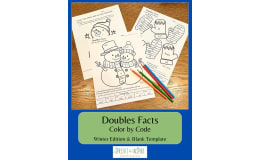
Children can practice mastering doubles facts with these fun, fall themed color by code worksheets!
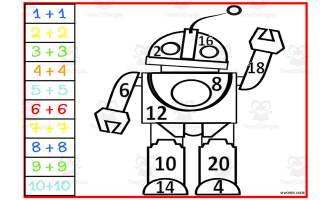
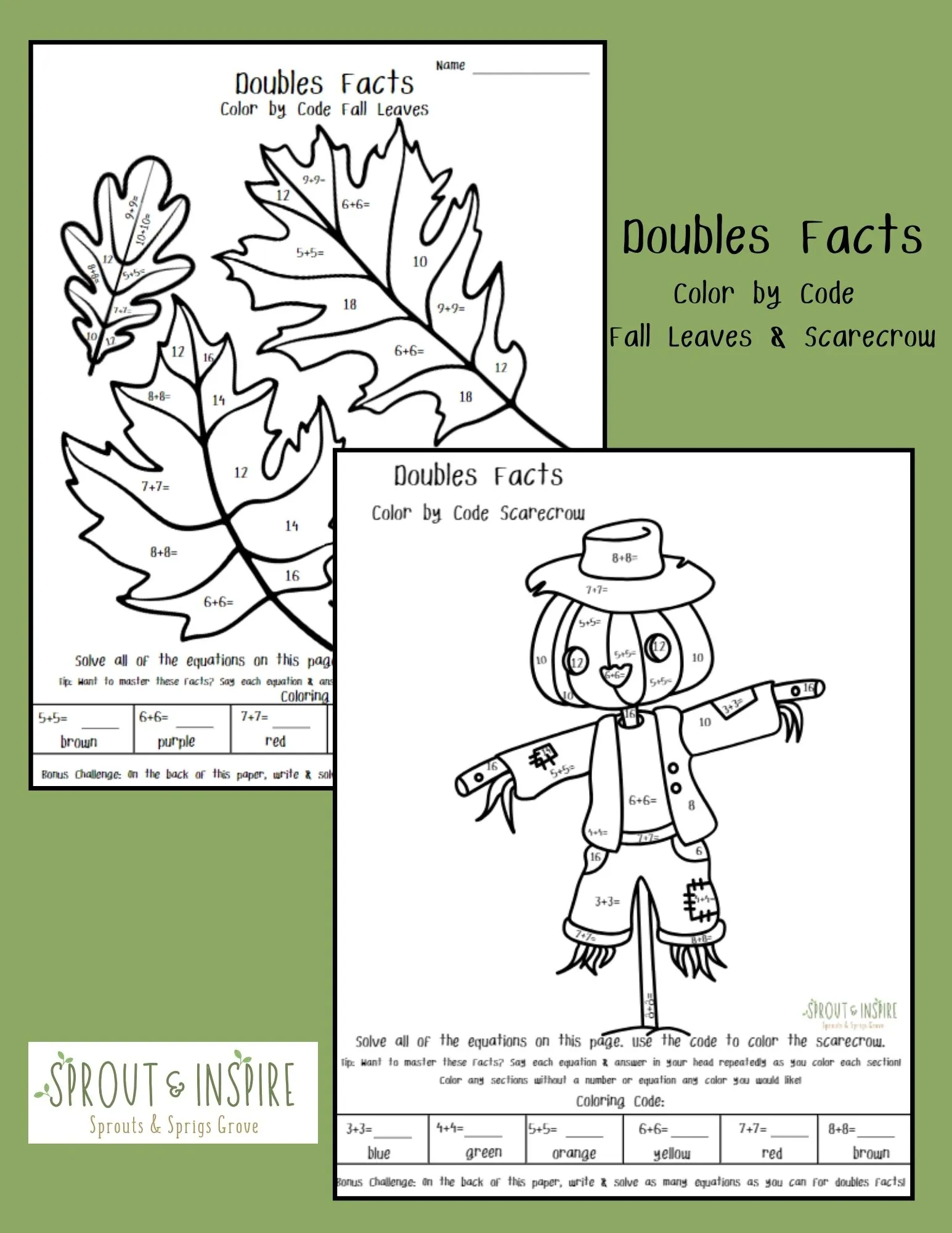
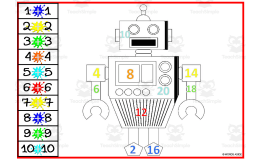
This document contains 2 pages. Each page includes a fun, fall themed color by code worksheet with math equations for doubles such as: 1+1=2, 2+2=4, 3+3=6, 4+4=8, 5+5=10, 6+6=12, 7+7=14, 8+8-16, and 9+9-18.
Children will practice gaining fluency in solving these doubles equations as they correctly color the sections of the leaves and scarecrows using the coloring code. If the code says: 8+8= yellow, children should color the sections of the picture that show both 8+8 and 16 yellow.
To help them memorize these doubles facts, encourage children to repeat the equations and sums in their heads as they color each section (ex: 8+8=16, 8+8=16, 8+8=16).
Be sure to check out other math practice activities and fall related content at: Sprout & Inspire
Learning Objectives
I can demonstrate an understanding of addition
I can accurately add the same number to itself to solve a doubles fact equation
As a bonus challenge, invite children to write down as many doubles fact equations as they can on the back of each worksheet. They can even practice their writing skills by making up fall themed story problems if you would like!
Related resources
More resources teachers may find useful
24 related resources were found using this product's title, contributor, categories and tags.

In the classroom
Teaching tips & learning objectives

Learning objectives
Solve doubles addition facts from 3+3 through 10+10 and state each sum
Recognise that an equation section and its answer section name the same value, and color them the same
Read a six-entry coloring code and apply the matching color to every section it covers

Teaching tips
Give the scarecrow page first if a group is still building fact recall - its code runs 3+3 to 8+8, while the leaves page starts at 5+5 and reaches 10+10
Point out that each page carries its own code before children start: 5+5 is brown among the leaves but orange on the scarecrow, and 8+8 is yellow among the leaves but brown on the scarecrow
Set out the six colors each page needs - brown, purple, red, yellow, orange and gold for the leaves; blue, green, orange, yellow, red and brown for the scarecrow - so no section stalls for a missing crayon. For more practice with the same number facts, use these adding doubles worksheets.

Skills covered
Doubles-fact fluency - students solve every doubles equation from 3+3 to 10+10 across the two pictures.
Equation-to-sum matching - sections print either "7+7=" or "14", and both take the same color, so students connect each fact to its answer.
Following a color code - students read the six-entry key at the foot of the page and apply it section by section.
Good to know
Questions teachers ask about this resource
Do both pictures use the same coloring code?
Each page prints its own code, and they differ, so children read the key on the page in front of them. On the leaves page 5+5 is brown and 8+8 is yellow; on the scarecrow page 5+5 is orange and 8+8 is brown.
Which doubles does each picture practise?
The leaves picture works the larger doubles, 5+5 through 10+10, with sums up to 20. The scarecrow starts lower, 3+3 through 8+8 with sums from 6 to 16, which makes it the gentler of the two pages.
What happens with picture sections that hold no equation?
The scarecrow page settles this in print: "Color any sections without a number or equation any color you would like!", so blank areas are free choice and finished scarecrows vary from child to child.

No reviews yet
Downloaded this resource? Tell other teachers how it went.
Curriculum
Standards, concepts & topics
Standards
 Standards
- 1.OA.C.6 — Add and subtract within 20, demonstrating fluency for addition and subtraction within 10. Use strategies such as counting on; making ten (e.g., 8 + 6 = 8 + 2 + 4 = 10 + 4 = 14); decomposing a number leading to a ten (e.g., 13 – 4 = 13 – 3 – 1 = 10 – 1 = 9); using the relationship between addition and subtraction (e.g., knowing that 8 + 4 = 12, one knows 12 – 8 = 4); and creating equivalent but easier or known sums (e.g., adding 6 + 7 by creating the known equivalent 6 + 6 + 1 = 12 + 1 = 13).
- 2.OA.B.2 — Fluently add and subtract within 20 using mental strategies.2 By end of Grade 2, know from memory all sums of two one-digit numbers.
Core concepts
 Core concepts
Doubles facts
Addition within 20
Color by code
Fact fluency
 Topics
Explore more
Categories this resource belongs to
Explore related searches
More to explore
You may also like