Endangered Species Reading Comprehension Article


- Grades
- Grades 5–7
- Pages
- 6
- File type
- Multiple File Types
- Answer key
- Included


- Subject
- Science
- Topic
- Endangered species, Conservation
- Resource types
- Worksheets, Activities
- Answer key
- Included
- Standards
- CCSS.RI.6.1
Product description
From the author
Related resources
More resources teachers may find useful
24 related resources were found using this product's title, contributor, categories and tags.



In the classroom
Teaching tips & learning objectives

Learning objectives
Identify the natural and human causes that put an animal species at risk of becoming endangered.
Explain threats to giant pandas or mountain gorillas described in the passage, using textual evidence.
Research an additional endangered species not covered in the article and present findings in a poster or brochure.

Teaching tips
The five core comprehension questions come with a complete answer key, but the three extension questions are open research/creative tasks with sample ideas supplied for the first — plan separate time or materials (poster paper, a brochure template) for those.
Both a Word document and a PDF version of the same article are included, so choose whichever format is easier to edit or distribute for your class.
Use the footnote vocabulary definitions (species, extinct, pesticides, habitat, poaching) as a pre-reading vocabulary preview before assigning the full passage.

Skills covered
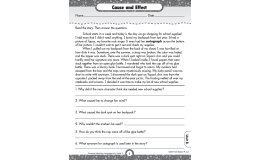
Informational reading comprehension — students answer 5 questions that require locating and restating causes and examples from the passage.
Cause-and-effect reasoning — questions ask students to explain why specific species (Mountain Gorilla, Tasmanian tiger) became endangered or extinct.
Vocabulary in context — five terms (species, extinct, pesticides, habitat, poaching) are defined alongside the passage in which they appear.
Good to know
Questions teachers ask about this resource
How do the extensions differ from the comprehension questions?
The five core questions use the reading, while the extensions ask students to suggest conservation actions, research poaching for a brochure and investigate another species for a poster. The key gives sample ideas for the first extension; the two projects are open-ended.
Should I update the animal profiles before teaching?
Yes. The reading’s conservation-status examples are dated. Check current classifications for the giant panda and mountain gorilla before presenting those profiles as current information.

No reviews yet
Downloaded this resource? Tell other teachers how it went.
Curriculum
Standards, concepts & topics
Standards
 Standards
- CCSS.RI.6.1 — Cite textual evidence to support analysis of what the text says explicitly as well as inferences drawn from the text.
Core concepts
 Core concepts
Endangered species
Extinction
Human impact on habitats
 Topics
Explore more
Categories this resource belongs to
Explore related searches
More to explore
You may also like