Equivalent Fractions Worksheets

- Grades
- Grades 3–5, Elementary
- Pages
- 8
- File type
- Answer key
- Included


- Subject
- Math, Fractions
- Topic
- equivalent fraction worksheet, equivalent fractions
- Resource types
- Worksheets & Printables, Worksheets
- Answer key
- Included
- Standards
- 4.NF.A.1
About this resource
What's inside this resource
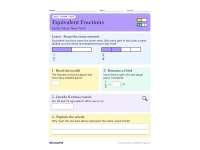
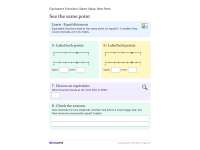
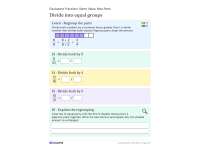
This equivalent fractions worksheet PDF starts with pictures and ends with rules, so students see why two fractions name the same amount before they practice the shortcuts. Page 1 shows 1/2 and 2/4 on equal fraction bars and asks students to read the model, rename a third in sixths and explain why the two bars must be the same size. Page 2 moves to number lines, where equivalent fractions land on the same point.
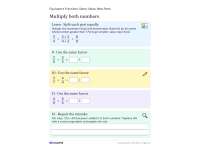
Pages 3 and 4 teach the two rules. Students multiply the numerator and denominator by the same number, repair a classmate who added 2 to both parts, then divide by a common factor and explain how grouping parts keeps the shaded amount the same. Page 5 is an extension on checking pairs with cross products, finding a missing numerator and writing two equivalents of their own. A teacher plan lays out five short sessions, and a two-page answer guide covers all 20 tasks.
- Grades 3–5: equivalent fractions with models, number lines and scaling
- Eight pages: five student pages with 20 tasks, a teacher plan and a two-page answer guide
- Print options: a full-color copy or a black-and-white copy
Related resources
More resources teachers may find useful
24 related resources were found using this product's title, contributor, categories and tags.

In the classroom
Teaching tips & learning objectives

Learning objectives
Explain why equivalent fractions name the same amount of the same-sized whole.
Identify equivalent fractions on fraction bars and on aligned number lines.
Generate equivalent fractions by multiplying the numerator and denominator by the same number.

Teaching tips
Fold paper strips into halves and then fourths before page 1, as the teacher plan suggests, so the shaded amount stays visible while the parts change.
On page 2, remind students to count the spaces between tick marks rather than the marks themselves.
Use task 12, where a student adds 2 to the top and bottom, to show on equal bars why adding does not keep the value.

Skills covered
Fraction models: students read shaded fraction bars and explain why two bars must show the same-sized whole.
Number lines: students label points such as 2/3 and 4/6 that land in the same place on two lines from 0 to 1.
Scaling up and down: students multiply or divide both the numerator and denominator by the same number to rename a fraction.
Good to know
Questions teachers ask about this resource
What grade levels is this for?
Grades 3–5. Pages 1–4 suit students meeting equivalent fractions for the first time, and page 5 adds a cross-product extension for students ready for more.
Does it use visual models or only rules?
Both. Pages 1 and 2 use fraction bars and number lines, and pages 3 and 4 connect those models to multiplying and dividing both numbers.
Is there an answer key?
Yes. A two-page answer guide gives the answer for each of the 20 tasks, sample explanations and notes on what to listen for.
How many lessons does it cover?
The teacher plan maps the pages to five short sessions, one page per session.

No reviews yet
Downloaded this resource? Tell other teachers how it went.
Curriculum
Standards, concepts & topics
Standards
 Standards
- 4.NF.A.1 — Explain why a fraction a/b is equivalent to a fraction (n × a)/(n × b) by using visual fraction models, with attention to how the number and size of the parts differ even though the two fractions themselves are the same size. Use this principle to recognize and generate equivalent fractions.
Core concepts
 Core concepts
Equivalent fractions
Fraction models
Number lines
Numerator and denominator
Simplifying fractions
Cross products
 Topics
Explore more
Categories this resource belongs to
Explore related searches
More to explore