ESL Reading Comprehension + Writing Activity Worksheets - Brainrot


- Grades
- Grades 7–9
- Pages
- 3
- File type
- Preparation
- Print ready


- Subject
- ELA, Reading Comprehension, Writing
- Topic
- Brainrot, Internet culture
- Preparation
- Print ready
- Standards
- CCSS.RI.8.1 CCSS.W.8.1
Product description
From the author
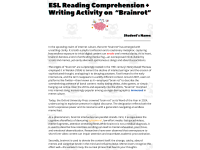
Explore how the supplied passage describes brainrot, its history and internet use. This three-page resource for intermediate and advanced ESL learners includes nineteen comprehension and vocabulary questions.
Two writing prompts ask students to argue an opinion or explain the concept to an imagined 19th-century audience. Preview the passage for classroom fit and provide extra writing paper.
Related resources
More resources teachers may find useful
24 related resources were found using this product's title, contributor, categories and tags.


In the classroom
Teaching tips & learning objectives

Learning objectives
Summarize how the meaning of "brainrot" changed from its 1854 literary use to its current internet-slang usage.
Define vocabulary in context (erode, ephemeral, immersed) and generate synonyms for a target word.
Construct a written opinion, supported by reasoning, on whether brainrot represents a genuine cultural concern.

Teaching tips
Pre-teach or review "erode," "ephemeral," and "immersed" before assigning the vocabulary questions, since students must define or generate synonyms for them without a separate glossary.
Split the packet across two sessions — the 19 comprehension/vocabulary questions in one sitting, the two full essay prompts in another — rather than assigning all of it at once.
Provide a notebook or extra paper for the extended writing responses.

Skills covered
Reading comprehension of an informational text — students answer content, sequence, and evidence-based questions drawn directly from the brainrot passage.
Vocabulary in context — students define and generate synonyms for words such as erode, ephemeral, and immersed as used in the passage.
Opinion and explanatory writing — students argue a position about brainrot or explain it to an imagined 19th-century audience.

No reviews yet
Downloaded this resource? Tell other teachers how it went.
Curriculum
Standards, concepts & topics
Standards
 Standards
- CCSS.RI.8.1 — Cite the textual evidence that most strongly supports an analysis of what the text says explicitly as well as inferences drawn from the text.
- CCSS.W.8.1 — Write arguments to support claims with clear reasons and relevant evidence. a. Introduce claim(s), acknowledge and distinguish the claim(s) from alternate or opposing claims, and organize the reasons and evidence logically. b. Support claim(s) with logical reasoning and relevant evidence, using accurate, credible sources and demonstrating an understanding of the topic or text. c. Use words, phrases, and clauses to create cohesion and clarify the relationships among claim(s), counterclaims, reasons, and evidence. d. Establish and maintain a formal style. e. Provide a concluding statement or section that follows from and supports the argument presented.
Core concepts
 Core concepts
Digital media literacy
Reading comprehension
Vocabulary in context
Opinion writing
 Topics
Explore more
Categories this resource belongs to
Explore related searches
More to explore
You may also like