ESL Reading Comprehension + Writing Activity Worksheets on Goosebumps


- Grades
- Grades 6–9
- Pages
- 3
- File type
- Preparation
- Print ready


- Subject
- ELA, ESL, Reading Comprehension, Writing
- Topic
- Goosebumps, R. L. Stine
- Preparation
- Print ready
- Standards
- CCSS.RI.7.1 W.7.1
Product description
From the author
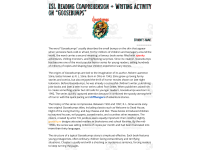
Read about R. L. Stine’s Goosebumps series in this three-page resource for intermediate ESL learners. A two-page nonfiction passage introduces the author, genre, themes, adaptations and responses from readers and critics.
The final page supplies 22 comprehension and vocabulary questions, including two true-or-false claims requiring evidence. Three essay prompts invite personal reading reflections, comparison with another horror novel, film or TV series, and discussion of another book series that encouraged young readers. Provide separate paper for extended essays.
Related resources
More resources teachers may find useful
24 related resources were found using this product's title, contributor, categories and tags.


In the classroom
Teaching tips & learning objectives

Learning objectives
Read and comprehend a nonfiction passage about a popular book series, identifying key facts such as author background and publication history.
Define genre- and criticism-related vocabulary (cliffhanger, grotesque, formulaic) using context from the passage.
Compose an essay comparing personal reading experience or another horror novel, film, TV series or young-reader book series to Goosebumps, supporting opinions with reasons.

Teaching tips
Assign the reading passage before the comprehension questions so students meet key vocabulary (grotesque, formulaic, cliffhanger) in context first.
Use the two true-or-false argument questions near the end of the comprehension set as a quick check for evidence-based reasoning.
Pair the three essay prompts with brief pre-writing discussion, since each one asks students to compare Goosebumps to a personal experience or another series.

Skills covered
Reading comprehension — students answer 22 factual and inferential questions drawn directly from the Goosebumps passage.
Vocabulary in context — students explain terms like grotesque, cliffhanger, and formulaic as used in the text.
Essay writing — three prompts ask students to compare, describe, and evaluate horror novels, films or TV series and young-reader book series in extended written responses.
Good to know
Questions teachers ask about this resource
What does the writing activity ask students to do beyond summarizing the passage?
The three essay prompts ask students to compare Goosebumps to another horror novel, film or TV series or to a different book series that encouraged young readers, using their own reasoning and examples rather than restating the passage.
What aspects of the Goosebumps series does the reading passage cover beyond the plots of individual books?
It covers R. L. Stine's biography, the series' original run, its blend of horror and humor, its expansion into TV, games, and film, and how critics and teachers view its literary value.

No reviews yet
Downloaded this resource? Tell other teachers how it went.
Curriculum
Standards, concepts & topics
Standards
 Standards
- CCSS.RI.7.1 — Cite several pieces of textual evidence to support analysis of what the text says explicitly as well as inferences drawn from the text.
- W.7.1
Core concepts
 Core concepts
Reading comprehension
Vocabulary in context
Essay writing
Textual evidence
 Topics
Explore more
Categories this resource belongs to
Explore related searches
More to explore
You may also like