



Pizza Fractions Project – 2-Day Class Activity
- Grades
- Grade 3, Elementary
- File type
- Editable
- Yes


- Subject
- Math, Fractions, Common Core
- Topic
- fractions, pizza
- Resource types
- Activities, Projects, Word Problems
- Editable
- Yes
About this resource
What's inside this resource
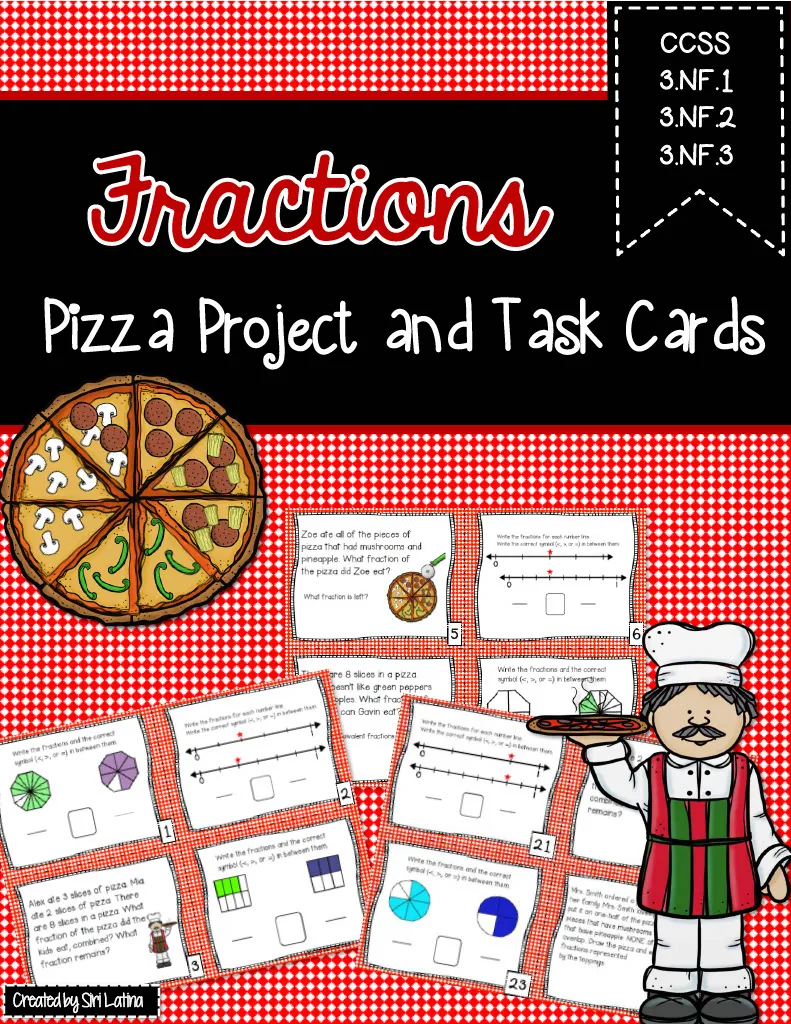
This is a Pizza Fractions Project!
This activity is designed to be done over the course of two days, at the middle or end of a 3rd Grade Fractions unit.
I decorated my classroom to look like an Italian restaurant and had pictures of Italy on the Smartboard. I also made an Italian music station on Internet radio and had spaghetti sauce (with breadsticks for dipping) in the crockpot!
Students wore paper chef hats, which were inexpensive on Amazon. The pizzas they created were done in pizza boxes, but you could use long construction paper or poster board, just as easily.
I also had students do a close reading about the history of Pizza, which I got from Learnzillion.
You will need to run the pizza template and toppings off on colored paper or cardstock and I had them cut out in advance, to save time.
Included in this file:
Page 4: Performance Task Student Directions
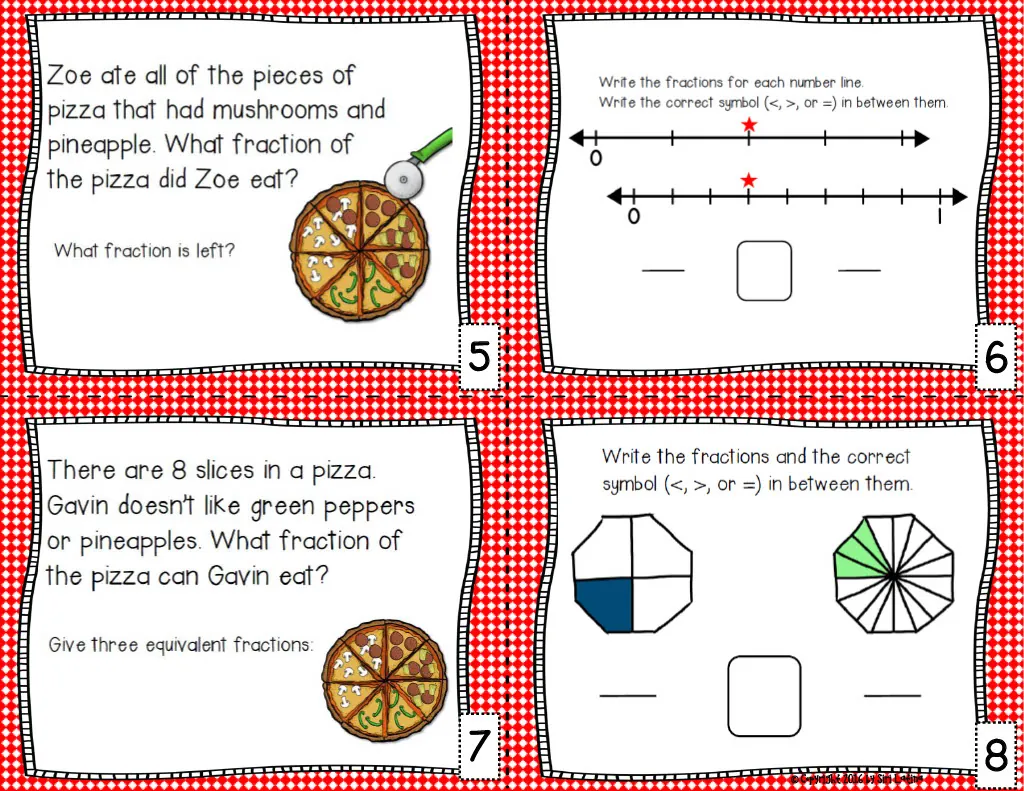
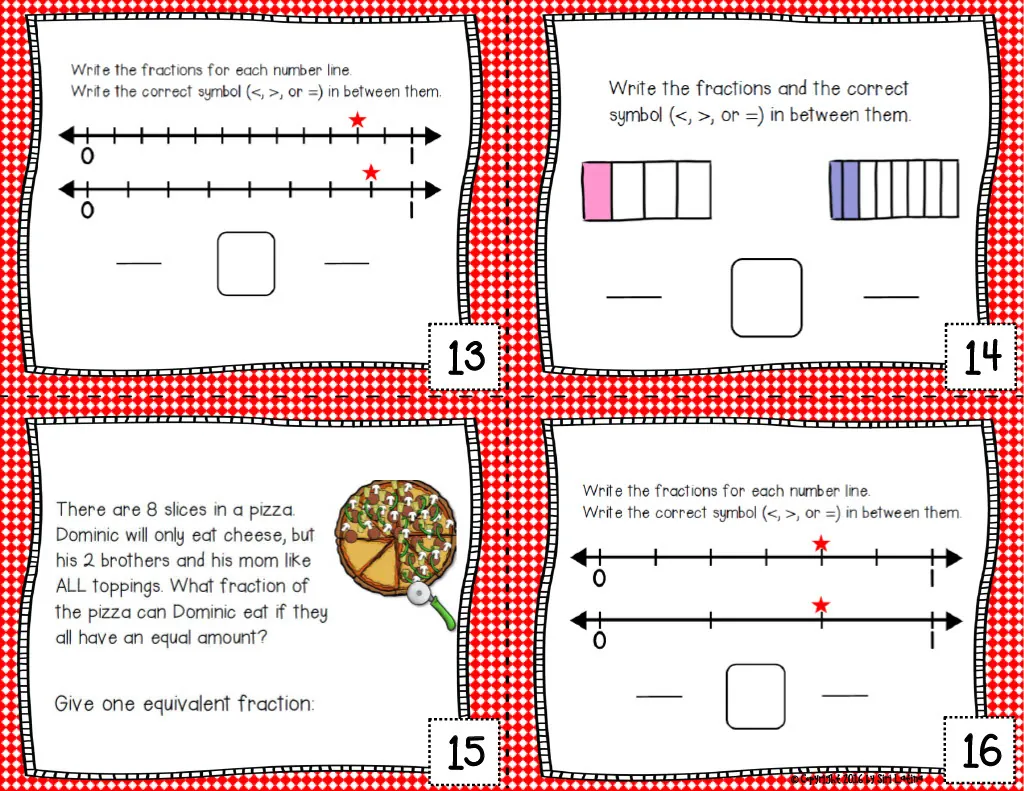
Pages 5-10: Task Cards (Alternative to Fractioni’s PowerPoint Comparing Fractions & Word Problems
Page 11: Task Card Recording Sheets
Pages 12-13: Pizza Parts-run off on beige card stock or construction paper and cut out. Students can add tomato sauce and cheese with crayons, if desired
Page 14: Green Peppers-run off on green card stock or construction paper and cut out. I used 12 copies of each topping for a class of 24.
Page 15: Pepperoni-run off on red card stock or construction paper and cut out.
Page 16: Pineapple-run off on yellow card stock or construction paper and cut out.
Page 17: Mushrooms-run off on white card stock or construction paper and cut out.
Page 18: Pizza Key and Word Problem sheet-I ran this off on the same color that I used for the pizza
Related resources
More resources teachers may find useful
24 related resources were found using this product's title, contributor, categories and tags.

In the classroom
Teaching tips & learning objectives

Learning objectives
Compare fractions and equivalent fractions represented as shapes, number lines, and pizza-slice toppings using <, >, and = symbols
Represent at least five different fractions concretely by distributing toppings across at least two of eight pizza slices
Write and solve original fraction word problems based on a self-created pizza model

Teaching tips
Run the review slides (comparing and equivalent fractions) on day one using a 'Showdown' team-whiteboard structure, then introduce the performance task with the included slides or the printed direction sheet.
Differentiate the topping requirement up or down (for example, 7 toppings for advanced pairs, 4 for pairs who need support) while keeping the core 5-fraction requirement for most students.
Have students check their word problem with you before writing it on the pizza-box lid, since classmates will later solve each other's problems.

Skills covered
Fraction comparison — students compare fractions shown as shaded shapes, number lines, and pizza-slice toppings, writing <, >, or = between them.
Concrete fraction representation — students physically distribute toppings across pizza slices so that each of at least five fractions is represented by at least two of eight equal parts.
Fraction word-problem composition and solving — students write and later solve classmates' original word problems based on toppings represented on their own pizza.
Good to know
Questions teachers ask about this resource
Why must each pizza topping cover at least two of the eight slices rather than just one?
The project requires every topping to represent a genuine, comparable fraction of the pizza (at least 2/8), since a topping on only a single slice wouldn't let students practice writing and comparing meaningful fractional relationships across at least five different toppings.
How does the partner rule about disliked toppings shape the fractions each pizza ends up representing?
Because each partner must like at least half the pizza, a topping one partner dislikes can only cover up to half the pizza's slices, so pairs have to negotiate topping placement — a constraint that naturally produces a wider variety of fraction combinations across the class.

No reviews yet
Downloaded this resource? Tell other teachers how it went.
Curriculum
Standards, concepts & topics
Standards
 Standards
- 3. NF.A.3 — Explain equivalence of fractions in special cases, and compare fractions by reasoning about their size. a. Understand two fractions as equivalent (equal) if they are the same size, or the same point on a number line. b. Recognize and generate simple equivalent fractions, e.g., 1/2 = 2/4, 4/6 = 2/3). Explain why the fractions are equivalent, e.g., by using a visual fraction model. c. Express whole numbers as fractions, and recognize fractions that are equivalent to whole numbers. Examples: Express 3 in the form 3 = 3/1; recognize that 6/1 = 6; locate 4/4 and 1 at the same point of a number line diagram. d. Compare two fractions with the same numerator or the same denominator by reasoning about their size. Recognize that comparisons are valid only when the two fractions refer to the same whole. Record the results of comparisons with the symbols >, =, or <, and justify the conclusions, e.g., by using a visual fraction model.
- 3.G.A.2 — Partition shapes into parts with equal areas. Express the area of each part as a unit fraction of the whole. For example, partition a shape into 4 parts with equal area, and describe the area of each part as 1/4 of the area of the shape.
- 3. NF.A.1 — Understand a fraction 1/b as the quantity formed by 1 part when a whole is partitioned into b equal parts; understand a fraction a/b as the quantity formed by a parts of size 1/b.
Core concepts
 Core concepts
fractions
equivalent fractions
comparing fractions
fraction word problems
 Topics
Explore related searches
More to explore
You may also like


