Free 6th Grade Math Spiral Review Escape Room – Ratios & Unit Rates


- Grades
- Grades 5–7, Middle School, Elementary
- Pages
- 5
- File type
- Answer key
- Included


- Subject
- Math
- Topic
- Matemaths, Guided Notes
- Resource types
- Worksheets, Worksheets & Printables, Teacher Tools, Activities, Escape Room
- Answer key
- Included
About this resource
What's inside this resource
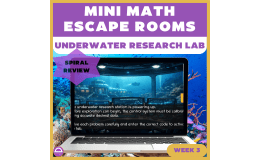
This escape room is a no-prep way to spiral review with your students without losing an entire class period! It is designed to be completed much more quickly than a traditional escape room, so it’s perfect for a warm up, an early finisher activity, or a quick review day.
Students solve 5 problems based on ratios and unit rates; each answer gives them a digit to use in their final code. Entering the code unlocks the final door, so students are able to check their own work and work independently to fix mistakes.
This activity is self-checking and requires no set-up at all: just assign to students and let them get started. Everything students need is contained in one short assignment, and it feels more fun than a worksheet!
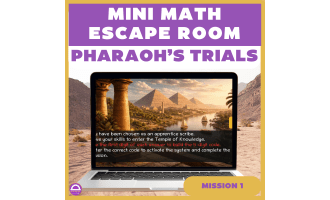
This resource is Mission 1 out of 5 in a week-long set of mini escape rooms designed to provide spiral review of ratios and unit rates, but can also be used on its own!
What’s Included
5 ratio and unit rate problems
Numeric code built from student answers
Self-checking format
No prep required
Skills Addressed
Understanding ratios
Calculating unit rates
Applying ratio and rate concepts in problem-solving
Suggested Uses
Daily spiral review
Warm-ups or bell ringers
Early finisher activity
Quick review before assessments
This free mini escape room is an easy way to keep ratio and unit rate skills fresh while adding variety to your math block! It’s short, focused, and built to fit into real classroom schedules.
Related resources
More resources teachers may find useful
24 related resources were found using this product's title, contributor, categories and tags.


No reviews yet
Downloaded this resource? Tell other teachers how it went.
Curriculum
Standards, concepts & topics
Standards
 Standards
- 6. NS.B.2 — Fluently divide multi-digit numbers using the standard algorithm.
- 6.EE.A.2 — Write, read, and evaluate expressions in which letters stand for numbers. a. Write expressions that record operations with numbers and with letters standing for numbers. For example, express the calculation “Subtract y from 5” as 5 – y. COMMON CORE STATE STANDARDS for MATHEMATICS GRADE 6 | 44 b. Identify parts of an expression using mathematical terms (sum, term, product, factor, quotient, coefficient); view one or more parts of an expression as a single entity. For example, describe the expression 2 (8 + 7) as a product of two factors; view (8 + 7) as both a single entity and a sum of two terms. c. Evaluate expressions at specific values of their variables. Include expressions that arise from formulas used in real-world problems. Perform arithmetic operations, including those involving whole-number exponents, in the conventional order when there are no parentheses to specify a particular order (Order of Operations). For example, use the formulas V = s3 and A = 6 s2 to find the volume and surface area of a cube with sides of length s = 1/2.
- 6. NS.A.1 — Interpret and compute quotients of fractions, and solve word problems involving division of fractions by fractions, e.g., by using visual fraction models and equations to represent the problem. For example, create a story context for (2/3) ÷ (3/4) and use a visual fraction model to show the quotient; use the relationship between multiplication and division to explain that (2/3) ÷ (3/4) = 8/9 because 3/4 of 8/9 is 2/3. (In general, (a/b) ÷ (c/d) = ad/bc.) How much chocolate will each person get if 3 people share 1/2 lb of chocolate equally? How many 3/4-cup servings are in 2/3 of a cup of yogurt? How wide is a rectangular strip of land with length 3/4 mi and area 1/2 square mi?
- 6.RP.A.1 — Understand the concept of a ratio and use ratio language to describe a ratio relationship between two quantities. For example, “The ratio of wings to beaks in the bird house at the zoo was 2:1, because for every 2 wings there was 1 beak.” “For every vote candidate A received, candidate C received nearly three votes.”
- 6.RP.A.3 — Use ratio and rate reasoning to solve real-world and mathematical problems, e.g., by reasoning about tables of equivalent ratios, tape diagrams, double number line diagrams, or equations. a. Make tables of equivalent ratios relating quantities with whole-number measurements, find missing values in the tables, and plot the pairs of values on the coordinate plane. Use tables to compare ratios. b. Solve unit rate problems including those involving unit pricing and constant speed. For example, if it took 7 hours to mow 4 lawns, then at that rate, how many lawns could be mowed in 35 hours? At what rate were lawns being mowed? c. Find a percent of a quantity as a rate per 100 (e.g., 30% of a quantity means 30/100 times the quantity); solve problems involving finding the whole, given a part and the percent. d. Use ratio reasoning to convert measurement units; manipulate and transform units appropriately when multiplying or dividing quantities.
Core concepts
 Core concepts
Applied problem solving
6th grade math escape room
 Topics
Explore more
Categories this resource belongs to
Explore related searches
More to explore
You may also like