Free Science Reading Comprehension Passage: Objects in the Sky PDF


- Grades
- Grades 3–5, Elementary
- Pages
- 5
- File type
- Answer key
- Included


- Subject
- ELA, Reading, Reading Comprehension, Science, Earth and Environmental Sciences, Space
- Topic
- objects in the sky, space reading comprehension
- Resource types
- Worksheets & Printables, Worksheets
- Answer key
- Included
- Standards
- CCSS.RI.3.1 CCSS.RI.3.4 +1
About this resource
What's inside this resource
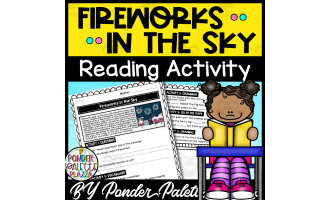
Why does the moon seem to follow the car at night? This free science reading comprehension passage on objects in the sky answers that question for grades 3–5. The one-page passage, about 390 words, compares things close to Earth, such as kites, balloons and helicopters, with faraway objects like the moon, the sun and stars. It explains why distant objects seem to move slowly and introduces star, planet, moon, asteroid, orbit, solar system and galaxy.
Fifteen items in eight sections fill three question pages. Students check answers, sort six pictures as near Earth or far in space, and explain why a high jet seems to crawl. They label a sun, Earth and moon orbit diagram and read a NASA-based table of planet widths and known moons. A clue match for space words, a biggest-to-smallest ordering task and an explanation of why the moon looks bigger than stars come next. The set ends with Look Up Tonight, where students record two things they see in the night sky.
- Grades 3–5: earth and space science reading
- Five pages: passage, three question pages and an answer key
- Free files: color and black-and-white PDFs
Related resources
More resources teachers may find useful
24 related resources were found using this product's title, contributor, categories and tags.


In the classroom
Teaching tips & learning objectives

Learning objectives
Tell objects near Earth apart from objects far out in space.
Explain why faraway objects seem to move slowly across the sky.
Define star, planet, moon, asteroid, orbit, solar system and galaxy.

Teaching tips
Have students underline each bold space word as they read, as the page 1 directions say.
Point out the "Not to scale" note on the orbit diagram before Section 3.
Walk through the table heading for Section 4: width is measured straight across the middle of each planet.

Skills covered
Distance and motion: students explain why a nearby helicopter seems to rush past while a high jet seems to crawl.
Diagram labeling: students name the star, planet, moon and orbit in a drawing of the sun, Earth and moon.
Data reading: students compare planet widths and moon counts and test whether Jupiter is more than ten times as wide as Earth.
Good to know
Questions teachers ask about this resource
Is this passage free?
Yes. The five-page lesson is a free download in color and in black and white.
What grade is it for?
Grades 3–5. The passage is about 390 words on one page.
Is there a data or diagram task?
Yes. Students label an orbit diagram of the sun, Earth and moon, then use a planet table to answer three data questions.
Does it include an answer key?
Yes. The last page answers all 15 items under the same section numbers, with a short teacher note.

No reviews yet
Downloaded this resource? Tell other teachers how it went.
Curriculum
Standards, concepts & topics
Standards
 Standards
- CCSS.RI.3.1 — Ask and answer questions to demonstrate understanding of a text, referring explicitly to the text as the basis for the answers.
- CCSS.RI.3.4 — Determine the meaning of general academic and domain-specific words and phrases in a text relevant to a grade 3 topic or subject area.
- CCSS.RI.3.7 — Use information gained from illustrations (e.g., maps, photographs) and the words in a text to demonstrate understanding of the text (e.g., where, when, why, and how key events occur).
Core concepts
 Core concepts
objects in the sky
solar system
planets
orbits
stars
space vocabulary
 Topics
Explore more
Categories this resource belongs to
Explore related searches
More to explore
You may also like