Functions Domain & Range Quiz - Multiple Versions Bundle



- Grades
- Grades 8–10
- Pages
- 33
- File type
- Answer key
- Included


- Subject
- Math, Algebra
- Topic
- Function domain, Function range
- Resource types
- Quizzes
- Answer key
- Included
- Standards
- HSF-IF.A.1
Product description
From the author
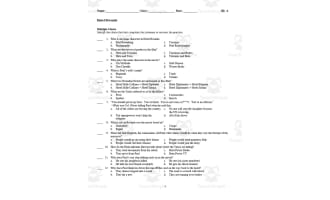
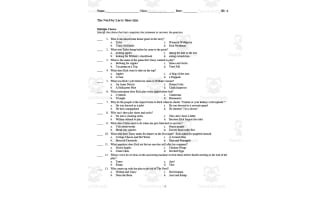
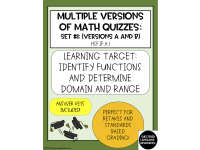
This resource contains all three sets (six versions) of math quizzes that ask students to identify functions and determine the domain and range of a function. Answer keys are provided.
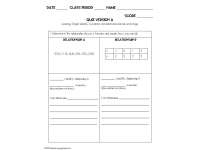
-Each quiz contains three question groups; the first and third ask students to explain their reasoning. The quizzes are formatted in an easy to use way and provide space for student explanations.
-These quizzes are perfect for standards based grading (the standard is clearly listed) and perfect for providing retakes if students don’t get it the first time around.
-These quizzes are quick to grade…I can grade a class set of 35 in about 15 minutes!
Suggested ways to use:
There are many ways you can score the quizzes
-Use your own rubric or your school’s rubric to score the quizzes.
-Use traditional points and percents.
-Assign each question multiple points and give students partial credit for partially correct answers.
-Use standards based descriptions such as ‘M’ for meets, ‘E’ for exceeds, etc.
There are many ways to use the quizzes
-Use one version as a pre-test…see what your students already know before you start.
-Use one version as a preview for students so they can see what kind of questions will be on a future test.
-Use for review or reteaching.
-Use to refresh a concept that students were introduced to in the past.
-Analyze quiz results so you know where reteaching is needed.
-Provide to intervention teachers so they know exactly what to practice.
-Let students take multiple versions to increase their score and show understanding as they improve their skills.
Related resources
More resources teachers may find useful
24 related resources were found using this product's title, contributor, categories and tags.


In the classroom
Teaching tips & learning objectives

Learning objectives
Determine whether a relationship (given as ordered pairs or a table) represents a function and justify the reasoning in writing.
Find the domain and range of a function represented by a table and by a graph.
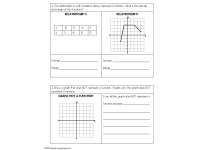
Sketch a graph that does not represent a function and explain why it fails, using the vertical line test.

Teaching tips
Choose a version for an initial check and another for follow-up practice.
The six versions use the same question format; the draw-a-non-function prompt is repeated, so account for that when interpreting a retake.
Questions 1 and 3 require explanations; question 2 asks for domain and range.

Skills covered
Function identification — students determine whether a relationship (as ordered pairs or a table) is a function and explain their reasoning in writing.
Domain and range determination — students find domain and range from both a table and a graph.
Written mathematical explanation — questions 1 and 3 require written justifications; question 2 asks for domain and range.
Good to know
Questions teachers ask about this resource
How do the six versions differ?
They use parallel question formats with different relationships and graphs. The final non-function drawing prompt repeats. The files do not establish that the versions have equivalent difficulty.

No reviews yet
Downloaded this resource? Tell other teachers how it went.
Curriculum
Standards, concepts & topics
Standards
 Standards
- HSF-IF.A.1 — Understand that a function from one set (called the domain) to another set (called the range) assigns to each element of the domain exactly one element of the range. If f is a function and x is an element of its domain, then f(x) denotes the output of f corresponding to the input x. The graph of f is the graph of the equation y = f(x).
Core concepts
 Core concepts
Functions
Domain and range
Vertical line test
 Topics
Explore more
Categories this resource belongs to
Explore related searches
More to explore
You may also like