Grade 2 Measurement – Body Parts Worksheets



- Grades
- Grades 2–3, Elementary
- Pages
- 5
- File type
- Preparation
- Print ready


- Subject
- Math, Measurements
- Topic
- Measuring length, Standard units
- Resource types
- Worksheets, Worksheets & Printables
- Preparation
- Print ready
- Standards
- 2.MD.A.1
Product description
From the author
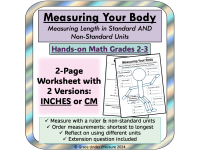
This fun and engaging primary math lesson is a perfect addition to your class measurement unit in grade 2 or grade 3.
The lesson includes worksheets with two versions: measuring in inches and measuring in centimetres.
Teacher Instructions:
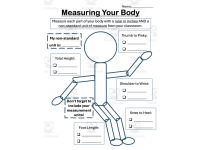
• Your students will measure different body parts (for example, their foot length, their total height, the length from shoulder to wrist, etc.).
• They can work with a partner or small group to complete the task.
• Print a class set of worksheets in either centimetres or inches.
• Decide if your students should all utilize the exact same non-standard measurement unit (it could be a counter, an eraser, a paper clip, etc.) or if you will let them pick their own. Note: Each student should use the exact same non-standard measurement unit for all five body measurements.
• Let your students measure each of the body parts in standard units (inches or cm) AND the consistent non-standard unit.
• After collecting all of the data, students will order their body parts from shortest to longest. They do this twice: in each type of unit.
• They will think about why both lists are in the same order. They should realize that no matter what measurement units you use, if you measure consistently you will get the same order of results. Your height will always be the longest measurement in this set of five.
• Finally, an included bonus question is a good way to introduce some simple ratio ideas.
What's Included:
5 Page PDF: Ready to Print and Use!
- Teacher Instructions
- 2-Page Worksheet in inches
- 2-Page Worksheet in cm
Grades to Use With:
This lesson is designed for students in grade 2 or grade 3 who are learning basic measurement skills using rulers and non-standard units.
Related resources
More resources teachers may find useful
24 related resources were found using this product's title, contributor, categories and tags.


In the classroom
Teaching tips & learning objectives

Learning objectives
Measure five body lengths with a ruler in inches or centimetres, writing the unit alongside each number
Order five recorded measurements from shortest to longest in each of the two units
Explain why the two ordered lists come out the same when both sets of measurements are accurate

Teaching tips
The instructions recommend working in pairs, and total height in particular is not a measurement a child can take alone.
Only one of the two versions needs printing - the inches and centimetre sheets are otherwise identical, down to the placement of the five body parts.
The bonus question is where the ratio thinking sits; the instruction page suggests students share how they worked it out and prove their answer by more than one method.

Skills covered
Using a ruler - each of the five body lengths is measured in inches or centimetres, with the sheet reminding students to record the unit and not just the number.
Ordering by length - the five recorded lengths are arranged shortest to longest twice, once in each unit.
Estimating a conversion - the bonus asks how many of the student's own units make up 10 inches or 20 centimetres, worked out from the measurements they have just taken.
Good to know
Questions teachers ask about this resource
How is the non-standard unit chosen?
Either by the teacher for the whole class or by each student. The instruction page suggests a counter, a paper clip or an eraser and leaves the choice open; the one rule is that a student must use the same unit for all five measurements. The recording page carries a line reading "My non-standard unit is: ______" so the choice is written down.
Why are the measurements ordered twice?
So the two lists can be compared. Students order the five body parts shortest to longest in inches or centimetres and again in their own unit, then answer what they notice and why. The instruction page gives the reasoning being aimed at: measuring accurately in any unit gives consistent results, so height stays the longest whichever unit is used.
What does the bonus question ask for?
A conversion the student has to reason out. It asks roughly how many of their own non-standard units would make up something 10 inches long, or 20cm on the centimetre version, with the instruction page suggesting they use the data they have just collected and prove their thinking more than one way.

No reviews yet
Downloaded this resource? Tell other teachers how it went.
Curriculum
Standards, concepts & topics
Standards
 Standards
- 2.MD.A.1 — Measure the length of an object by selecting and using appropriate tools such as rulers, yardsticks, meter sticks, and measuring tapes.
Core concepts
 Core concepts
Measurement
Length
Standard units
Non-standard units
Ordering by size
 Topics
Explore more
Categories this resource belongs to
Explore related searches
More to explore
You may also like