Grade 2 Math Worksheets – Dinosaur-Themed Set


- Grades
- Grades 2–3, Elementary
- Pages
- 12
- File type
- Answer key
- Included


- Subject
- Math, Addition and Subtraction, Addition, Geometry, Graphing, Money, Place Value, Subtraction, Time
- Topic
- grade 2 math, dinosaurs
- Resource types
- Worksheets & Printables, Word Problems, Worksheets
- Answer key
- Included
About this resource
What's inside this resource
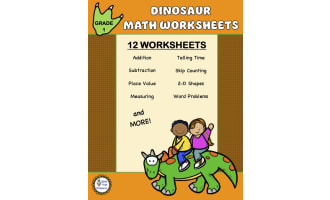
Give your grade 2 learners something to roar about with this set of 12 math worksheets. Designed to include a variety of math concepts presented in second grade curriculum, each worksheet meets current mathematics standards. Learners will enjoy the friendly dinosaur characters as they work to solve problems in addition, subtraction, graphing, telling time, greater than/less than, place value, and much more. They’ll also present their answers in different formats so as to bring variety to each worksheet. In some cases, learners will choose between two answers and color the graphic that shows the correct answer. Other times, they’ll circle the most appropriate answers. Some worksheets will require them to solve math equations while giving them space to show their work. These worksheets are versatile and were created to bring fun and ease to your educational environment. Most worksheets are available in color, while all worksheets are ready for you to simply print and go with a black & white format. Use them during a dinosaur themed unit, when you need a quick activity for a substitute teacher to use or provide them to learners as a review packet during the summer months. In any situation, you can’t go wrong. An answer key for each worksheet is also included. See the list below of details for each worksheet.
WORKSHEET 1: learners will add 1-digit and 2-digit numbers and color the dinosaur bone which shows the correct answer.
WORKSHEET 2: learners will solve the 1-digit and 2-digit subtraction equations. They’ll show their work and write their answers in the box each dinosaur is holding.
WORKSHEET 3: learners will identify odd and even numbers and color the volcanos with the corresponding numbers.
WORKSHEET 4: using the given prompts, learners will skip count and write their answers in the dinosaur footprints.
WORKSHEET 5: learners will compare 2-digit and 3-digit numbers and write the greater than or less than symbols inside each dinosaur egg.
WORKSHEET 6: using the given place value prompts, learners will color the dinosaur which shows the 2-digit or 3-digit matching answer.
WORKSHEET 7: learners will read the prompts about a class trip to the dinosaur museum. They’ll then color the analog clock showing the matching time.
WORKSHEET 8: using the given prompts, learners will circle which prices of dinosaur merchandise are greater than or less than the price in the prompt.
WORKSHEET 9: learners will use the given prompts to write their answers in number form or expanded form.
WORKSHEET 10: learners will fill-in the numbers in each sentence by identifying and counting the appropriate 2-D shapes.
WORKSHEET 11: using the given information, learners will complete the bar graph. They’ll then answer questions using data about the graph.
WORKSHEET 12: learners will solve the addition and subtraction word problems by showing their work and writing the correct answers.
Answer key
Related resources
More resources teachers may find useful
24 related resources were found using this product's title, contributor, categories and tags.



In the classroom
Teaching tips & learning objectives

Learning objectives
Solve Grade 2 addition and subtraction equations
Read and represent time and place-value information
Interpret graphing and word-problem prompts

Teaching tips
Select the computation pages separately from the time, graphing, and place-value pages when focusing on one Grade 2 domain.
Use the color or black-and-white layout consistently before reviewing the corresponding response material.

Skills covered
Addition and subtraction — students solve themed equations across multiple layouts.
Number sense — place value, skip counting, and odd-even tasks use Grade 2 values.
Data and problem solving — graphing and word-problem pages require interpreting mathematical information.

No reviews yet
Downloaded this resource? Tell other teachers how it went.
Curriculum
Standards, concepts & topics
Standards
 Standards
- 2.OA.A.1 — Use addition and subtraction within 100 to solve one- and two-step word problems involving situations of adding to, taking from, putting together, taking apart, and comparing, with unknowns in all positions, e.g., by using drawings and equations with a symbol for the unknown number to represent the problem. 1
- 2.OA.B.2 — Fluently add and subtract within 20 using mental strategies.2 By end of Grade 2, know from memory all sums of two one-digit numbers.
- 2.NBT.A.1 — Understand that the three digits of a three-digit number represent amounts of hundreds, tens, and ones; e.g., 706 equals 7 hundreds, 0 tens, and 6 ones. Understand the following as special cases: a. 100 can be thought of as a bundle of ten tens — called a “hundred.” b. The numbers 100, 200, 300, 400, 500, 600, 700, 800, 900 refer to one, two, three, four, five, six, seven, eight, or nine hundreds (and 0 tens and 0 ones).
- 2.NBT.A.2 — Count within 1000; skip-count by 5s, 10s, and 100s.
- 2.NBT.A.3 — Read and write numbers to 1000 using base-ten numerals, number names, and expanded form.
- 2.NBT.A.4 — Compare two three-digit numbers based on meanings of the hundreds, tens, and ones digits, using >, =, and < symbols to record the results of comparisons.
- 3. MD.B.3 — Draw a scaled picture graph and a scaled bar graph to represent a data set with several categories. Solve one- and two-step “how many more” and “how many less” problems using information presented in scaled bar graphs. For example, draw a bar graph in which each square in the bar graph might represent 5 pets.
- 2.MD.A.7 — Tell and write time from analog and digital clocks to the nearest five minutes, using a.m. and p.m.
- 2.MD.A.8 — Solve word problems involving dollar bills, quarters, dimes, nickels, and pennies, using $ and ¢ symbols appropriately. Example: If you have 2 dimes and 3 pennies, how many cents do you have?
- 3.G.A.1 — Understand that shapes in different categories (e.g., rhombuses, rectangles, and others) may share attributes (e.g., having four sides), and that the shared attributes can define a larger category (e.g., quadrilaterals). Recognize rhombuses, rectangles, and squares as examples of quadrilaterals, and draw examples of quadrilaterals that do not belong to any of these subcategories.
Core concepts
 Core concepts
Grade 2 math
Addition and subtraction
Place value
Graphing
 Topics
Explore more
Categories this resource belongs to
Explore related searches
More to explore
You may also like