


Halloween Non-Fiction Articles: Spiders, Owls, Skeletons and the Moon
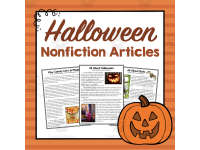
Four one-page Halloween nonfiction articles for early readers (spiders, barn owls, the skeleton and the Harvest Moon) with 16 questions, a fact-sheet page and a key.



- Grades
- Grades 2–4, Elementary
- Pages
- 6
- File type
- Answer key
- Included


- Subject
- Holiday & Seasonal, ELA, Holidays, Halloween, Reading, Research
- Topic
- halloween reading, nonfiction articles
- Resource types
- Worksheets & Printables, Worksheets
- Answer key
- Included
- Standards
- CCSS.RI.2.1 CCSS.RI.2.2 +9
About this resource
What's inside this resource
The articles use Halloween symbols as a way into real science rather than spooky stories. Read one a day for four days, then use the fact sheet, which works with any article, on day five.
Related resources
More resources teachers may find useful
24 related resources were found using this product's title, contributor, categories and tags.


In the classroom
Teaching tips & learning objectives

Learning objectives
- Identify the main idea of a short informational article.
- Find facts and numbers under headings and in captions.
- Explain a cause and its effect using details from the article.

Teaching tips
- Read each article aloud once, then let students reread it to answer the questions.
- Preview arachnid, spinnerets, screech, pellet, skull and harvest before reading.

No reviews yet
Downloaded this resource? Tell other teachers how it went.
Curriculum
Standards, concepts & topics
Standards
 Standards
- CCSS.RI.2.1 — Ask and answer such questions as who, what, where, when, why, and how to demonstrate understanding of key details in a text
- CCSS.RI.2.2 — Identify the main topic of a multiparagraph text as well as the focus of specific paragraphs within the text.
- CCSS.RI.3.1 — Ask and answer questions to demonstrate understanding of a text, referring explicitly to the text as the basis for the answers.
- CCSS.RI.3.2 — Determine the main idea of a text; recount the key details and explain how they support the main idea
- CCSS.RI.4.1 — Refer to details and examples in a text when explaining what the text says explicitly and when drawing inferences from the text.
- CCSS.RI.4.2 — Determine the main idea of a text and explain how it is supported by key details; summarize the text
- CCSS.RI.2.8 — Describe how reasons support specific points the author makes in a text.
- CCSS.RI.2.4 — Determine the meaning of words and phrases in a text relevant to a grade 2 topic or subject area.
- CCSS.RI.3.4 — Determine the meaning of general academic and domain-specific words and phrases in a text relevant to a grade 3 topic or subject area.
- CCSS.RI.4.4 — Determine the meaning of general academic and domain-specific words or phrases in a text relevant to a grade 4 topic or subject area.
- CCSS.RI.4.6 — Compare and contrast a firsthand and secondhand account of the same event or topic; describe the differences in focus and the information provided.
Core concepts
 Core concepts
- Informational text
- Main idea
- Text features
- Cause and effect
 Topics
Explore more
Categories this resource belongs to
Explore related searches
More to explore
You may also like
Worksheets & Printables, Worksheets


Tests, Quizzes and Tests, Teacher Tools
Worksheets & Printables, Worksheets
Worksheets & Printables, Worksheets

Worksheets & Printables, Worksheets

Tests, Quizzes and Tests, Teacher Tools