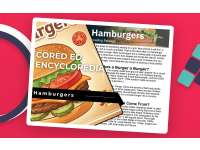
Hamburgers Reading Comprehension Passage - Cored Ed Encyclopedia





- Grades
- Grades 2–5, Homeschool Resources, Elementary
- Pages
- 7
- File type
- Answer key
- Included


- Subject
- ELA, Language Development, Resources for Teachers, Reading Comprehension, Reading, Pre-Reading, Writing, Strategies, History, Social Studies
- Topic
- vocabulary, spelling
- Resource types
- Worksheets & Printables, Worksheets, Teacher Tools, Centers, Activities, Writing Prompts, Assessments, Tests, Quizzes and Tests, Quizzes
- Answer key
- Included
- Standards
- CCSS.L.2.6 CCSS.L.3.6 +13
About this resource
What's inside this resource
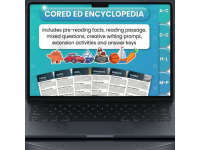
This hamburgers reading comprehension contains the following:
Pre-Reading Trivia
Students will write down one thing they already know about the subject and then read five more facts and discuss. These facts are fun, and the students will enjoy learning about the subject before reading more.
COMPANION VIDEO NOW AVAILABLE (EMBEDDED AFTER PREVIEW PICTURES IN PRODUCT DESCRIPTION)
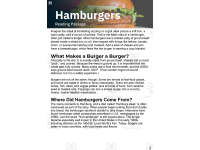
Reading Passage
The text is a high-interest reading passage with set paragraphs, roughly three to four paragraphs long. It contains a variety of themes about the topic, anywhere from history to technology. The passage is between 250 and 350 words in length.
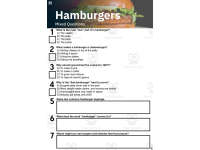
Mixed Questions
The first question page contains four multiple-choice questions, each with a choice of four answers, and three written response questions that require a sentence or two from the student.
Creative Writing
In this question, the student will be required to write a five to eight sentence paragraph on a question related to the topic.
Extension Activities
This page is optional for fast finishers. If there are five to ten minutes left at the end of the lesson, the student can choose one of three activities, each one requiring a different skill.
Answer Key
There are answers for the multiple-choice questions and three written response questions have sample answers.
FULL CATALOG OF DOWNLOAD LINKS AND ENCYCLOPEDIA INDEX HERE
Lesson Snapshot
Title: Hamburgers
Genre: Nonfiction (informational passage)
Subject: Reading (Informational Text)
Primary Topic: What hamburgers are and where they came from
Estimated Guided Reading Level (A–Z): M
Support pages included: Pre-reading trivia; mixed questions + short responses; creative writing prompt; extension activities; answer key; QR/index page.
QA notes on support pages: Some support content adds details not stated in the passage (e.g., “kill harmful germs” explanation for 160°F; “food trucks/home kitchens/cookouts” as burger locations).
What This Lesson Teaches Best
Defines what a hamburger is by describing key parts (bun/roll, patty, toppings like lettuce, tomato, onion, sauces).
Explains why fully cooking ground beef matters and names a specific safe temperature (160°F) and a tool cooks use (food thermometer).
Uses text features (section headings) to organize information into categories (what it is, what makes it a burger, where it came from).
Introduces variation within a category by listing different patty types (chicken, turkey, fish, bean, veggie) and different buns/toppings.
Gives a brief origin/history explanation (Hamburg connection, 1890s newspaper ads, early 1900s popularity, 1904 St. Louis World’s Fair).
Learning Goals
Students can describe the basic parts of a hamburger using details from the text.
Students can explain why the patty is the “star” of a burger according to the passage.
Students can identify the temperature the USDA says ground beef should reach (160°F).
Students can give examples of different kinds of burgers and buns named in the text.
Students can describe where the name “hamburger” connects to and summarize key history details (1890s, early 1900s, 1904 fair).
Key Vocabulary From the Text
sizzling — making a hot cooking sound.
patty — a shaped, cooked piece of ground meat (or other foods).
thermometer — a tool that measures temperature.
historians — people who study and write about the past.
advertised — shown to people to promote something for sale.
Cored Ed Encyclopedia Overview
The Cored Ed Encyclopedia is a weekly series of lessons that you can pick up and use right away. These short readings fit into whatever time you have available. Each one includes a warm-up, a reading, and a set of questions, but it’s flexible — you can do just the reading, the full lesson, or skip the writing section if you need to. Each lesson focuses on a single topic so students don’t get lost. The writing is clear but never childish, making it perfect for grades two through five. Topics range from animals and science to history, inventions, and everyday things. No matter the level of the student, everyone should take away at least one new idea or fact from each lesson. The materials are easy to print, easy to explain, and require no setup. They work well for whole-class teaching, partner work, or independent study.
Related resources
More resources teachers may find useful
24 related resources were found using this product's title, contributor, categories and tags.
In the classroom
Teaching tips & learning objectives

Learning objectives
Identify central facts in a food-history passage
Use passage details to respond to comprehension prompts
Develop a descriptive paragraph from a food-design scenario

Teaching tips
Discuss the difference between historical evidence and competing origin claims.
Ask students to point to the passage detail supporting each response.

Skills covered
Informational reading
Text-evidence use
Descriptive writing

No reviews yet
Downloaded this resource? Tell other teachers how it went.
Curriculum
Standards, concepts & topics
Standards
 Standards
- CCSS.L.2.6 — Use words and phrases acquired through conversations, reading and being read to, and responding to texts, including using frequently occurring conjunctions to signal simple relationships (e.g., because).
- CCSS.L.3.6 — Acquire and use accurately grade-appropriate conversational, general academic, and domainspecific words and phrases, including those that signal spatial and temporal relationships (e.g., After dinner that night we went looking for them).
- CCSS.L.4.6 — Demonstrate understanding of figurative language, word relationships, and nuances in word meanings. a. Explain the meaning of simple similes and metaphors (e.g., as pretty as a picture) in context. b. Recognize and explain the meaning of common idioms, adages, and proverbs. c. Demonstrate understanding of words by relating them to their opposites (antonyms) and to words with similar but not identical meanings (synonyms).
- CCSS.L.5.6 — Acquire and use accurately grade-appropriate general academic and domain-specific words and phrases, including those that signal contrast, addition, and other logical relationships (e.g., however, although, nevertheless, similarly, moreover, in addition).
- CCSS.RI.2.1 — Ask and answer such questions as who, what, where, when, why, and how to demonstrate understanding of key details in a text
- CCSS.RI.2.2 — Identify the main topic of a multiparagraph text as well as the focus of specific paragraphs within the text.
- CCSS.RI.3.1 — Ask and answer questions to demonstrate understanding of a text, referring explicitly to the text as the basis for the answers.
- CCSS.RI.3.2 — Determine the main idea of a text; recount the key details and explain how they support the main idea
- CCSS.RI.4.1 — Refer to details and examples in a text when explaining what the text says explicitly and when drawing inferences from the text.
- CCSS.RI.4.2 — Determine the main idea of a text and explain how it is supported by key details; summarize the text
- CCSS.RI.5.2 — Determine two or more main ideas of a text and explain how they are supported by key details; summarize the text.
- CCSS.W.2.3 — Write narratives in which they recount a wellelaborated event or short sequence of events, include details to describe actions, thoughts, and feelings, use temporal words to signal event order, and provide a sense of closure.
- CCSS.W.3.3 — Write narratives to develop real or imagined experiences or events using effective technique, descriptive details, and clear event sequences. a. Establish a situation and introduce a narrator and/or characters; organize an event sequence that unfolds naturally. b. Use dialogue and descriptions of actions, thoughts, and feelings to develop experiences and events or show the response of characters to situations. c. Use temporal words and phrases to signal event order. d. Provide a sense of closure.
- CCSS.W.4.3 — Write narratives to develop real or imagined experiences or events using effective technique, descriptive details, and clear event sequences. a. Orient the reader by establishing a situationand introducing a narrator and/or characters; organize an event sequence that unfolds naturally. b. Use dialogue and description to develop experiences and events or show the responses of characters to situations. c. Use a variety of transitional words and phrases to manage the sequence of events. d. Use concrete words and phrases and sensory details to convey experiences and events precisely. e. Provide a conclusion that follows from the narrated experiences or events.
- CCSS.W.5.3 — Write narratives to develop real or imagined experiences or events using effective technique, descriptive details, and clear event sequences. a. Orient the reader by establishing a situation and introducing a narrator and/or characters; organize an event sequence that unfolds naturally. b. Use narrative techniques, such as dialogue, description, and pacing, to develop experiences and events or show the responses of characters to situations. c. Use a variety of transitional words, phrases, and clauses to manage the sequence of events. d. Use concrete words and phrases and sensory details to convey experiences and events precisely. e. Provide a conclusion that follows from the
Core concepts
 Core concepts
Hamburger history
Food science
Reading comprehension
 Topics
Explore more
Categories this resource belongs to
Explore related searches
More to explore
You may also like