Homonyms Practice Worksheet
- Grades
- K–1, Elementary
- Pages
- 5
- File type
- Preparation
- Print ready


- Subject
- ELA, Spelling, Language Development, Vocabulary
- Topic
- Homonyms Practice, Vocabulary Practice
- Resource types
- Worksheets, Worksheets & Printables
- Preparation
- Print ready
Product description
From the author
We have so many new skills to teach our young learners, so ensuring that we can keep them engaged very early on is so important. Two ways to do this are by incorporating topics they are interested in and by providing them with hands-on activities.
What You Get:
This is a Homonyms Practice Worksheet. It is great for your kindergarten and 1st grade students. You can use this to introduce homonyms or review this skill if students have mastered it.
How To Implement This Resource:
It is a 5-page printable. You may choose to print copies of each page for every student to complete. It may also be good to print a few copies and laminate them for repeated use. If you choose to laminate them, you can attach Velcro dots to the cut-out pictures for students to match. This works well as a small group or reading center activity.
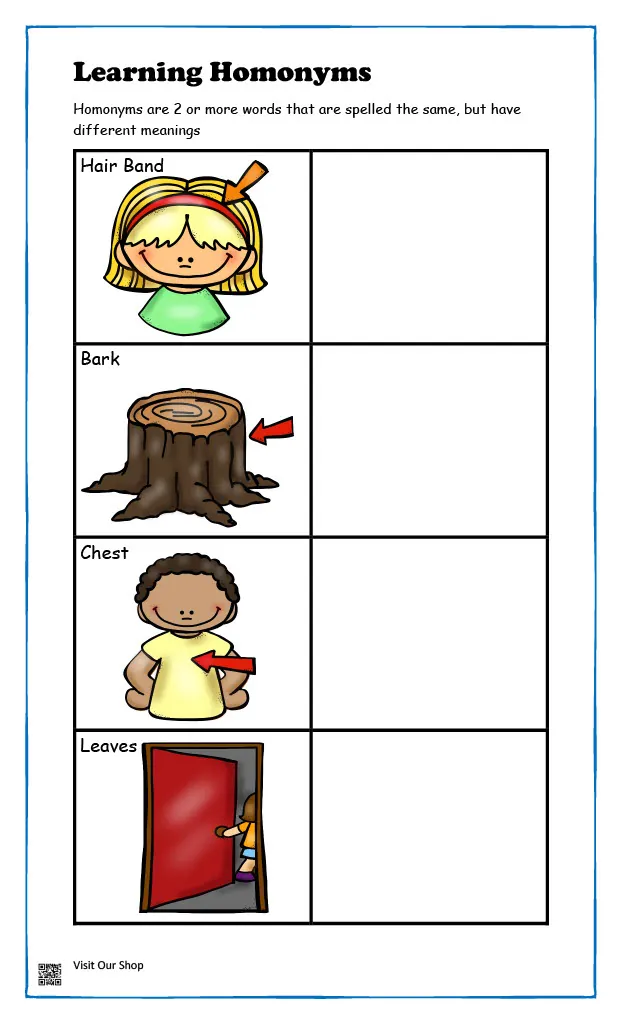
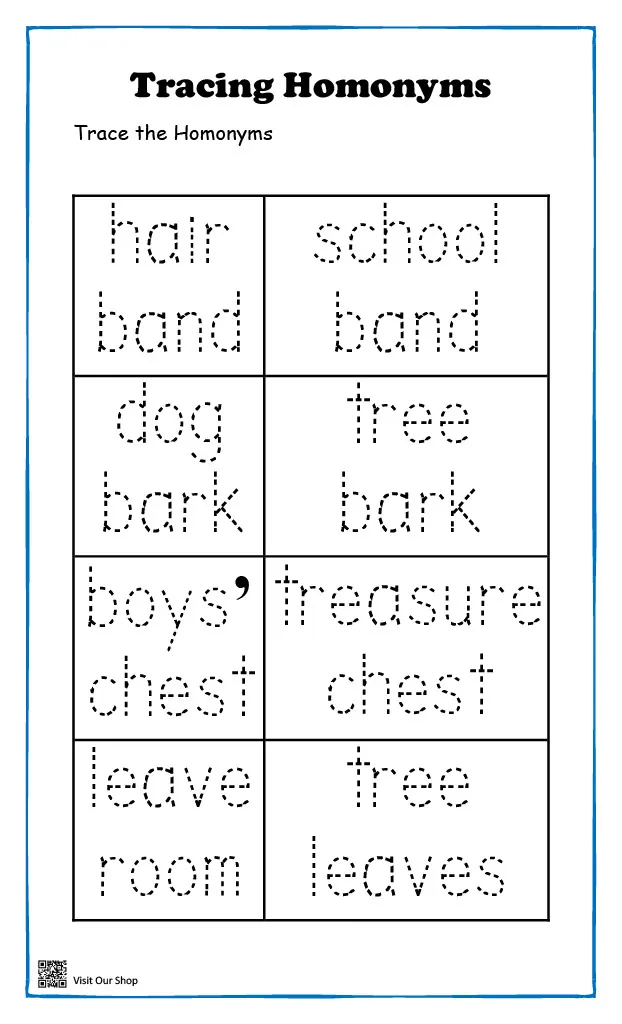
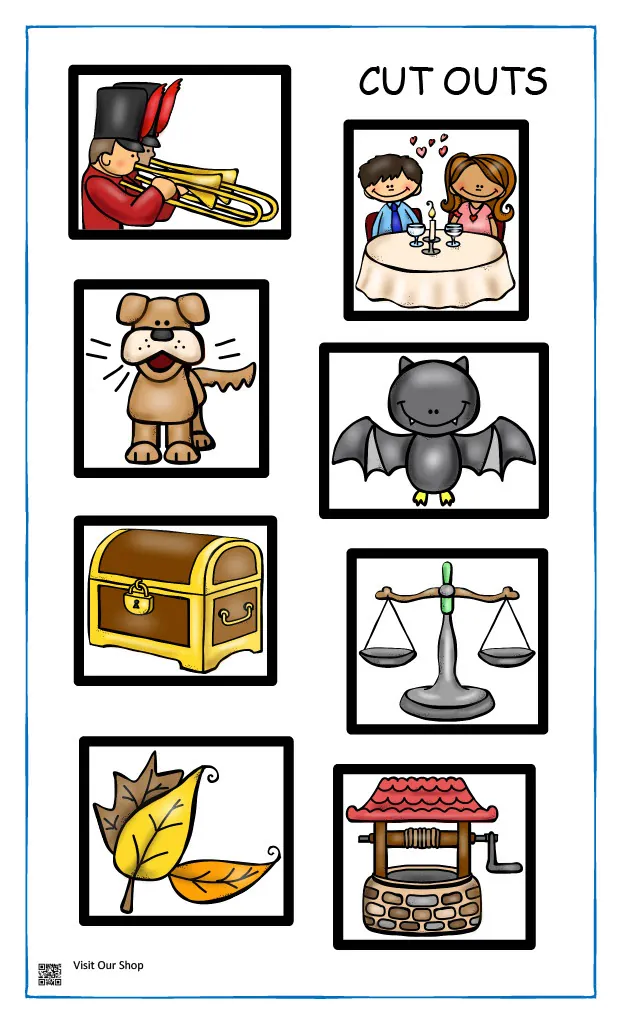
Students will look at the images on the first 2 pages and find their homonym match from the cut-outs on the last page. Students will also get handwriting practice by tracing the homonyms.
I hope you enjoy!
Related resources
More resources teachers may find useful
24 related resources were found using this product's title, contributor, categories and tags.


In the classroom
Teaching tips & learning objectives

Learning objectives
Students will read and trace eight homonym spellings (band, bark, chest, leaves, date, bat, scale, well).
Students will use a context-clue word (such as "dog" or "tree" for bark) to identify which meaning of a homonym is shown.
Students will match a cut-out picture card to the homonym it represents.

Teaching tips
Cut apart the page 5 picture cards ahead of time so they are ready for the matching step.
Introduce the picture-labeled pages first, then move to the tracing pages so the context-clue words are already familiar before students trace.
Have students say both context words aloud for a homonym (for example, "baseball" and "flying" for bat) before tracing the shared spelling, to reinforce that one spelling carries two meanings.

Skills covered
Homonym recognition — students connect a single spelling (bark, chest, leaves, well, and others) to two different real-world meanings shown through picture and context-word pairs.
Letter formation and tracing — students trace each homonym twice per tracing page for words including band, bat, scale, and date.
Context-clue use — paired words such as "fish" and "money" or "feeling" and "wishing" signal which meaning of the homonym is being shown.
Good to know
Questions teachers ask about this resource
How are the cut-out picture cards meant to be used?
Cut apart the eight pictures on the last page and place them in the blank boxes on the first two pages to show the alternate meanings. The tracing pages are a separate activity.

No reviews yet
Downloaded this resource? Tell other teachers how it went.
Resource details
Concepts & topics
Core concepts
 Core concepts
Homonyms
Multiple-meaning words
Context clues
Tracing practice
 Topics
Explore more
Categories this resource belongs to
Explore related searches
More to explore
You may also like