



Interpret the Remainder Interactive Notebook Page
- Grades
- Grades 4–6, Elementary, Middle School
- File type
- Preparation
- Print ready


- Subject
- Math, Multiplication and Division, Multiplication
- Topic
- Interpret the Remainder, Long Division Practice
- Resource types
- Worksheets & Printables, Worksheets
- Preparation
- Print ready
About this resource
What's inside this resource
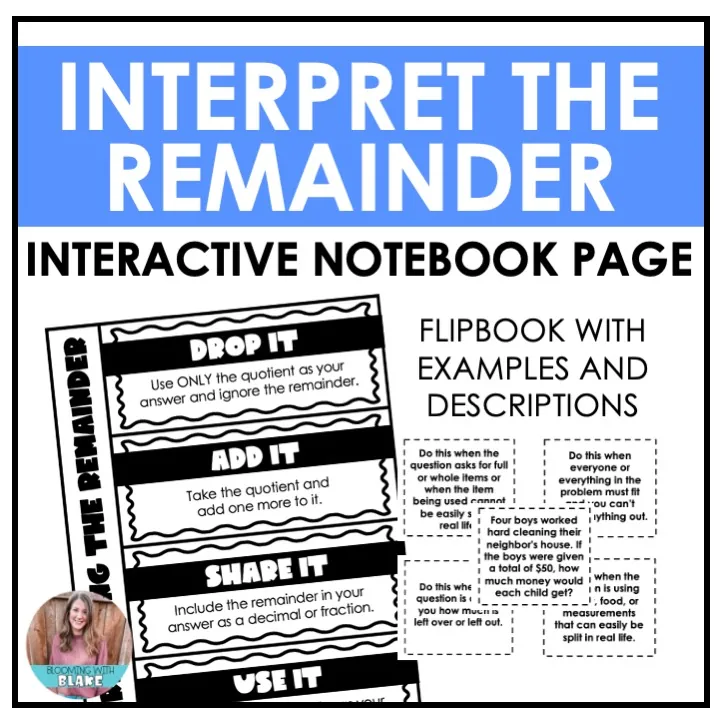
If you are looking for an engaging way to increase long division practice, look no more. This is an Interpret the Remainder Interactive Notebook Page that will give students the practice they need at home or in the classroom.
What You Get:
A 2 page interactive notebook set with an answer key included.
How To Use the Interpret the Remainder Interactive Notebook:
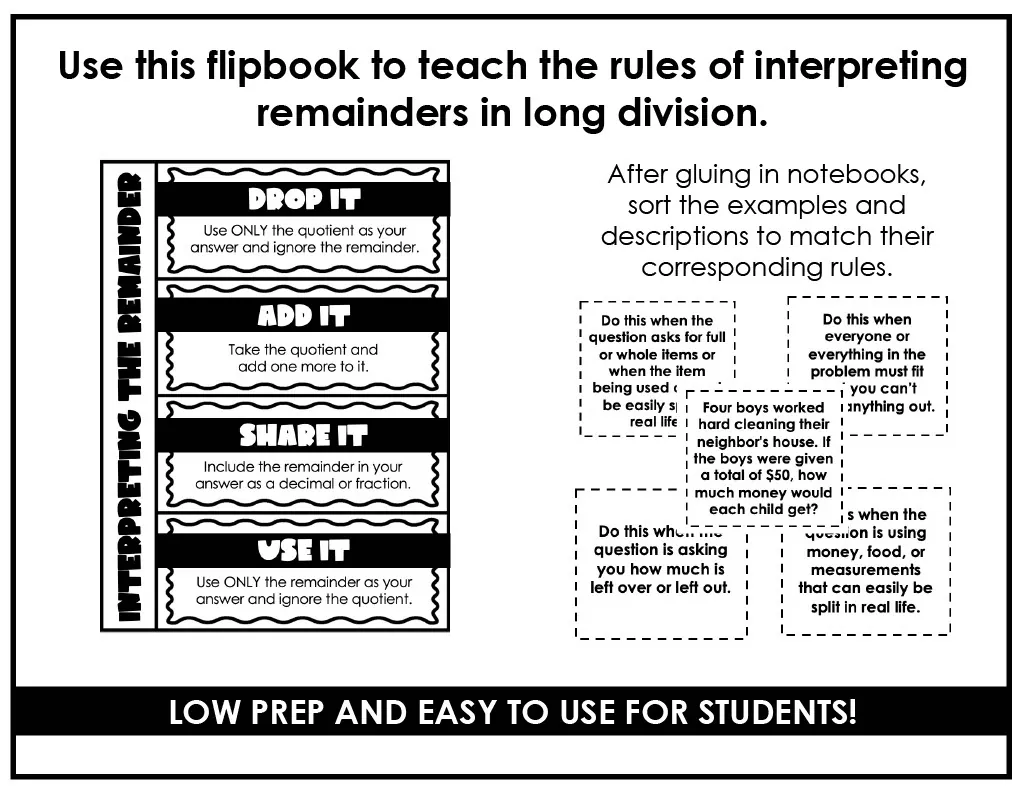
This is a low prep and easy to use interactive notebook page. If your students use interactive notebooks in your math classroom, this notebook page is a great addition to it when you are in your long division unit. Even if your students do not use interactive notebooks, you can still print these pages and have students adhere them to a piece of notebook paper (or blank white paper). Use this flipbook to teach the rules of interpreting remainders in long division. After gluing in notebooks, sort the examples and descriptions to match their corresponding rules.
I hope you enjoy!
Here’s A Look at Some of My Best Sellers:
Finish the Story: St. Patrick’s Day Writing Prompts
Grammar Go Fish: Parts of Speech (Summer Edition)
Fall Grammar Word Search Packet
Spring Season Student Activity Packet
Finish the Story: Winter Writing Prompts
Verbs Animal Mysteries Activity
You Can Find My Store Front Here: Blooming with Blake
Related resources
More resources teachers may find useful
24 related resources were found using this product's title, contributor, categories and tags.

In the classroom
Teaching tips & learning objectives

Learning objectives
Name the four ways a division remainder can be handled and state what each does to the quotient
Read a division word problem and decide whether the remainder is dropped, rounded up into, expressed as a fraction or decimal, or used as the answer itself
Justify a choice against the printed condition - for example choosing ADD IT when "everyone or everything in the problem must fit and you can't leave anything out"

Teaching tips
Glue the flipbook in before the sorting begins, as the directions page specifies; the loose descriptions and word problems are then matched to flaps that are already fixed in place
Teach the rules in pairs - DROP IT and ADD IT both discard the remainder and differ only in whether the leftover forces one more whole group, which is the distinction the bus problem is built to expose
Use the money problem ($50 split four ways) to introduce SHARE IT, since it is the one case where the remainder can legitimately be written as a decimal or a fraction

Skills covered
Interpreting a remainder in context - students choose between DROP IT, ADD IT, SHARE IT and USE IT rather than reporting a quotient and remainder mechanically.
Reading a word problem for the question it actually asks - each description names a signal, such as money, food or measurements that can easily be split, or how much is left over.
Dividing two-digit numbers by one-digit divisors - the four problems require 46 ÷ 7, 67 ÷ 9, 50 ÷ 4 and 43 ÷ 7 before any rule can be applied.
Good to know
Questions teachers ask about this resource
What separates DROP IT from ADD IT when both discard the remainder?
The condition printed beside each. DROP IT applies when the question asks for full or whole items, or when the item cannot easily be split in real life. ADD IT applies when everyone or everything in the problem must fit and nothing can be left out - which is why 67 students needing buses that hold 9 takes one extra bus rather than the bare quotient.
How do the cut pieces relate to each other once the flipbook is in the notebook?
Three sets have to be lined up: the four rules on the flipbook flaps, the four descriptions of when each rule applies, and the four word problems. Students sort the descriptions and the examples so each rule ends up with the condition that triggers it and a problem that demonstrates it.
What division does a student need to be able to do before starting?
Two-digit-by-one-digit division that leaves a remainder. The four problems work out to 46 ÷ 7, 67 ÷ 9, 50 ÷ 4 and 43 ÷ 7, and the directions page frames the whole flipbook as a set of rules for long division, so the algorithm itself is assumed rather than taught here.

No reviews yet
Downloaded this resource? Tell other teachers how it went.
Resource details
Concepts & topics
Core concepts
 Core concepts
Interpreting remainders
Long division
Division word problems
Interactive notebook
 Topics
Explore more
Categories this resource belongs to
Explore related searches
More to explore
You may also like


