States of Matter Memory Game, Find the Pair


About This Product
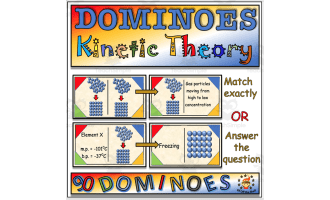
This is an engaging and enjoyable memory game on the kinetic theory of matter which uses the particle model to explain change of state, gas pressure and diffusion. Pupils work in teams of three or four. Each team lays out their 42 cards face down in a square and take it in turn to turn over two cards. If the cards are a question and its correct answer, the pupil keeps the pair. If they are not a match they are turned face down and the next pupil gets a turn. This process continues until all cards are matched and the winner is the pupil with the most pairs.
If a team member thinks that the selectors pair is not a correct match, they can challenge.
Pupils are encouraged to check their books for the correct answer but the teacher also has a quick-check answer sheet. If the challenge is correct, the challenger keeps the pair.
Included in this Pack.
> 42 question and answer cards
> Teacher’s answer sheet.
> Instruction sheet
Preparation
> Use double-sided printing to copy 1 set per group of 4 pupils.
> Sheets could be laminated to enable year-on-year use.
> Cut sheets into cards.
Prior Knowledge Required
> Three states of matter are solid, liquid and gas.
> Arrangement of particles in solids, liquids and gases.
> Properties of solids, liquids and gases in terms of the arrangement of their particles.
> Change of state including sublimation.
> Pressure in gases and the effect of increasing the number of particles and temperature and decreasing volume.
> Diffusion.
See more Elf Off the Shelf resources on this topic and many others
What's Included
1 Zip file
Resource Tags
0 Reviews
Check out these other great products