Family in Spanish – Family Tree Activity



- Grades
- Grades 1–5, Elementary
- Pages
- 7
- File type
- Preparation
- Print ready


- Subject
- Foreign Languages, Spanish
- Topic
- Spanish Family, Family Tree
- Resource types
- Activities
- Preparation
- Print ready
Product description
From the author
Use this fun “FamilyTree” activity to help your students learn the members of a family in Spanish!
First, watch this YouTube video to review Spanish family vocabulary: MI FAMILIA (MiCamino Spanish) https://www.youtube.com/watch?v=mg0-NfrMIJM&t=20s
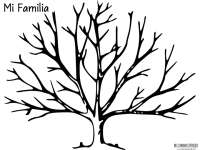
Then, print out the tree on white cardstock so that you have one for each student.
Print out the family pictures that you prefer for this activity on regular paper. (There are frames with pictures & labels, pictures with no labels, empty frames with labels, and empty frames with no labels.)
Finally, have students present their family tree to the class in Spanish!
Learn the following Spanish vocabulary:
Mi Padre / Mi Madre
Mi Abuelo / Mi Abuela
Mi Hermano / Mi Hermana
Mi Tío / Mi Tía
Mi Primo / Mi Prima
Mi Perro / Mi Gato
Related resources
More resources teachers may find useful
24 related resources were found using this product's title, contributor, categories and tags.



In the classroom
Teaching tips & learning objectives

Learning objectives
Recognise and use twelve Spanish family terms in the possessive form, from Mi Abuelo to Mi Gato
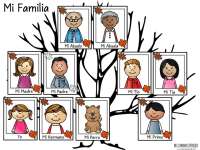
Place family members correctly by generation on a tree diagram, following the completed example
Present a completed family tree to the class in Spanish

Teaching tips
Print the tree on white cardstock and the frames on ordinary paper, as the instructions specify — the two are meant to be different weights so the frames sit on the sturdier tree
The four frame versions are the differentiation built into the file: labelled pictures for beginners, empty unlabelled frames for students ready to supply both the image and the Spanish word
Show the completed example first; it is the only page that demonstrates which relative belongs at which level of the tree, and it sets the standard without a separate rubric

Skills covered
Spanish family vocabulary — students work with abuelo, abuela, padre, madre, hermano, hermana, tío, tía, primo, prima, perro and gato, all in the possessive form Mi ___.
Building a family tree diagram — frames are placed on a printed tree so that generations sit in the right positions, following the completed example.
Speaking in the target language — the closing instruction asks students to present their finished tree to the class in Spanish.
Good to know
Questions teachers ask about this resource
How many versions of the picture frames are supplied?
Four, named in the instructions: frames with pictures and labels, pictures with no labels, empty frames with labels, and empty frames with no labels. The same tree can therefore run as a matching task, a labelling task or a drawing task depending on the group.
Which family words does the activity cover?
Twelve are listed on the instruction page: abuelo, abuela, padre, madre, hermano, hermana, tío, tía, primo, prima, perro and gato. The frame sheets go slightly further, printing both sets of grandparents and adding Yo, for fifteen frames in all.

No reviews yet
Downloaded this resource? Tell other teachers how it went.
Resource details
Concepts & topics
Core concepts
 Core concepts
Spanish vocabulary
Family members
Family tree
Possessive adjectives
 Topics
Explore more
Categories this resource belongs to
Explore related searches
More to explore
You may also like