Literacy worksheets: noise pollution


- Grades
- Grades 3–5, Elementary
- File type
- Preparation
- Print ready


- Subject
- ELA, Language Development, Vocabulary, Science, Earth and Environmental Sciences, Environmental Science
- Topic
- noise pollution, noise
- Resource types
- Worksheets & Printables, Worksheets
- Preparation
- Print ready
About this resource
What's inside this resource
Related resources
More resources teachers may find useful
24 related resources were found using this product's title, contributor, categories and tags.
In the classroom
Teaching tips & learning objectives

Learning objectives
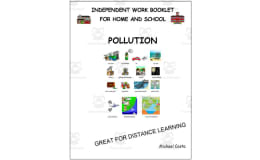
Match six noise-pollution terms to the pictures that illustrate them, then write each word unaided under its picture
Use a domain-specific term correctly in an original sentence, and then in a connected story
Look up a chosen term in a dictionary, record the definition and put the word into context

Teaching tips
The contents page maps every task to its page, which makes single-page assignment straightforward when the booklet is used as morning work or homework rather than start to finish
Two pages need materials beyond a pencil: the research page sends students online and the vocabulary study page requires a dictionary, so check both are available before setting them
The bingo card and the word search are blank for students to build, so pair students up and have them swap finished sheets to play or solve each other's

Skills covered
Domain-specific vocabulary — six noise-pollution terms, including three phrase-length ones (disruption of migration, of mating calls, of echolocation), are labelled, defined, used and drawn across the booklet.
Sentence and narrative writing — students write five sentences each containing a chosen word, then a titled, illustrated story that works in as many of the six terms as possible.
Dictionary use — the vocabulary study page asks for a looked-up definition and an original sentence for two separate words.
Good to know
Questions teachers ask about this resource
How many vocabulary words does the whole booklet run on?
Six, listed on their own page: traffic, jackhammer, disruption of migration, disruption of mating calls, disruption of echolocation and airplane. Every task from the bingo card to the comic strip works from that same list, so students meet the six terms more than twenty times in different forms.
What is the pichenette race on the final activity page?
A pencil-flick track game. Students first draw the vocabulary words into boxes along an oval track, then take turns putting the pencil tip on the START line and flicking it with a finger, marking an X where the line stops and starting the next turn there. A flick is cancelled if the line lands on a drawing, outside the oval or in the swimming pool, and there is a solo version that asks for the fewest flicks to the finish.
Do the two comic strip levels differ in more than length?
Mainly in length and panel size. Level 1 gives five large numbered panels with one writing line under each; level 2 gives twelve smaller panels with two writing lines each, followed by an EXTRA page of further panels for a longer strip. Both carry the same brief: create a comic strip about the topic of the vocabulary list.

No reviews yet
Downloaded this resource? Tell other teachers how it went.
Resource details
Concepts & topics
Core concepts
 Core concepts
Vocabulary
Noise pollution
Sentence writing
Independent work
 Topics
Explore more
Categories this resource belongs to
Explore related searches
More to explore
You may also like