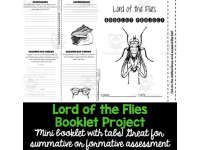
"Lord of the Flies" Booklet Project



- Grades
- Grades 9–12
- Pages
- 7
- File type
- Preparation
- Print ready


- Subject
- ELA, Literature
- Topic
- Lord of the Flies, Booklet project
- Resource types
- Novel Studies, Projects
- Preparation
- Print ready
Product description
From the author
If your students are reading The Lord of the Flies, you may be on the hunt for all the resources to pair alongside this renowned novel.
This resource is a Lord of the Flies Booklet Project that was designed to give your students the opportunity to reflect on the text and show what they know.
For the teacher: Print the booklet pages back to back. The pages should be cut on the dotted lines and around the tabs. Put the pages in order and staple. It would be best to staple in one corner or at the top of the booklet. Stapling on the sides will cut off part of the project. Once the book is properly assembled, students will be able to work from page to page.
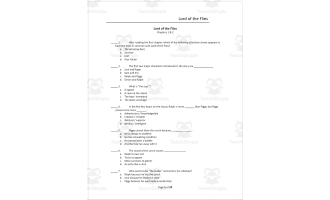
The pages are as follows:
1. Characters. Students will illustrate one of the three characters included. They will select a quote by that character and use it as evidence to explain the importance of that character.
2. Mini-Essays. There are 3 essay questions for students to respond to.
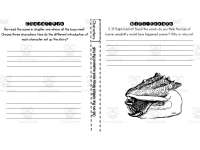
3. Characters. Students will reflect on how the different introduction of each character sets up the story.
4. Setting & Tone. Students will find a passage in the book that has an ominous tone and explain why.
5. Compare and Contrast. Students will explain the positive and negative roles that Piggy’s glasses have. Students will compare and contrast Ralph’s strengths and weaknesses as a leader.
6. Setting & Tone. Students will reflect on the tone that displays itself at the end of chapter 9.
7. Symbols and Morals. Students will reflect on what they think certain objects in the story symbolize. Students will write the moral of the story.
This resource was designed for 7th grade students and higher. This is great for independent work, but students may also enjoy discussing pages with a partner before formulating their individual answers.
An answer key is not included, as most pages are reflective writing pieces.
Related resources
More resources teachers may find useful
24 related resources were found using this product's title, contributor, categories and tags.


In the classroom
Teaching tips & learning objectives

Learning objectives
Support a character analysis with a direct textual quote as evidence
Identify and explain the tone of a passage using specific imagery and word choice
Interpret symbolic objects in the novel and state the novel's moral in their own words

Teaching tips
Print pages back-to-back and cut along the dotted tabs before stapling in a corner or at the top; the file's own instructions warn that side-stapling cuts off part of the project
Assign as independent work, or let students discuss each page with a partner before writing their individual answers
Provide access to the novel separately so students can select quotations and cite chapters and pages

Skills covered
Textual evidence citation — students select a direct quote to support their explanation of a character's importance.
Tone analysis — students identify how imagery and word choice create an ominous or shifting tone in specific passages.
Symbolic interpretation — students explain what objects such as the Beast, the Scar, and the island represent, using chapter and page references.
Good to know
Questions teachers ask about this resource
How does the booklet introduce the concept of an 'ominous' tone before students find their own example?
It models the skill first: the page quotes the novel's own line about clouds 'sitting on the land' and explains why that phrasing feels oppressive, then asks students to locate and explain a second ominous passage on their own.
How are the mini-essay questions arranged in the booklet?
They are woven between the Characters pages rather than grouped together: the three mini-essay prompts on fear, adult behavior, and the conch sit alongside the character-response sections on pages 3 and 4.

No reviews yet
Downloaded this resource? Tell other teachers how it went.
Curriculum
Standards, concepts & topics
Standards
 Standards
- RL.9.2
- W.9.9
Core concepts
 Core concepts
Tone and imagery
Symbolism
Character analysis
Textual evidence
 Topics
Explore related searches
More to explore
You may also like