24 related resources

Most Commonly Misspelled Words
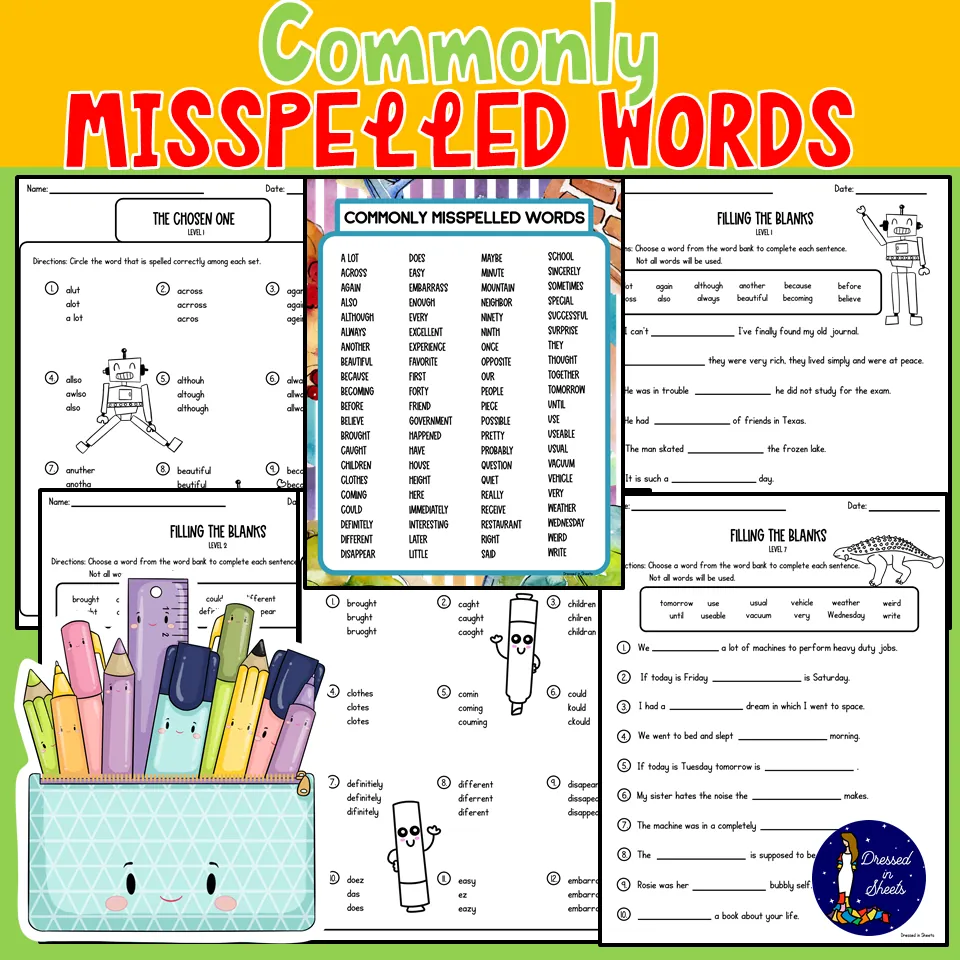
Eighty-four commonly misspelled words are practiced across seven leveled sets, each using the same twelve words in four different activity formats.
Grades
Grades 3–5, Elementary
File type
PDF
Preparation
Print ready

Updated Feb 21, 2024

Subject
ELA, Language Development, Vocabulary, Spelling
Topic
grammar, spelling
Resource types
Worksheets & Printables, Worksheets
Preparation
Print ready

About this resource

What's inside this resource

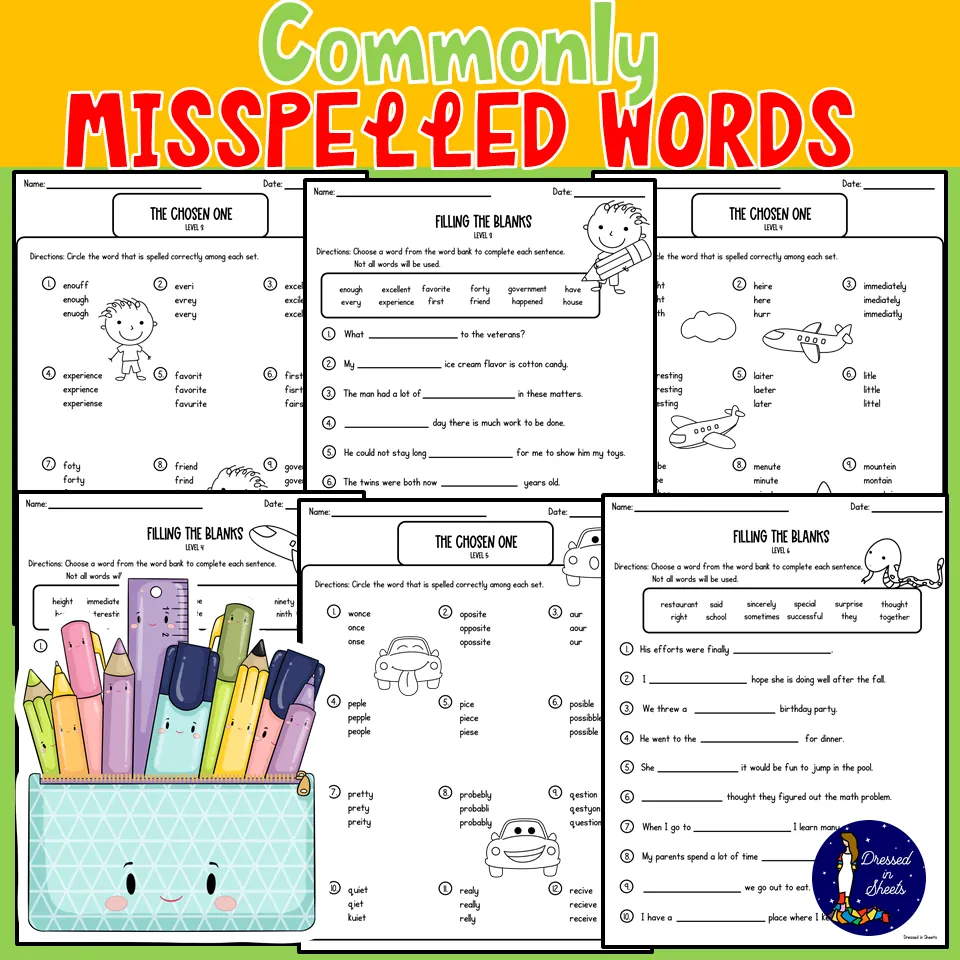
Eighty-four commonly misspelled words are organized into seven leveled sets of twelve words each, with every level built around four activities: circling the correctly spelled version of a word from three near-miss options, filling in a cloze sentence from a word bank, writing an original sentence using a chosen word, and alphabetizing the same twelve words. A full answer key at the back of the packet supplies correct answers for the circle-the-word, fill-in-the-blank, and alphabetizing activities across all seven levels, though the open-ended sentence-writing pages have no single correct answer to key. Words range from everyday vocabulary such as 'because' and 'friend' to trickier terms such as 'definitely,' 'restaurant,' and 'immediately,' with difficulty roughly increasing from Level 1 through Level 7. The packet is designed for repeated independent practice or homework, with each level reusing its own word list across all four activity types.

Product description

From the author

Most Commonly Misspelled Words is a teaching resource that helps students in grades 3-5 improve their spelling. This packet focuses on 84 of the most commonly misspelled words that elementary students frequently use but struggle to spell correctly. The activities allow students to identify proper spelling, choose the correctly spelled word using context clues, practice using the words in sentences, and alphabetize commonly misspelled words. With consistent exposure and writing practice for each word, students will remember the proper spelling both phonetically and visually. This resource can be implemented in small groups, whole class instruction, or as individual practice to reinforce spelling skills. Using these targeted activities and repeated practice, students will become better writers and readers.
In the classroom

Teaching tips & learning objectives

Learning objectives

  • Identify the correctly spelled version of commonly misspelled words by distinguishing them from close misspellings.

  • Use commonly misspelled words correctly in context by completing cloze sentences.

  • Apply correct spelling in original writing by composing sentences with target words.

  • Alphabetize a list of commonly misspelled words.

Teaching tips

  • Assign one level per week, since each of the seven levels reuses the same twelve words across all four activity types before introducing new words.

  • Use the circle-the-word and fill-in-the-blank pages as a quick check before moving to the open-ended sentence-writing page, which has no single correct answer.

  • Have students self-check the circle-the-word, fill-in-the-blank, and alphabetizing pages against the included answer key after completing each level.

Skills covered

  • Spelling discrimination — students circle the correctly spelled option among three near-miss spellings for each of 84 words.

  • Contextual word use — students choose the correct commonly misspelled word from a word bank to complete cloze sentences.

  • Alphabetical ordering — students arrange each level's 12-word list into alphabetical order.

  • Sentence construction — students write original sentences using target commonly misspelled words.

Good to know

Questions teachers ask about this resource

How does the sentence-writing activity differ in purpose from the other three activities in each level?

The circle-the-word, fill-in-the-blank, and alphabetizing activities all involve selecting or arranging words that are already printed on the page, while the sentence-writing activity asks students to compose an original sentence themselves, making it the only activity that requires open-ended application rather than recognition.

Do the four activities within a level use the same set of words?

Yes — each level's word bank (for example, 'a lot, again, although, another, because, before, across, also, always, beautiful, becoming, believe' in Level 1) is reused across the circle-the-word, fill-in-the-blank, writing, and alphabetizing pages for that level.

No reviews yet

Downloaded this resource? Tell other teachers how it went.

Curriculum

Standards, concepts & topics

Standards

  • CCSS.L.3.2 — Demonstrate command of the conventions of standard English capitalization, punctuation, and spelling when writing. a. Capitalize appropriate words in titles. b. Use commas in addresses. c. Use commas and quotation marks in dialogue. d. Form and use possessives. e. Use conventional spelling for high-frequency and other studied words and for adding suffixes to base words (e.g., sitting, smiled, cries, happiness). f. Use spelling patterns and generalizations (e.g., word families, position-based spellings, syllable patterns, ending rules, meaningful word parts) in writing words. g. Consult reference materials, including beginning dictionaries, as needed to check and correct spellings.
  • CCSS.L.5.2 — Demonstrate command of the conventions of standard English capitalization, punctuation, and spelling when writing. a. Use punctuation to separate items in a series.* b. Use a comma to separate an introductory element from the rest of the sentence. c. Use a comma to set off the words yes and no (e.g., Yes, thank you), to set off a tag question from the rest of the sentence (e.g., It’s true, isn’t it?), and to indicate direct address (e.g., Is that you, Steve?). d. Use underlining, quotation marks, or italics to indicate titles of works. e. Spell grade-appropriate words correctly, consulting references as needed.

Core concepts

  • Commonly misspelled words

  • Spelling

  • Alphabetical order

More to explore

You may also like