


Adding and Subtracting Fractions Guided Notes with Mixed Numbers
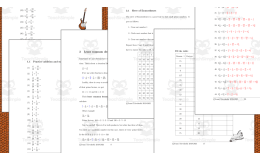
Common denominators, equivalent fractions and regrouping with mixed numbers are taught in fill-in notes with eight worked examples, followed by 29 practice problems that end with a page of fraction word problems.


- Grades
- Grades 5–7, Middle School, Elementary
- Pages
- 7
- File type
- Answer key
- Included


- Subject
- Math, Fractions
- Topic
- adding and subtracting fractions, unlike denominators
- Resource types
- Worksheets, Worksheets & Printables, Teacher Tools, Presentations
- Answer key
- Included
About this resource
What's inside this resource
Students list multiples to find the least common denominator; the key works every answer through the LCD, so students who used a larger common denominator can still compare their simplified answers. Answers go in simplest form, with sums over 1 as mixed numbers.
Related resources
More resources teachers may find useful
24 related resources were found using this product's title, contributor, categories and tags.


In the classroom
Teaching tips & learning objectives

Learning objectives
- Find the least common denominator and rewrite unlike fractions as equivalent fractions.
- Add and subtract fractions with unlike denominators and write answers in simplest form.
- Add and subtract mixed numbers, regrouping when needed.

Teaching tips
- Have students point to the sixths bar in Example 2 before writing the sum, so the change to sixths is seen and not only computed.
- The hint above item 19, 8 = 7 8/8, models regrouping a whole number; ask a student to explain it before the mixed-number set.
- Use Jo’s item 21 to ask why 2/7 cannot be right when it is less than 1/3 on its own.

No reviews yet
Downloaded this resource? Tell other teachers how it went.
Curriculum
Standards, concepts & topics
Standards
 Standards
- 6. NS.B.3 — Fluently add, subtract, multiply, and divide multi-digit decimals using the standard algorithm for each operation.
- 6. NS.A.1 — Interpret and compute quotients of fractions, and solve word problems involving division of fractions by fractions, e.g., by using visual fraction models and equations to represent the problem. For example, create a story context for (2/3) ÷ (3/4) and use a visual fraction model to show the quotient; use the relationship between multiplication and division to explain that (2/3) ÷ (3/4) = 8/9 because 3/4 of 8/9 is 2/3. (In general, (a/b) ÷ (c/d) = ad/bc.) How much chocolate will each person get if 3 people share 1/2 lb of chocolate equally? How many 3/4-cup servings are in 2/3 of a cup of yogurt? How wide is a rectangular strip of land with length 3/4 mi and area 1/2 square mi?
Core concepts
 Core concepts
- Least common denominator
- Equivalent fractions
- Mixed numbers
- Regrouping
 Topics
Explore more
Categories this resource belongs to
Explore related searches
More to explore
You may also like
Worksheets & Printables, Worksheets, Workbooks, Word Problems


Task Cards, Worksheets & Printables

Worksheets & Printables, Worksheets

Task Cards, Worksheets & Printables
Worksheets & Printables

Worksheets, Worksheets & Printables, Teacher Tools, Presentations