Multiplying Fractions with Fractions and Integers


- Grades
- Grades 4–5
- Pages
- 30
- File type
- Answer key
- Included


- Subject
- Math
- Topic
- Math, Fractions
- Resource types
- Worksheets, Activities
- Answer key
- Included
- Standards
- 5.NF.B.4
Product description
From the author
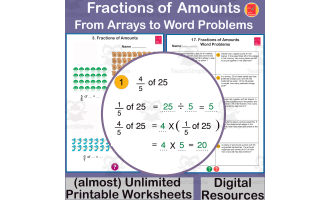
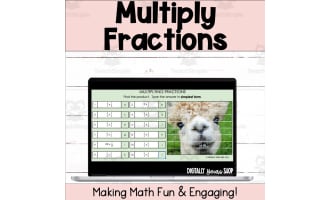
This collection of worksheets focuses on introducing and developing skills in fractional multiplication, covering both fraction-to-fraction and fraction-to-integer operations.
The material is organized into three difficulty tiers:
Tier A: Utilizes visual aids such as rectangular grids for conceptual understanding
Tier B: Emphasizes standard computational methods, including fraction simplification
Tier C: Applies learned concepts to solve practical word problems
The worksheet series comprises seven distinct sets:
Fraction-to-Fraction Multiplication:
1. Foundational concepts using visual representations
2. Numerical exercises involving calculation and simplification
3. Real-world application problems
Fraction-to-Integer Multiplication:
4. Questions incorporating visual grid support
5. Computational practice with simplification and mixed number conversion
6. Contextual word problems
Advanced Practice:
7. Complex operations involving three fractions with simplification
Upon completing this module, learners should be proficient in:
• Performing multiplication with fractions and whole numbers
• Reducing fractional results to their simplest form
• Transforming improper fractions into mixed numbers
• Utilizing fraction multiplication to address practical scenarios
This will also help prepare them for the next level which covers multiplication of mixed numbers which will require all the various mathematical skills gained here to be well established Towards this end, you will see that there is an abundance of worksheets that will provide you with sufficient resources to enable your students gain a high proficiency in the essential skills
How Many worksheets exactly ?
The worksheets are virtually limitless. With a click of a button, numbers are randomized, which means that each worksheet is different. These worksheets are ideal not just for class time practice but also for math centers, end-of-lesson activities, or as resources for substitute teachers, homework assignments, requiring minimal instructions.
Answers are generated automatically with each new worksheet.
Interactive Teaching Pages
The Teaching Pages, designed for use with Interactive Whiteboards, help to introduce the content of the worksheets for the whole class.
Compatibility Note
It is essential to note that these resources can be downloaded as PDF documents. They operate with the official Adobe Acrobat Reader on both Windows and Mac.
Related resources
More resources teachers may find useful
24 related resources were found using this product's title, contributor, categories and tags.


In the classroom
Teaching tips & learning objectives

Learning objectives
Multiply two fractions together and simplify the resulting product.
Multiply a fraction by a whole-number integer and express the result as a simplified mixed number where applicable.
Solve real-world word problems requiring multiplication of fractions or a fraction by an integer.

Teaching tips
Introduce each strand with its array-model teaching page before assigning the matching worksheet sets, since the guide is built around visual arrays as the entry point.
Use Method 1 (multiply numerators and denominators, then simplify) for most students, but switch to Method 2 (simplify first, then multiply) when working with the three-fraction extra-challenge set, since the guide notes it is more efficient there.
Assign the word-problem sets (Set 3 and Set 6) only after students are comfortable with the array and calculation sets, since they require translating real-world scenarios into fraction multiplication.

Skills covered
Fraction-by-fraction multiplication - students solve problems such as 2/5 x 2/4 using array models and direct calculation, then simplify the result.
Fraction-by-integer multiplication - students solve problems such as 2/3 x 9 and convert improper-fraction results into simplified mixed numbers.
Multi-step fraction multiplication - students multiply three fractions together in the extra-challenge set, choosing between two solution methods.

No reviews yet
Downloaded this resource? Tell other teachers how it went.
Curriculum
Standards, concepts & topics
Standards
 Standards
- 5.NF.B.4 — Apply and extend previous understandings of multiplication to multiply a fraction or whole number by a fraction. a. Interpret the product (a/b) × q as a parts of a partition of q into b equal parts; equivalently, as the result of a sequence of operations a × q ÷ b. For example, use a visual fraction model to show (2/3) × 4 = 8/3, and create a story context for this equation. Do the same with (2/3) × (4/5) = 8/15. (In general, (a/b) × (c/d) = ac/bd.) b. Find the area of a rectangle with fractional side lengths by tiling it with unit squares of the appropriate unit fraction side lengths, and show that the area is the same as would be found by multiplying the side lengths. Multiply fractional side lengths to find areas of rectangles, and represent fraction products as rectangular areas.
Core concepts
 Core concepts
Fraction multiplication
Simplifying fractions
Mixed numbers
Word problems
 Topics
More to explore
You may also like