Multiplication – Groups, Arrays, Repeated Addition
- Grades
- Grade 3, Elementary
- Pages
- 14
- File type
- Answer key
- Included


- Subject
- Math, Multiplication and Division, Division
- Topic
- Math, Multiplication
- Resource types
- Worksheets & Printables, Worksheets
- Answer key
- Included
- Standards
- 3.OA.A.1
Product description
From the author
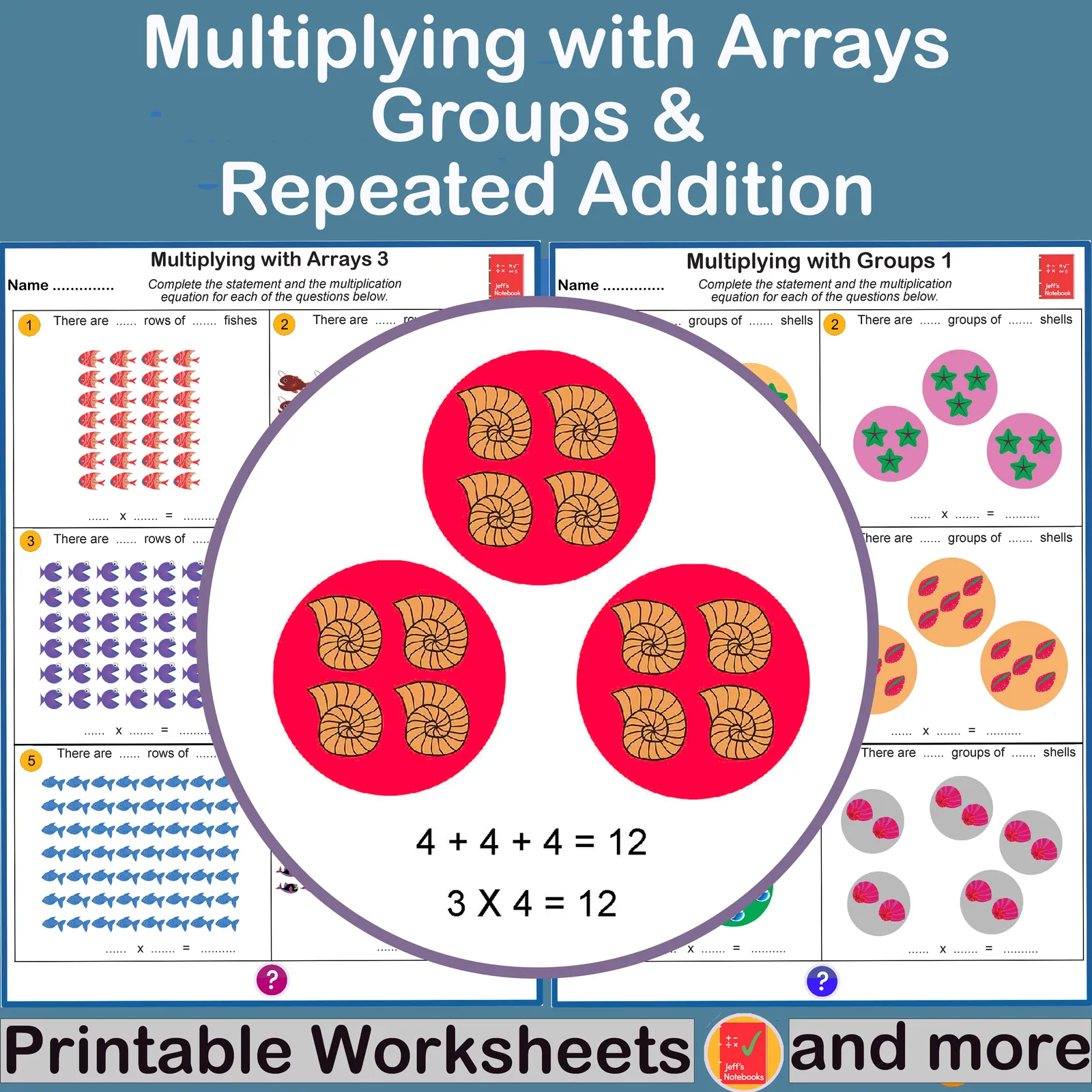
The introduction of multiplication in 3rd grade marks an important milestone in a child's mathematical development. Students transition from relying solely on counting strategies to understanding the relationship between repeated addition and multiplication. Providing a range of visual models like arrays, groups, and repeated addition gives students the concrete understanding they need to grasp this new concept.
Using Arrays is an effective way to model multiplication. Students can clearly see the number of rows and columns and how they relate to the factors in the equation. Making their own arrays to match given factors reinforces this relationship. Building arrays helps cement the idea that multiplication is a more efficient form of repeated addition.
Grouping objects into equal sets also parallels multiplication. Students learn that the number of groups and number of items in each group can be expressed as a multiplication equation. This mimics the structure of repeated addition. For example, 3 groups of 5 can be written as 3 x 5.
Explicitly walking through Repeated Addition and matching it to multiplication statements is key. Completing 5 + 5 + 5 and writing it as 3 x 5 makes the connection. As students gain experience with visual models, they see that multiplication is simply a shorthand for adding equal groups.
For each of the methods above there are 2 or 3 levels of differentiation to choose from, so for example with Arrays there are 3 levels:
Multiplication from 2 x 2 to 5 x 6
Multiplication from 3 x 4 to 7 x 7
Multiplication from 2 x 6 to 7 x 10
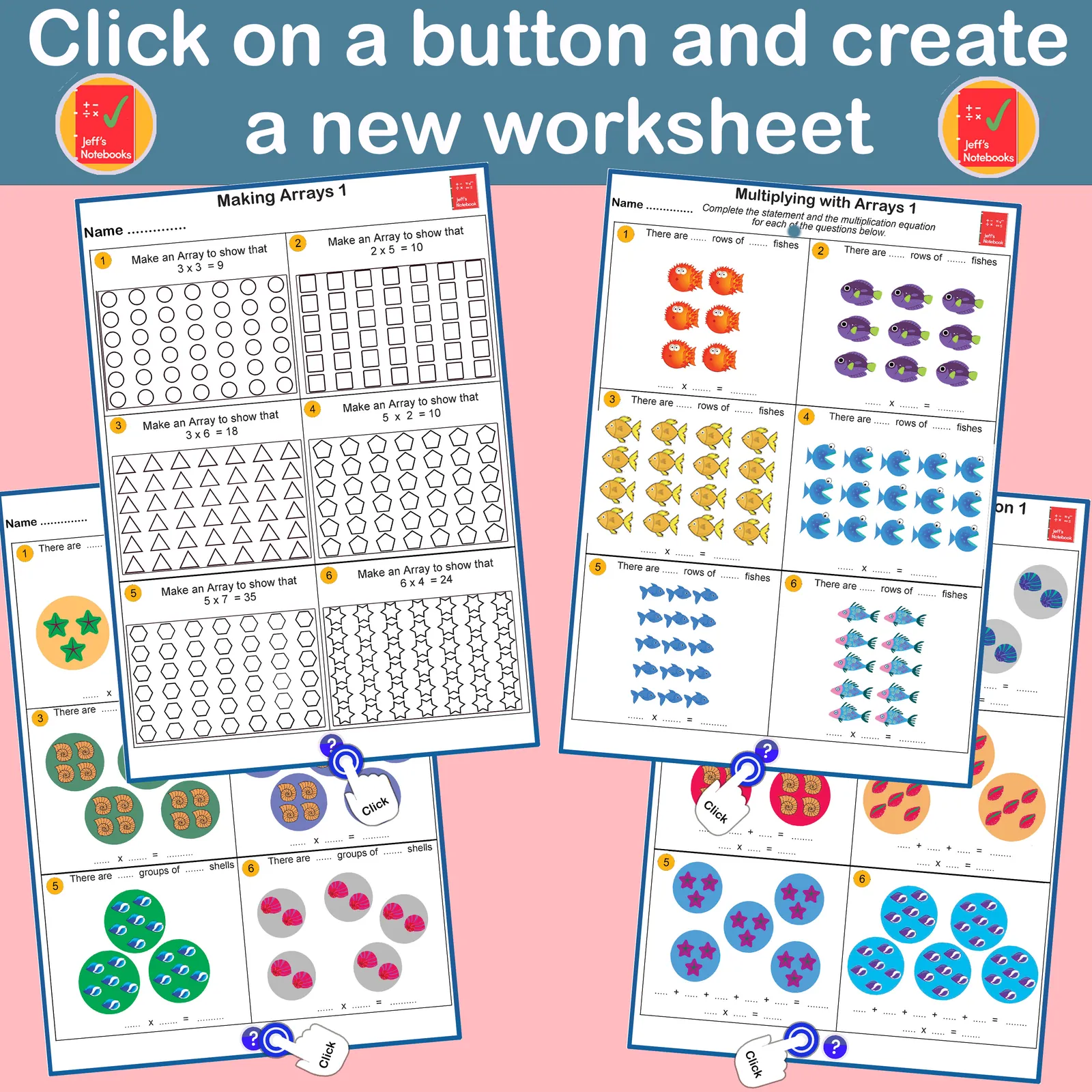
There are 10 sets of worksheets which feature a randomization button. With a single click, educators can generate an entirely new set of questions, making it a renewable resource for the entire school year. Be it for classwork, revision, or homework, the adaptability ensures students achieve proficiency in the topic.
Moving from repeated addition strategies to multiplication in 3rd grade marks a pivotal transition in young students' mathematical development. Providing hands-on practice with arrays, groups, and repeated addition statements allows children to concretely explore the relationship between these concepts. Visual models lay the foundation for true conceptual understanding of multiplication as repeated addition.
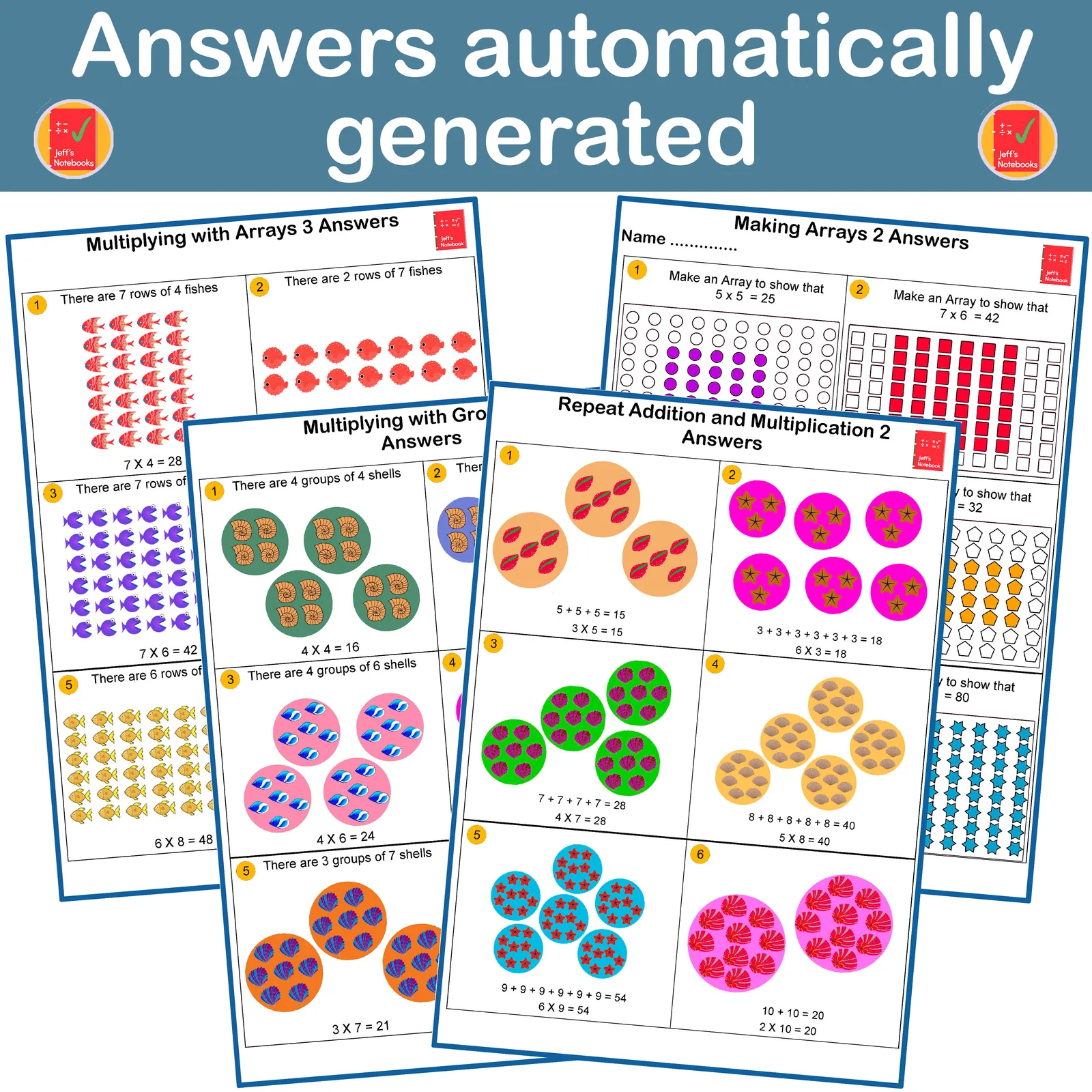
Each worksheet concludes with an automatically generated answer key on its second page, offering a quick reference point for educators. And if there's ever a need for a last-minute lesson or work for a substitute teacher, these sheets are a reliable fallback.
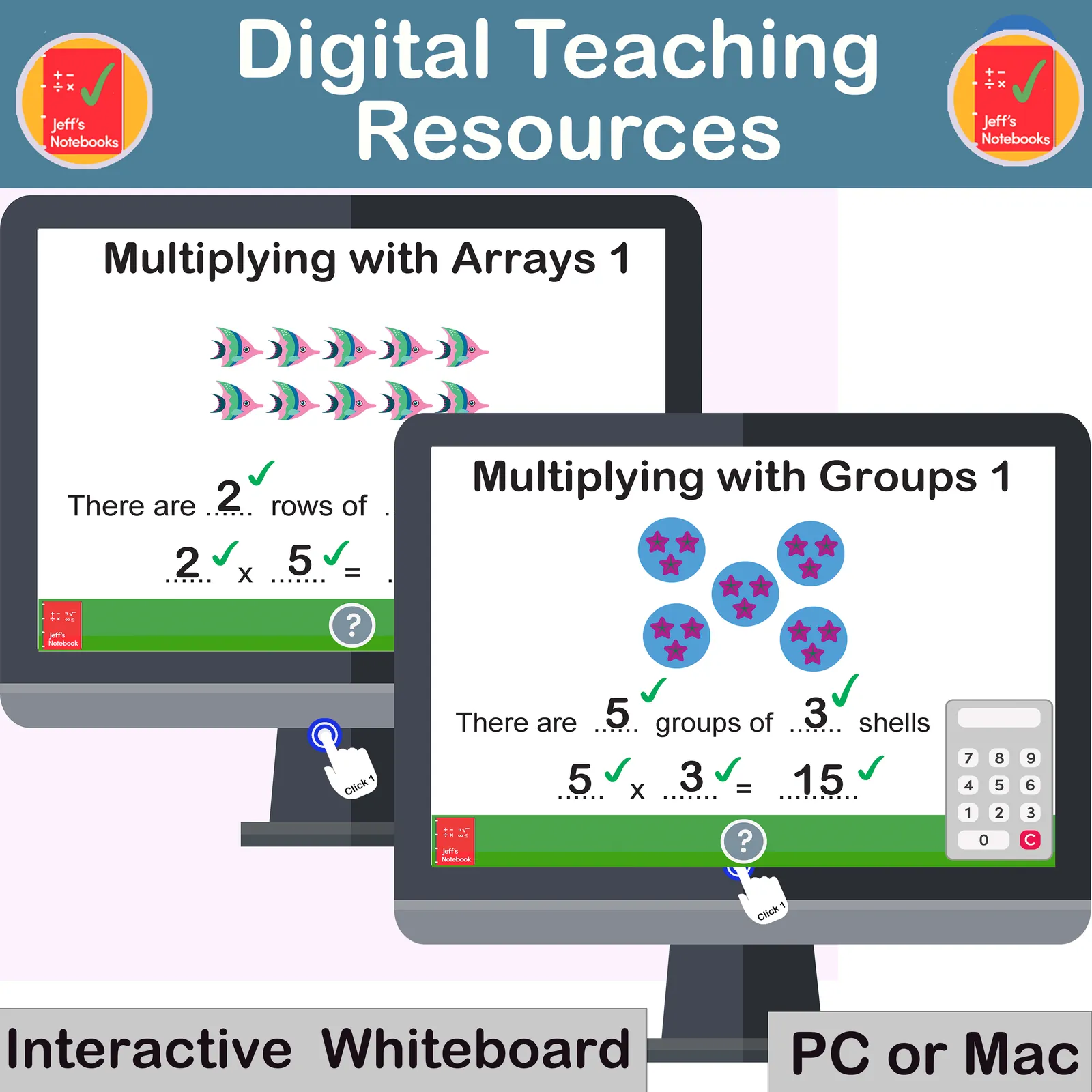
Interactive teaching resources designed for whole class instruction are invaluable. Using an interactive whiteboard allows instant feedback and unlimited examples to reinforce the concepts. This interactive element is perfect for introducing key ideas like multiplying with arrays and groups.
Lastly, it's essential to note that these resources are compatible PDF documents. They operate seamlessly with the official Adobe Acrobat Reader on both Windows and Mac. Plus, the randomizing features are effortlessly accessible via touchscreen devices or interactive whiteboards.
Related resources
More resources teachers may find useful
24 related resources were found using this product's title, contributor, categories and tags.


In the classroom
Teaching tips & learning objectives

Learning objectives
Represent a multiplication situation with equal groups
Write repeated addition for an array or grouped model
Connect a visual model to its multiplication equation

Teaching tips
Start with the pictured groups, then record repeated addition before writing the multiplication equation.
Use the repeated page layout to compare how one quantity appears as groups, an array, and an equation.

Skills covered
Equal-group reasoning — students count identical groups to find a total.
Array interpretation — rows and columns are connected to multiplication equations.
Representation matching — repeated addition, pictures, and equations show the same product.

No reviews yet
Downloaded this resource? Tell other teachers how it went.
Curriculum
Standards, concepts & topics
Standards
 Standards
- 3.OA.A.1 — Interpret products of whole numbers, e.g., interpret 5 × 7 as the total number of objects in 5 groups of 7 objects each. For example, describe a context in which a total number of objects can be expressed as 5 × 7.
Core concepts
 Core concepts
Multiplication
Equal groups
Arrays
Repeated addition
 Topics
Explore more
Categories this resource belongs to
Explore related searches
More to explore
You may also like