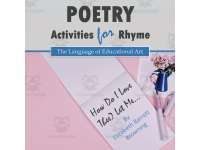
Poetry Activities for Rhyme (w/ 'How Do I Love Thee?')



- Grades
- Grades 9–12, High School
- File type
- Preparation
- Print ready


- Subject
- ELA, Literature, Poetry
- Topic
- creative writing, literature
- Resource types
- Activities
- Preparation
- Print ready
- Standards
- CCSS.L.9.1 CCSS.L.9.2 +14
About this resource
What's inside this resource
This comprehensive poetry analysis tool utilizes Elizabeth Barrett Browning's renowned poem, "How Do I Love Thee? Let Me Count the Ways," to delve into the literary element of rhyme. Through expertly guided annotation, literary analysis (via short answer and essay assignments), and a stimulating creative poem-writing activity, this versatile resource offers an in-depth exploration of rhyme in poetry.
This resource can be effortlessly divided into individual components, making it ideal for bell ringers, short writing assignments, and substitute plans. Alternatively, educators can seamlessly combine all three included activities to create a scaffolded lesson spanning 1-2 weeks, focusing on the masterful use of rhyme in poetry.
Teaching this resource is simple! Start by presenting and discussing the poem with the poem analysis activity, which makes an excellent bell ringer. Then, give students time to complete the guided annotation activity and answer the analysis question that accompany the lesson (answer key included!). Next, students have the opportunity to write their own poem using the poetic concept analyzed earlier. Finally, you can assess students understanding of the poem and its poetic concepts with a literary analysis essay. That essay assignment comes with a prompt, writing tips, peer review, and Common Core-aligned rubric!
Your TeachSimle download includes:
A POEM ANALYSIS ACTIVITY: Give students the opportunity to read Elizabeth Barrett Browning's "How Do I Love Thee? Let Me Count the Ways” (text included) and analyze the poem via an annotation activity and accompanying analysis questions (answer key included). Ideal for a bell ringer!
A CREATIVE WRITING ASSIGNMENT: Provide students the opportunity to further develop their understanding of rhyme with a creative poem writing assignment (tied to one Common Core Writing Standard). Ideal for sub plans!
A LITERARY ANALYSIS ESSAY: This essay assignment builds on students' understanding of rhyme and Barrett Browning's "How Do I Love Thee?” The assignment handout includes essay guidelines, analysis prompt, literary analysis writing tips, and a peer review checklist. The included rubric is tied to 4 Common Core ELA Standards and includes a link to an editable rubric that allows for grading customization and seamless integration into Google Classroom and many other Learning Management Systems (LMS's)
Although this resource can be fitted for any secondary Language Arts classroom, it has been carefully designed to work best in grades 9 through 12. The included rubric is subtly but specifically tied to Common Core ELA Standards for Language (1 and 2) and Writing (2 and 4). This resource is provided in print-ready, bookmarked, and adjustable PDF files and PowerPoint Show files.
This resource contains 5 pages and 1 Google Sheet.
Related resources
More resources teachers may find useful
24 related resources were found using this product's title, contributor, categories and tags.


In the classroom
Teaching tips & learning objectives

Learning objectives
- Identify rhyme and rhyme scheme in a sonnet
- Write a sonnet that follows a set Petrarchan rhyme scheme
- Explain how an original poem follows the sonnet form

Skills covered
- Rhyme scheme analysis — students mark rhymes on Browning's poem and comment in the margins
- Poetry writing — students compose an octave and sestet to a given rhyme pattern

No reviews yet
Downloaded this resource? Tell other teachers how it went.
Curriculum
Standards, concepts & topics
Standards
 Standards
- CCSS.L.9.1 — Demonstrate command of the conventions of standard English grammar and usage when writing or speaking. a. Use parallel structure.* b. Use various types of phrases (noun, verb, adjectival, adverbial, participial, prepositional, absolute) and clauses (independent, dependent; noun, relative, adverbial) to convey specific meanings and add variety and interest to writing or presentations.
- CCSS.L.9.2 — Demonstrate command of the conventions of standard English capitalization, punctuation, and spelling when writing. a. Use a semicolon (and perhaps a conjunctive adverb) to link two or more closely related independent clauses. b. Use a colon to introduce a list or quotation. c. Spell correctly.
- CCSS.L.10.1 — Demonstrate command of the conventions of standard English grammar and usage when writing or speaking. a. Use parallel structure.* b. Use various types of phrases (noun, verb, adjectival, adverbial, participial, prepositional, absolute) and clauses (independent, dependent; noun, relative, adverbial) to convey specific meanings and add variety and interest to writing or presentations.
- CCSS.L.10.2 — Demonstrate command of the conventions of standard English capitalization, punctuation, and spelling when writing. a. Use a semicolon (and perhaps a conjunctive adverb) to link two or more closely related independent clauses. b. Use a colon to introduce a list or quotation. c. Spell correctly.
- CCSS.L.11.1 — Demonstrate command of the conventions of standard English grammar and usage when writing or speaking. a. Apply the understanding that usage is a matter of convention, can change over time, and is sometimes contested. b. Resolve issues of complex or contested usage, consulting references (e.g., Merriam-Webster’s Dictionary of English Usage, Garner’s Modern American Usage) as needed.
- CCSS.L.11.2 — Demonstrate command of the conventions of standard English capitalization, punctuation, and spelling when writing. a. Observe hyphenation conventions. b. Spell correctly.
- CCSS.L.12.1 — Demonstrate command of the conventions of standard English grammar and usage when writing or speaking. a. Apply the understanding that usage is a matter of convention, can change over time, and is sometimes contested. b. Resolve issues of complex or contested usage, consulting references (e.g., Merriam-Webster’s Dictionary of English Usage, Garner’s Modern American Usage) as needed.
- CCSS.L.12.2 — Demonstrate command of the conventions of standard English capitalization, punctuation, and spelling when writing. a. Observe hyphenation conventions. b. Spell correctly.
- CCSS.W.9.2 — Write informative/explanatory texts to examine and convey complex ideas, concepts, and information clearly and accurately through the effective selection, organization, and analysis of content. a. Introduce a topic; organize complex ideas, concepts, and information to make important connections and distinctions; include formatting (e.g., headings), graphics (e.g., figures, tables), and multimedia when useful to aiding comprehension. b. Develop the topic with well-chosen, relevant, and sufficient facts, extended definitions, concrete details, quotations, or other information and examples appropriate to the audience’s knowledge of the topic. c. Use appropriate and varied transitions to link the major sections of the text, create cohesion, and clarify the relationships among complex ideas and concepts. d. Use precise language and domain-specific vocabulary to manage the complexity of the topic. e. Establish and maintain a formal style and objective tone while attending to the norms and conventions of the discipline in which they are writing. f. Provide a concluding statement or section that follows from and supports the information or explanation presented (e.g., articulating implications or the significance of the topic).
- CCSS.W.10.2 — Write informative/explanatory texts to examine and convey complex ideas, concepts, and information clearly and accurately through the effective selection, organization, and analysis of content. a. Introduce a topic; organize complex ideas, concepts, and information to make important connections and distinctions; include formatting (e.g., headings), graphics (e.g., figures, tables), and multimedia when useful to aiding comprehension. b. Develop the topic with well-chosen, relevant, and sufficient facts, extended definitions, concrete details, quotations, or other information and examples appropriate to the audience’s knowledge of the topic. c. Use appropriate and varied transitions to link the major sections of the text, create cohesion, and clarify the relationships among complex ideas and concepts. d. Use precise language and domain-specific vocabulary to manage the complexity of the topic. e. Establish and maintain a formal style and objective tone while attending to the norms and conventions of the discipline in which they are writing. f. Provide a concluding statement or section that follows from and supports the information or explanation presented (e.g., articulating implications or the significance of the topic).
- CCSS.W.11.2 — Write informative/explanatory texts to examine and convey complex ideas, concepts, and information clearly and accurately through the effective selection, organization, and analysis of content. a. Introduce a topic; organize complex ideas, concepts, and information so that each new element builds on that which precedes it to create a unified whole; include formatting (e.g., headings), graphics (e.g., figures, tables), and multimedia when useful to aiding comprehension. b. Develop the topic thoroughly by selecting the most significant and relevant facts, extended definitions, concrete details, quotations, or other information and examples appropriate to the audience’s knowledge of the topic. c. Use appropriate and varied transitions and syntax to link the major sections of the text, create cohesion, and clarify the relationships among complex ideas and concepts. d. Use precise language, domain-specific vocabulary, and techniques such as metaphor, simile, and analogy to manage the complexity of the topic. e. Establish and maintain a formal style and objective tone while attending to the norms and conventions of the discipline in which they are writing. f. Provide a concluding statement or section that follows from and supports the information or explanation presented (e.g., articulating implications or the significance of the topic).
- CCSS.W.12.2 — Write informative/explanatory texts to examine and convey complex ideas, concepts, and information clearly and accurately through the effective selection, organization, and analysis of content. a. Introduce a topic; organize complex ideas, concepts, and information so that each new element builds on that which precedes it to create a unified whole; include formatting (e.g., headings), graphics (e.g., figures, tables), and multimedia when useful to aiding comprehension. b. Develop the topic thoroughly by selecting the most significant and relevant facts, extended definitions, concrete details, quotations, or other information and examples appropriate to the audience’s knowledge of the topic. c. Use appropriate and varied transitions and syntax to link the major sections of the text, create cohesion, and clarify the relationships among complex ideas and concepts. d. Use precise language, domain-specific vocabulary, and techniques such as metaphor, simile, and analogy to manage the complexity of the topic. e. Establish and maintain a formal style and objective tone while attending to the norms and conventions of the discipline in which they are writing. f. Provide a concluding statement or section that follows from and supports the information or explanation presented (e.g., articulating implications or the significance of the topic).
- CCSS.W.9.4 — Produce clear and coherent writing in which the development, organization, and style are appropriate to task, purpose, and audience. (Grade-specific expectations for writing types are defined in standards 1–3 above.)
- CCSS.W.10.4 — Produce clear and coherent writing in which the development, organization, and style are appropriate to task, purpose, and audience. (Grade-specific expectations for writing types are defined in standards 1–3 above.)
- CCSS.W.11.4 — Produce clear and coherent writing in which the development, organization, and style are appropriate to task, purpose, and audience. (Grade-specific expectations for writing types are defined in standards 1–3 above.)
- CCSS.W.12.4 — Produce clear and coherent writing in which the development, organization, and style are appropriate to task, purpose, and audience. (Grade-specific expectations for writing types are defined in standards 1–3 above.)
Core concepts
 Core concepts
- Rhyme
- Rhyme scheme
- Petrarchan sonnet
- Elizabeth Barrett Browning
 Topics
Explore more
Categories this resource belongs to
Explore related searches
More to explore
You may also like