



Prefixes, Suffixes, and Root Words Worksheets for Grade 1, 2, 3



- Grades
- Grades 2–5, Elementary
- Pages
- 10
- File type
- Preparation
- Print ready


- Subject
- Language Development, ELA, Vocabulary
- Topic
- Prefixes and suffixes, root words
- Resource types
- Worksheets & Printables, Worksheets
- Preparation
- Print ready
- Standards
- CCSS.RF.3.3.a CCSS.L.4.4 +1
About this resource
What's inside this resource
Introduction
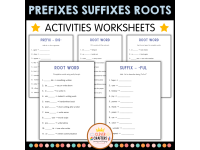
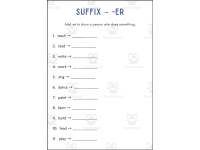
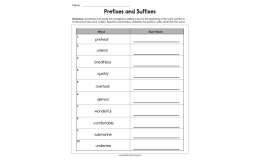
This set of 10 engaging worksheets helps students explore how prefixes, suffixes, and root words change or build meaning in English. Through a variety of hands-on activities, learners add prefixes (un, re, dis), attach suffixes (-ful, -less, -er), and work with common Greek and Latin roots like port, spect, and scrib/script.
Students practice forming new words, discovering meanings, and expanding vocabulary as they complete short exercises, matching tasks, and fill-in-the-blank tasks. These activities strengthen word analysis, spelling, and comprehension, giving learners tools to decode and understand unfamiliar words with confidence.
What’s Included:
10 printable worksheets
Prefix, suffix, and root word practice
Greek and Latin roots (port, spect, scrib/script)
Prefix & suffix mix review sheet
Vocabulary-building and word-formation activities
Grades / Ages:
Ideal for Grades 1–6
Implementation Format:
Great for vocabulary lessons, literacy centres, morning work, or homework.
Answer Key:
Not included
File Type:
PDF (Non-editable)
Number of Pages:
10 pages total
License:
Paid product for personal or single-classroom use only
Tags to Use:
Prefixes and suffixes, root words, Greek and Latin roots, vocabulary building, grammar practice, ELA worksheets, morphology activities, English word formation, word study
Related resources
More resources teachers may find useful
24 related resources were found using this product's title, contributor, categories and tags.

In the classroom
Teaching tips & learning objectives

Learning objectives
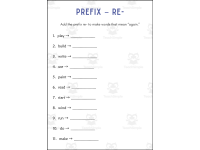
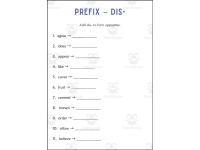
Add the correct prefix (un-, re-, dis-) to a base word and state its new meaning.
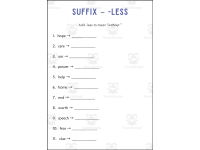
Add the correct suffix (-ful, -less, -er) to a base word and state its new meaning.
Build words from the roots port, spect, and scrib/script using given word parts.

Teaching tips
Introduce one affix family per day rather than assigning all ten pages in a single sitting.
Have students verbally define each new word they form before writing it, since only the base word is provided.
Use the root word pages (port, spect, scrib/script) as a bridge to teach Latin root families more broadly. Apply the word parts with this prefix, suffix, and root-word worksheet.

Skills covered
Prefix meaning application -- students add un-, re-, or dis- to base words (e.g., happy, play, agree) and write the resulting word's meaning.
Suffix meaning application -- students add -ful, -less, or -er to base words (e.g., hope, care, teach) to form new words.
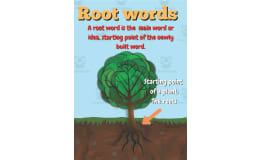
Latin root word building -- students complete words using the roots port (carry), spect (look), and scrib/script (write) across multiple vocabulary items.
Good to know
Questions teachers ask about this resource
Some root-word items give only a partial word stem, like 'in___' or '___acle.' What is being asked of students there?
Students fill in the missing root (spect or scrib/script) to complete the word -- for example 'in' plus spect to mean 'look inside,' or '___acle' plus spect to form 'spectacle,' something to look at.

No reviews yet
Downloaded this resource? Tell other teachers how it went.
Curriculum
Standards, concepts & topics
Standards
 Standards
- CCSS.RF.3.3.a — Identify and know the meaning of the most common prefixes and derivational suffixes.
- CCSS.L.4.4 — Determine or clarify the meaning of unknown and multiple-meaning words and phrases based on grade 4 reading and content, choosing flexibly from a range of strategies. a. Use context (e.g., definitions, examples, or restatements in text) as a clue to the meaning of a word or phrase. b. Use common, grade-appropriate Greek and Latin affixes and roots as clues to the meaning of a word (e.g., telegraph, photograph, autograph). c. Consult reference materials (e.g., dictionaries, glossaries, thesauruses), both print and digital, to find the pronunciation and determine or clarify the precise meaning of key words and phrases.
- CCSS.L.2.4 — Determine or clarify the meaning of unknown and multiple-meaning words and phrases based on grade 2 reading and content, choosing flexibly from an array of strategies. a. Use sentence-level context as a clue to the meaning of a word or phrase. b. Determine the meaning of the new word formed when a known prefix is added to a known word (e.g., happy/unhappy, tell/retell). c. Use a known root word as a clue to the meaning of an unknown word with the same root (e.g., addition, additional). d. Use knowledge of the meaning of individual words to predict the meaning of compound words (e.g., birdhouse, lighthouse, housefly; bookshelf, notebook, bookmark). e. Use glossaries and beginning dictionaries, both print and digital, to determine or clarify the meaning of words and phrases.
Core concepts
 Core concepts
prefixes
suffixes
root words
word morphology
 Topics
More to explore
You may also like
![Vocabulary: Greek and Latin Roots [Vol.2]](https://res.cloudinary.com/teach-simple/image/fetch/f_auto,q_auto,w_330,h_200,c_pad/https://teachsimplecom.s3.us-east-2.amazonaws.com/images/vocabulary-greek-and-latin-roots-vol2/image-1647455479514-1.jpg)


