Prime Factorization Tree Activity, Digital and Printable


About This Product
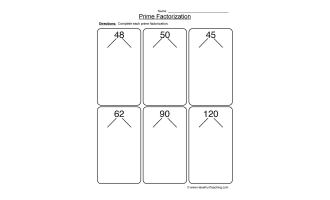
Introduce your fourth-grade students to an exciting and educational prime factorization activity that combines learning and fun seamlessly. Our engaging, no-prep resource is available in both digital and printable formats, making it suitable for any learning environment.
Designed specifically to capture students' attention, this Google Slides activity offers a total of 30 slides, each featuring composite numbers. Students will have the opportunity to practice prime factorization by dragging and dropping number tiles to complete a factor tree. To reinforce their understanding, they will then type the corresponding expression in a text box.
This versatile worksheet is an ideal choice for distance learning, as it can be easily incorporated into your Google Classroom. With just a few clicks, you can effortlessly assign and track student progress, providing a seamless and interactive learning experience for your remote learners.
For those who prefer a traditional classroom or hybrid setting, we have included a set of task cards and a worksheet version of the activity. This flexibility ensures that every student, regardless of their learning environment, can fully engage with the material.
To facilitate your grading process and provide added convenience, we have also included a comprehensive answer key. With solutions readily available, you can quickly assess student understanding and provide timely feedback.
By downloading this resource, you will receive a comprehensive package that includes 30 Google Slides, a task card version of all slides, a worksheet version of all slides, and an answer key for each slide. This comprehensive package allows for maximum versatility and ensures that you have all the necessary materials at your fingertips.
COMMON CORE STANDARDS:
CCSS4.OA.B.4
Find all factor pairs for a whole number in the range 1-100. Recognize that a whole number is a multiple of each of its factors. Determine whether a given whole number in the range 1-100 is a multiple of a given one-digit number. Determine whether a given whole number in the range 1-100 is prime or composite.
CCSS6.NS.B.4
Find the greatest common factor of two whole numbers less than or equal to 100 and the least common multiple of two whole numbers less than or equal to 12. Use the distributive property to express a sum of two whole numbers 1–100 with a common factor as a multiple of a sum of two whole numbers with no common factor. For example, express 36 + 8 as 4 (9 + 2).
Resource Tags
0 Reviews
Check out these other great products