Prime and Composite Anchor Chart – Math Notebook




- Grades
- Grades 2–5, Elementary
- Pages
- 14
- File type
- Preparation
- Print ready


- Subject
- Math, Numbers
- Topic
- math anchor chart, numbers chart
- Resource types
- Anchor Charts, Teacher Tools
- Preparation
- Print ready
- Standards
- 4.OA.B.4
About this resource
What's inside this resource
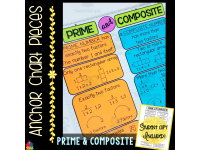
This resource is a Prime and Composite Anchor Chart.
It will come with everything you need to develop this math anchor chart with your students.
It will cover:
- Primes
- Composites
- Rectangular arrays
- Factors
- Examples
There is a final copy at the end that can be printed for students to keep in their math notebook for reference.
Related resources
More resources teachers may find useful
24 related resources were found using this product's title, contributor, categories and tags.




In the classroom
Teaching tips & learning objectives

Learning objectives
Determine whether a number is prime or composite.
Use factor pairs and arrays to justify classification.
Recognize numbers that do not fit either category.

Teaching tips
Print pieces on different colors to highlight each category (suggested on page 1).
Assemble the chart with students to model how factor pairs are found.
Use the student version (page 14) for notebooks or independent reference.

Skills covered
Finding factor pairs
Classifying prime and composite numbers
Using arrays to represent factors
Good to know
Questions teachers ask about this resource
Does this resource include visuals?
Yes, it includes rectangular arrays and factor pair diagrams.
Are special-number rules included?
Yes, the chart states that 0 and 1 are neither prime nor composite, and all even numbers except 2 are composite. 
Is there a student handout?
Yes, page 14 includes a student-sized reference version. 

No reviews yet
Downloaded this resource? Tell other teachers how it went.
Curriculum
Standards, concepts & topics
Standards
 Standards
- 4.OA.B.4 — Find all factor pairs for a whole number in the range 1–100. Recognize that a whole number is a multiple of each of its factors. Determine whether a given whole number in the range 1–100 is a multiple of a given one-digit number. Determine whether a given whole number in the range 1–100 is prime or composite.
Core concepts
 Core concepts
Prime vs. composite numbers
Factors and rectangular arrays
Identifying special cases (0, 1, and 2)
 Topics
Explore more
Categories this resource belongs to
Explore related searches
More to explore
You may also like