Greetings Worksheets for Grades 2–4 – ESL Conversation Set




- Grades
- Grades 2–4
- Pages
- 6
- File type
- Multiple File Types


- Subject
- ESL
- Topic
- Greetings, Conversation starters
- Resource types
- Worksheets
Product description
From the author
Introduction
This set of 6 engaging worksheets is designed to help young learners develop confidence and fluency in using everyday English greetings and introductions. Each worksheet focuses on a different aspect of greeting language, providing a variety of fun and interactive exercises. Whether used in class or at home, these activities support listening, speaking, reading, and writing skills.
Objective:
Students will practice listening, speaking, reading, and writing common English greetings, helping them feel more confident in social interactions.
What’s Included:
Basic greetings (Hello, Hi, Good morning)
Asking and answering “How are you?”
Introducing yourself and others
Responding politely
Matching phrases and completing dialogues
Simple reading and writing practice
Grades / Ages:
Ideal for Grades 1–3
Implementation Format:
Great for ESL classes, morning meetings, social skills lessons, or home learning
Answer Key:
Not included
File Type:
PDF (Non-editable)
Number of Pages:
6 pages total
License:
Paid product – for personal or single-classroom use only
Tags to Use:
greetings worksheets, introductions for kids, ESL greetings, early language practice, preschool communication, social skills, English for beginners
Related resources
More resources teachers may find useful
24 related resources were found using this product's title, contributor, categories and tags.


In the classroom
Teaching tips & learning objectives

Learning objectives
Pair a greeting with the reply that answers it, such as "How are you?" with "I'm fine, thank you!"
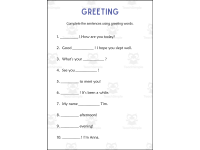
Complete a greeting sentence with the missing word, using context such as "I hope you slept well" to choose between morning, afternoon and evening
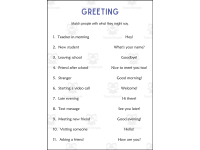
Match a greeting to the person, setting or moment that suits it, including a first meeting, a video call and a text message

Teaching tips
Choose among response matching, gap filling, situation choices, time/occasion matching and unscrambling to match the lesson.
Read greeting-and-response pairs aloud before students draw matching lines.
Discuss more than one suitable greeting when the social situation allows it.

Skills covered
Greeting and response pairing — students match ten openers to their replies, learning that "Nice to meet you!" is answered with "Nice to meet you too!" rather than with any polite phrase.
Time-of-day vocabulary — page 5 lines greetings up against 7:00 AM, 1:00 PM, 7:00 PM and 10:00 PM, separating good morning, good afternoon, good evening and good night.
Spelling recall — the final page scrambles ten greetings, including whole questions such as "atW'h soryu mnea?", so students must reproduce the phrase letter by letter.
Good to know
Questions teachers ask about this resource
What does the final page ask students to do?
Unscramble ten greetings written with their letters jumbled — olHel for Hello, doGo ignonmr for Good morning, eGeodn viagne for Good evening — including two full questions and one self-introduction. Its heading repeats the line from the page before about times of day, but the task itself is spelling.
Are the two columns on the matching pages already lined up?
No — the right-hand column is deliberately shuffled. On page 1 "Hello!" sits opposite "Good evening!" and "How are you?" opposite "Bye!", so students have to draw across the page rather than read straight along a row.

No reviews yet
Downloaded this resource? Tell other teachers how it went.
Resource details
Concepts & topics
Core concepts
 Core concepts
Greetings
Conversation phrases
Register
Time of day vocabulary
 Topics
Explore more
Categories this resource belongs to
Explore related searches
More to explore
You may also like