



2,270 products added recently
1st Grade Reading Worksheets
Support your first graders' literacy journey with worksheets tailored to their reading level. Featuring simple texts and comprehension questions, these activities help develop decoding skills, vocabulary, and understanding. Integrate them into your curriculum to nurture confident and proficient young readers.

 Show filters


CVC Words | Short Vowel Phonics | Word Families for K- 2nd Grade
ELA, Language Development, Pre-Reading, Grammar, Phonics, Reading, Spelling, Kindergarten, Grade 1, 2, Teacher Tools, Lesson Plans, Worksheets & Printables, Worksheets
This CVC Words | Short Vowel Phonics | Word Families Activity is for Kindergarten, First Grade, and Second Grade These worksheets are fun and engaging with a fun ocean / beach setting! Students will read, cut, sort, and paste each fish with the CVC words onto the ocean / beach background that is identified in each word family. The fish with the CVC word that is NOT included for that sound is placed on the hook. This helps students read all the words as they sort out which sound that belongs in that family. There are 23 pages included in all for many CVC words. Fun activity for each sound. Perfect for whole group, individual work, and homework. 23 Pages included. Students will read, sort, cut and paste onto an Ocean / Beach background for the Word Family: AN Students will read, sort, cut and paste onto an Ocean / Beach background for the Word Family: AD Students will read, sort, cut and paste onto an Ocean / Beach background for the Word Family: AP Students will read, sort, cut and paste onto an Ocean / Beach background for the Word Family: ET Students will read, sort, cut and paste onto an Ocean / Beach background for the Word Family: ED Students will read, sort, cut and paste onto an Ocean / Beach background for the Word Family: EN Students will read, sort, cut and paste onto an Ocean / Beach background for the Word Family: IN Students will read, sort, cut and paste onto an Ocean / Beach background for the Word Family: IP Students will read, sort, cut and paste onto an Ocean / Beach background for the Word Family: IT Students will read, sort, cut and paste onto an Ocean / Beach background for the Word Family: OG Students will read, sort, cut and paste onto an Ocean / Beach background for the Word Family: OT Students will read, sort, cut and paste onto an Ocean / Beach background for the Word Family: OP Students will read, sort, cut and paste onto an Ocean / Beach background for the Word Family: UN Students will read, sort, cut and paste onto an Ocean / Beach background for the Word Family: UM Students will read, sort, cut and paste onto an Ocean / Beach background for the Word Family: UG For a list of other phonics and grammar activities, click on the following links: CVC Word Families for Beginning Readers: Stamp it, Make it, Trace it, and Write it CVC Words | Short Vowel Phonics | Word Families for K- 2nd Grade Phonics for 1st and 2nd Grade: Help Students Learn Long A Words: AY, AI, A_E, EIGH, EY, and EA Phonics for 1st and 2nd Grade: Help Students Learn Long E Words: EE, EA, E_E, and Y Phonics for 1st and 2nd Grade: Help Students Learn Long I Words: I_E, IE, IGH, and Y Phonics for 1st and 2nd Grade: Help Students Learn Long O Words: O_E, OA, OW, OE, and OUGH Phonics for 1st and 2nd Grade: Help Students Learn Long U Words: U_E, EW, OO, UE, UI and OU Phonics / Digraphs for 1st and 2nd Grade: Beginning, Middle, and Ending Sounds Phonics / Digraphs for 1st -2nd: Ending Sounds: CK, NG, SH, TH, and NK Phonics / Digraphs for 1st and 2nd Grade: Beginning Sounds: SH, TH, WH and PH Phonics: R-Controlled Words for 1st and 2nd Grade and Early Readers
Author K-5 Treasures
Tags CVC Words, CVC, Phonics, Reading, Learning To Read, Short Vowels, Kindergarten Worksheets, 1st Grade Worksheets, Short Vowel Words, Word Families

EA Phonic Worksheets for Early Years/Intervention/Special Needs
Special Resources, ELA, Language Development, Phonics, Reading, Spelling, Kindergarten, Preschool, Grade 1, 2, Activities, Games, Worksheets & Printables, Worksheets
This is a pack of 30 phonic worksheets for the Long Vowel EA (as in eat) specially designed for those with special needs, including those with dyslexia or who may be suspected of being dyslexic but will work equally well with young learners in Kindergarten/EYFS/Y1. A pack of 30 worksheets with a variety of exercises to help build phonemic awareness and reading fluency. These sheets are LETRS and UK GOV requirements aligned. These worksheets also align with the most popular phonic programmes, including RWI and Letters and Sounds. What is included? 30 worksheets for the sound EA taking pupils from hearing the sounds in words to reading and spelling them at word and sentence level. all following my special method devised as I privately tutor children of all ages with profound special needs. Your phonics lessons covered! Tracking, fluency triangles, spelling, reading, games, comprehension exercises....and more! 2 PDF games to send home for extra practice included! Who are these worksheets for? I have written them for pupils who struggle with processing information - especially sounds. This includes children who are DYSLEXIC or have ANY other kind of processing disorder. Such children may have failed with other methods of teaching phonics. Such pupils need activities that: ·are highly structured - one tiny step at a time building on the one before using only a limited number of words to start with and only using words that the child has already learnt to sound out, with no nasty surprises. ·Have only a little on each pageas these pupils tire easily. What makes these worksheets special? I have a powerful three-step process which I use with my special needs pupils, which is worked out over the course of the 30 worksheets: 1. See it!where we focus on becoming aware of the new sound in words. This involves first hearing the new sound in words and then seeing it in words (tracking). 2. Sound-it-out!Having learnt to see the new sound in words, we learn to sound out these words to read and write them. We begin by usingsound-it-out boxesfor reading and spelling which help the child to segment the word prior to blending the sounds together. Once the child can read and write individual words, we work on fluency by building familiarity with the common words in the new sound family. Once the child can sound the words out to read and spell confidently, we move on to recognising them/using them in longer reading and dictation passages, as soon as the child is able. I provide 2 reading passages with comprehension exercises and one dictation passage, with a page in the workbook dedicated to it, with room for a picture, which again cements understanding. 3. Write it! Incorporated into the above two steps, we constantly write the new sound. This adds a multi-sensory dimension to our work - we see with our eyes, we sound it with our mouth parts and voice, and then we move by writing. All three steps work together to help the child feel in control of his/her learning and to become a successful, confident learner. We finish each sound with a dictation which culminates our work before we move on to the next sound. I try to give the dictation a week after we finish the work on the EA sound to act as revision. The dictation: Read this passage to your pupil, who should write it. Have the child read his/her work and check for errors. Make sure the writing is completely accurate before saying the child has finished, including full stops and capital letters correctly used. Flashcards are included of some common EA words. What is included? 1 PDF with flashcards, 2 easy-prep games and 30 worksheets
Author Lilibette's Resources
Tags Phonic Worksheets, Special Needs, Phonic Games, Print N Play Phonic Game, Ea Worksheets, Dyslexia, Spelling EA Words, Learn To Read EA Words, Long E, Vowel Teams

AI Phonic Worksheets for Early Years/Intervention/Special Needs
Special Resources, ELA, Language Development, Phonics, Reading, Spelling, Kindergarten, Preschool, Grade 1, 2, Activities, Games, Worksheets & Printables, Worksheets
This is a pack of 18 phonic worksheets for the Long Vowel AI (as in rain) specially designed for those with special needs, including those with dyslexia or who may be suspected of being dyslexic but will work equally well with young learners in Kindergarten/EYFS/Y1. A pack of 18 AI worksheets with a variety of exercises to help build phonemic awareness and reading fluency. These sheets are LETRS and UK GOV requirements aligned. These worksheets also align with the most popular phonic programmes, including RWI and Letters and Sounds. What is included? 30 worksheets for the sound AI taking pupils from hearing the sounds in words to reading and spelling them at word and sentence level. all following my special method devised as I privately tutor children of all ages with profound special needs. Your phonics lessons are covered! Tracking, fluency triangles, spelling, reading, games, comprehension exercises....and more! 2 PDF games to send home for extra practice included! Who are these worksheets for? I have written them for pupils who struggle with processing information - especially sounds. This includes children who are DYSLEXIC or have ANY other kind of processing disorder. Such children may have failed with other methods of teaching phonics. Such pupils need activities that: ·are highly structured - one tiny step at a time building on the one before using only a limited number of words to start with and only using words that the child has already learnt to sound out, with no nasty surprises. ·Have only a little on each pageas these pupils tire easily. What makes these worksheets special? I have a powerful three-step process which I use with my special needs pupils, which is worked out over the course of the 18 worksheets: 1. See it!where we focus on becoming aware of the new sound in words. This involves first hearing the new sound in words and then seeing it in words (tracking). 2. Sound-it-out!Having learnt to see the new sound in words, we learn to sound out these words to read and write them. We begin by usingsound-it-out boxesfor reading and spelling which help the child to segment the word prior to blending the sounds together. Once the child can read and write individual words, we work on fluency by building familiarity with the common words in the new sound family. Once the child can sound the words out to read and spell confidently, we move on to recognising them/using them in longer reading and dictation passages, as soon as the child is able. I provide 2 reading passages with comprehension exercises and one dictation passage, with a page in the workbook dedicated to it, with room for a picture, which again cements understanding. 3. Write it! Incorporated into the above two steps, we constantly write the new sound. This adds a multi-sensory dimension to our work - we see with our eyes, we sound it with our mouth parts and voice, and then we move by writing. All three steps work together to help the child feel in control of his/her learning and to become a successful, confident learner. We finish each sound with a dictation which culminates our work before we move on to the next sound. I try to give the dictation a week after we finish the work on the EA sound to act as revision. The dictation: Read this passage to your pupil, who should write it. Have the child read his/her work and check for errors. Make sure the writing is completely accurate before saying the child has finished, including full stops and capital letters correctly used. Flashcards are included of some common AI words. What is included? 1 PDF with flashcards, 2 easy-prep AI games and 30 worksheets
Author Lilibette's Resources
Tags Phonic Worksheets, Special Needs, Phonic Games, Print N Play Phonic Game, Dyslexia, Vowel Teams, Spelling Ai Words, Ai Worksheets, Learn To Read Ai Words, Long A
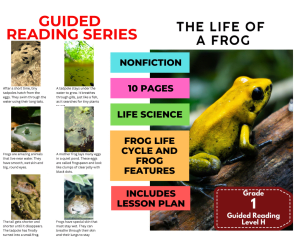
Guided Reading Level H - The Life of a Frog (with Lesson Plan)
ELA, Resources for Teachers, Reading Comprehension, Reading, Science, Animals, Life Sciences, Pre-Reading, Language Development, Vocabulary, Grade 1, 2, 3, Worksheets & Printables, Worksheets, Teacher Tools, Centers, Activities, Literacy Readers, Quizzes, Quizzes and Tests, Assessments, Lesson Plans
This Guided Reading Book - The Life of a Frog (Level H) with lesson plan includes: Guided Reading Color Label (front cover x1) This is a quick way to match the book’s demands to what students can generally handle.. The overall goal is to use the level/color to pick books for several smaller groups. To qualify for a certain level, a student is expected to read a book from that level with about 90–94% accuracy. If a student is consistently accurate and understands, move up a level. If the student is struggling at that level, drop down and add more support. Each student will improve at completely different rates, but it is generally one of the best ways to check progress across the class. DOWNLOAD THE CATALOG TO VIEW ALL GUIDED READING BOOKS AVAILABLE (SORTED LEVELS A-Z) Pre-Reading Question (x1) Teacher asks the prompt aloud, can be while showing the cover or first page. Students share what they already know, or make educated guesses from the cover. Prompt them to use the target vocabulary. Write some of their responses on the board to look back at during the reading. Vocabulary Words (x5) Introduce the five words, best doing it one at a time. Start by saying it, while students repeat and then see if anyone knows what it means before reading further. Read through the meaning and try to briefly connect each word to a picture or gesture so it’s meaningful. Ask students to flip through the book pages and point to where they see each of the vocabulary words. While reading the book pause upon coming across one of the vocab words or read the sentence twice to make sure students understand the word has appeared. Optional: Ask students to raise hands whenever they see/hear one of the new words. Guided Reading Pages (x10) Check the book snapshot (below) for: primary topic - do you need to prep extra reading or intro materials on this? what is taught best - decide on 1-2 bullets to focus on, use the prompt or words provided here for best results. learning goals - what you are checking for students to be able to do after the session, elicit answers using prompts or words provided. key vocabulary (see section above). questions overview - so you know what is coming up and if you need to prep extra materials to assist understanding. Run the lesson You may have already looked at a few of the pages together, but you can show them some of the pictures again first to set meaning. Depending on how much time you have and how familiar your students are with guided reading class, you may want to read the book aloud first with the group first. Students whisper or partner read, while you listen in. If time, do it as a group, one student reading a page each. Use the guided page’s prompts to coach: “Check the picture / does it make sense?” “Point under the words / try the first sound” “Reread the sentence smoothly”. Try to focus more on one student per session (rotating every time), so you can work out if they are ready to move up or need to move down a level. Comprehension Questions (back cover x3) This is your way to check that students didn’t just say the words, but actually understood the text. First, let students answer by pointing to the page/picture and saying a short sentence. After any answer, follow with: “Show me where you found that in the text.” In bigger groups, have partners answer first (10–20 seconds), then call on 2–3 students to share. Differentiation tips: Emerging speakers/struggling readers: oral + pointing On-level: oral in a full sentence Higher: one written sentence or draw + label Book Snapshot Title: The Life of a Frog Genre: Nonfiction (informational life cycle) Subject: Life Science + Reading (Informational Text) Primary Topic: Frog life cycle and frog features Estimated Guided Reading Level (A–Z): H What This Book Teaches Best Explains where frogs live and describes basic frog traits (smooth, wet skin; big, round eyes; living near water). Teaches the frog life cycle in clear steps: eggs (frogspawn) → tadpoles → legs grow → tail disappears → small frog. Shows how a tadpole lives and grows in water, including breathing through gills and eating tiny plants. Describes how frogs breathe (through skin and lungs) and how they get food (long, sticky tongue catching insects). Connects body parts to movement (strong back legs help frogs hop and jump high). Learning Goals Students will describe where frogs live and name physical traits the text mentions. Students will explain what frog eggs are called and describe what they look like. Students will retell the main stages of a frog’s life from eggs to a small frog. Students will describe how tadpoles move, breathe, and find food in the water. Students will explain how the frog’s body changes as legs grow and the tail disappears. Students will use text details to describe how a frog hunts and how it jumps. Key Vocabulary From the Text frogspawn — frog eggs that look like jelly. tadpoles — baby frogs that live in water and have tails. gills — body parts that help an animal breathe underwater. lungs — body parts used for breathing air. insects — small animals a frog can catch and eat. Discussion Prompts Pre-reading question: What changes do you think happen as a tadpole grows into a frog? Comprehension questions: Where does a mother frog lay many eggs, according to the text? Comprehension questions: What do tiny tadpoles use to swim through the water? Comprehension questions: What happens to the tadpole’s tail as it turns into a small frog? Printing Tips 1. Best Printing Method (Recommended) “Booklet” Printing (Best if Available) If your printer or PDF viewer supports Booklet Printing , use this. Settings to use: Print mode: Booklet Paper size: Letter or A4 (either works) Orientation: Landscape Print on both sides: Yes Flip on: Short edge Scaling: Fit to printable area Booklet subset: First test: Front sides only Then: Back sides only This will automatically: Pair pages correctly Put the cover on the outside Align everything for folding After printing, fold in half and staple along the spine . 2. If “Booklet” Printing Is NOT Available You can still print this correctly with manual duplex printing . Step-by-step: Open the PDF. Choose Print . Set: Orientation: Landscape Pages per sheet: 1 Print on both sides: Yes Flip on: Short edge Print all pages . Because each PDF page already contains two facing book pages, the result will still fold cleanly into a book. Thousands of Cored Education products are included with your TeachSimple membership. Download links and encyclopedia index available here.
Author Cored Education
Rating
Tags Reading Comprehension, Reading Passages, Reading, Guided Reading, Guided Reading Lesson Plan, Guided Reading Activity, Pre-reading, Science Lesson Plans, Animals, Frog Life Cycle
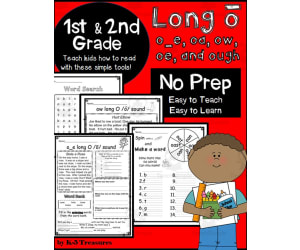
Phonics for 1st and 2nd Grade: Help Students Learn Long O Words: O_E, OA, OW, OE, and OUGH
ELA, Grammar, Language Development, Phonics, Reading, Grade 1, 2, Worksheets & Printables, Worksheets, Teacher Tools, Lesson Plans
This unit focuses only on the Long O sounds. Learning how to read can be the most challenging activity for students and for a teacher. Understanding that the combination of letters can make the same vowel sound requires lots of repetitive practice of reading and writing these words with these sounds. There are other phonics units that I sell that focuses on each of the long vowels with a combination of different letters. Reading can be made easier with these phonic helps that repeatedly encourage students to practice these Long O sounds. Activities include: - Reading comprehension and identifying the Long O in their reading - Writing their answers to questions regarding the paragraph - Identifying additional Long O words in sentences using a word bank - Matching words with pictures - Spinning a paperclip activity where students will write the word with the Long O sound - and lastly a fun wordsearch with variations of Long O words. These activities are for each long vowel words that are focused on the Long O sounds so there are plenty of opportunities for students to practice their comprehension reading skills and phonic sounds. Students will practice the following Long O Word sounds: O_E, OA, OW, OE, and OUGH. Teachers can use this resource in whole group, individually with students, students can practice with each other in centers, or these worksheets can be assigned as homework. Worksheets are also differentiated for each Long O sounds for all young learners which makes it perfect for all 1st - 2nd graders. A total of 31 pages full of reading and phonic activities. Along with reading and writing, there are matching, cutting, and pasting activities. Word searches and spin and make a word activity are also a part of this packet which make learning to read these phonic sounds entertaining for young learners. For a list of other phonics and grammar activities, click on the following links: CVC Word Families for Beginning Readers: Stamp it, Make it, Trace it, and Write it CVC Words | Short Vowel Phonics | Word Families for K- 2nd Grade Phonics for 1st and 2nd Grade: Help Students Learn Long A Words: AY, AI, A_E, EIGH, EY, and EA Phonics for 1st and 2nd Grade: Help Students Learn Long E Words: EE, EA, E_E, and Y Phonics for 1st and 2nd Grade: Help Students Learn Long I Words: I_E, IE, IGH, and Y Phonics for 1st and 2nd Grade: Help Students Learn Long O Words: O_E, OA, OW, OE, and OUGH Phonics for 1st and 2nd Grade: Help Students Learn Long U Words: U_E, EW, OO, UE, UI and OU Phonics / Digraphs for 1st and 2nd Grade: Beginning, Middle, and Ending Sounds Phonics / Digraphs for 1st -2nd: Ending Sounds: CK, NG, SH, TH, and NK Phonics / Digraphs for 1st and 2nd Grade: Beginning Sounds: SH, TH, WH and PH Phonics: R-Controlled Words for 1st and 2nd Grade and Early Readers
Author K-5 Treasures
Tags Phonics, Grammar, Vowel Sounds, Long Vowel Sounds, Reading, Long O Sounds, 1st Grade, 2nd Grade, Long O Words, Long O Words With Oe
Reading Response Forms: Remembering Gr. 1-2
ELA, Reading, Common Core, Grade 1, 2, Worksheets & Printables, Worksheets
Reading Response Forms: Remembering Gr. 1-2 - A Comprehensive Teaching Resource Reading Response Forms: Remembering Gr. 1-2 is a specially designed teaching resource that is focused on essential thinking skills and reading comprehension for students in grades 1 and 2. This teaching tool which has been adapted from the full lesson plan "Reading Response Forms," provides emphasis on "remembering", one of the six phases in Bloom's Taxonomy. The Benefit of Reading Response Forms to Young Learners Gives young learners the opportunity to express their thoughts about texts they've read or heard explained, reinforcing their comprehension and encouraging active engagement with literature. An eclectic mix of skill-based worksheets for individual efforts and interactive hands-on tasks that cater to group learning scenarios are provided. Bloom’s Taxonomy Simplified The Reading Response Forms simplifies Bloom’s Taxonomy by offering effective tools at each stage: Knowledge assimilation, Comprehension testing, Practical application, Etc. 'Teacher Implementation Guide'+ The tailored resources attached come with an insightful teacher implementation guide which provides a roadmap towards easy integration into lesson plans. 'Student Assessment Rubrics'+ This comprehensive material also comes with student assessment rubrics supplying teachers with details they require for evaluating learner performance. Supplementary materials such as word puzzles, colour graphic organisers - further enhance learning, making it more engaging and stimulating while providing learners with visual aids for information retention. A comprehension quiz then presents an evaluative testing method to cap up each learning experience. The Reading Response Forms: Remembering Gr. 1-2 adheres strictly to Common Core State Standards and is perfectly aligned with the various stages of Bloom's Taxonomy, ensuring its suitability for a variety of educational settings, including public schools or homeschooling setups. Please note that the Reading Response Forms: Remembering Gr. 1-2 are delivered in PDF format for easy accessibility on multiple platforms. Print out when necessary or easily share electronically, catering to the needs of a modern educational setup.
Author Classroom Complete Press
Tags PDF

Guided Reading Level H - Snow, Sleet, and Hail
ELA, Resources for Teachers, Reading Comprehension, Reading, Science, Pre-Reading, Language Development, Earth and Environmental Sciences, Earth Sciences, Physics, Kindergarten, Grade 1, 2, Worksheets & Printables, Worksheets, Teacher Tools, Centers, Activities, Literacy Readers, Quizzes, Quizzes and Tests, Assessments
This Guided Reading Book - Snow, Sleet, and Hail (Level H) includes: Guided Reading Color Label (front cover x1) This is a quick way to match the book’s demands to what students can generally handle.. The overall goal is to use the level/color to pick books for several smaller groups. To qualify for a certain level, a student is expected to read a book from that level with about 90–94% accuracy. If a student is consistently accurate and understands, move up a level. If the student is struggling at that level, drop down and add more support. Each student will improve at completely different rates, but it is generally one of the best ways to check progress across the class. DOWNLOAD THE CATALOG TO VIEW ALL GUIDED READING BOOKS AVAILABLE (SORTED LEVELS A-Z) Pre-Reading Question (x1) Teacher asks the prompt aloud, can be while showing the cover or first page. Students share what they already know, or make educated guesses from the cover. Prompt them to use the target vocabulary. Write some of their responses on the board to look back at during the reading. Vocabulary Words (x5) Introduce the five words, best doing it one at a time. Start by saying it, while students repeat and then see if anyone knows what it means before reading further. Read through the meaning and try to briefly connect each word to a picture or gesture so it’s meaningful. Ask students to flip through the book pages and point to where they see each of the vocabulary words. While reading the book pause upon coming across one of the vocab words or read the sentence twice to make sure students understand the word has appeared. Optional: Ask students to raise hands whenever they see/hear one of the new words. Guided Reading Pages (x10) Check the book snapshot (below) for: primary topic - do you need to prep extra reading or intro materials on this? what is taught best - decide on 1-2 bullets to focus on, use the prompt or words provided here for best results. learning goals - what you are checking for students to be able to do after the session, elicit answers using prompts or words provided. key vocabulary (see section above). questions overview - so you know what is coming up and if you need to prep extra materials to assist understanding. Run the lesson You may have already looked at a few of the pages together, but you can show them some of the pictures again first to set meaning. Depending on how much time you have and how familiar your students are with guided reading class, you may want to read the book aloud first with the group first. Students whisper or partner read, while you listen in. If time, do it as a group, one student reading a page each. Use the guided page’s prompts to coach: “Check the picture / does it make sense?” “Point under the words / try the first sound” “Reread the sentence smoothly”. Try to focus more on one student per session (rotating every time), so you can work out if they are ready to move up or need to move down a level. Comprehension Questions (back cover x3) This is your way to check that students didn’t just say the words, but actually understood the text. First, let students answer by pointing to the page/picture and saying a short sentence. After any answer, follow with: “Show me where you found that in the text.” In bigger groups, have partners answer first (10–20 seconds), then call on 2–3 students to share. Differentiation tips: Emerging speakers/struggling readers: oral + pointing On-level: oral in a full sentence Higher: one written sentence or draw + label Book Snapshot Title: Snow, Sleet, and Hail Genre: Nonfiction (informational) Subject: Life Science / Earth Science Primary Topic: Types of frozen water from the sky Estimated Guided Reading Level (A–Z): H What This Book Teaches Best Introduces three kinds of frozen water that fall from the sky: snow, sleet, and hail. Explains simple conditions and traits: snow falls when air is cold and feels “soft and light.” Builds science vocabulary using clear examples (snowflakes as “tiny crystal,” sleet as rain that “freezes as it falls”). Describes how hail forms and changes size (“grows inside a tall cloud” and “gets bigger and bigger”). Learning Goals Identify snow, sleet, and hail as kinds of frozen water. Describe what the text says snow is like and when it falls. Explain what a snowflake is, using the book’s words. Explain how the book says sleet forms as it falls. Describe how the book says hail forms and grows before it falls. Tell how frozen water affects Earth in the book (it “covers the earth,” and cold weather “changes the land”). Key Vocabulary From the Text crystal — a hard, shiny shape. sleet — rain that freezes as it falls. freezes — turns from water into ice when very cold. bounces — jumps back up after it hits something. hail — hard ice that falls during a big storm. Discussion Prompts Pre-reading question: What kinds of frozen water have you seen fall from the sky? Comprehension questions: What does the book say snow is like when it falls? Comprehension questions: What does the book say sleet is made from as it falls? Comprehension questions: Where does the book say hail grows before it falls? Printing Tips 1. Best Printing Method (Recommended) “Booklet” Printing (Best if Available) If your printer or PDF viewer supports Booklet Printing , use this. Settings to use: Print mode: Booklet Paper size: Letter or A4 (either works) Orientation: Landscape Print on both sides: Yes Flip on: Short edge Scaling: Fit to printable area Booklet subset: First test: Front sides only Then: Back sides only This will automatically: Pair pages correctly Put the cover on the outside Align everything for folding After printing, fold in half and staple along the spine . 2. If “Booklet” Printing Is NOT Available You can still print this correctly with manual duplex printing . Step-by-step: Open the PDF. Choose Print . Set: Orientation: Landscape Pages per sheet: 1 Print on both sides: Yes Flip on: Short edge Print all pages . Because each PDF page already contains two facing book pages, the result will still fold cleanly into a book. Thousands of Cored Education products are included with your TeachSimple membership. Download links and encyclopedia index available here.
Author Cored Education
Rating
Tags Vocabulary, Reading Comprehension, Reading Passages, Leveled Reading, Nonfiction, Reading, Guided Reading, Earth Science, Weather, Physics

Fall Fun - Pumpkin Seed Counting 1-10
Math, Early Math, Numbers, Common Core, Fall, Seasons, Holiday & Seasonal, Basic Operations, Counting, Special Education Needs (SEN), Special Resources, Language Development, ELA, Reading, Writing, Reading Comprehension, Strategies, Grammar, Pre-Reading, Spelling, Vocabulary, Kindergarten, Preschool, Infant, Toddler, Grade 1, 2, 3, Worksheets & Printables, Worksheets, Coloring Pages
Whether Fall is in the air and you want pumpkins everywhere, or you just want a fun activity for your younger child, let’s give your young learner a jump-start with counting that they will love! Created for Pre-K and Kindergarteners, this downloadable workbook with bright colors and pictures is designed to teach little ones the basics of counting while also engaging their hands and minds, keeping them busy with coloring, tracing, cutting, and touching. This downloadable, printable, pdf contains 12 pages of activities that include coloring numbers, tracing words, counting seeds, and cutting out and organizing pumpkins. Included: 12 printable pages of easy activities for teacher that are perfect for little hands and minds Pumpkins seeds that can be printed and cut out for counting and organizing Numbers that can be colored in Words that can be traced Don't stress about how you are going to teach your little one how to count and make it a fun memory; let this Pumpkin Seed Counting workbook give those little brains of yours a stimulating workout that both you and them will love! If you want more fun activities that you and your kids can enjoy together, find more at my storefront here: Homeschooling Dietitian Mom
Author Homeschooling Dietitian Mom
Tags Counting, Math Activities, Pumpkin, Fall, Numbers, Early Learning, Seeds, Pumpkin Seeds
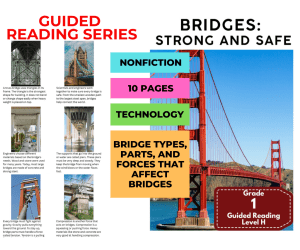
Guided Reading Level H - Bridges Strong and Safe
ELA, Resources for Teachers, Reading Comprehension, Reading, Language Development, Pre-Reading, Vocabulary, Science, Technology, Engineering, Kindergarten, Grade 1, 2, Worksheets & Printables, Worksheets, Teacher Tools, Centers, Activities, Literacy Readers, Quizzes, Quizzes and Tests, Assessments
This Guided Reading Book - Bridges Strong and Safe (Level H) includes: Guided Reading Color Label (front cover x1) This is a quick way to match the book’s demands to what students can generally handle.. The overall goal is to use the level/color to pick books for several smaller groups. To qualify for a certain level, a student is expected to read a book from that level with about 90–94% accuracy. If a student is consistently accurate and understands, move up a level. If the student is struggling at that level, drop down and add more support. Each student will improve at completely different rates, but it is generally one of the best ways to check progress across the class. DOWNLOAD THE CATALOG TO VIEW ALL GUIDED READING BOOKS AVAILABLE (SORTED LEVELS A-Z) Pre-Reading Question (x1) Teacher asks the prompt aloud, can be while showing the cover or first page. Students share what they already know, or make educated guesses from the cover. Prompt them to use the target vocabulary. Write some of their responses on the board to look back at during the reading. Vocabulary Words (x5) Introduce the five words, best doing it one at a time. Start by saying it, while students repeat and then see if anyone knows what it means before reading further. Read through the meaning and try to briefly connect each word to a picture or gesture so it’s meaningful. Ask students to flip through the book pages and point to where they see each of the vocabulary words. While reading the book pause upon coming across one of the vocab words or read the sentence twice to make sure students understand the word has appeared. Optional: Ask students to raise hands whenever they see/hear one of the new words. Guided Reading Pages (x10) Check the book snapshot (below) for: primary topic - do you need to prep extra reading or intro materials on this? what is taught best - decide on 1-2 bullets to focus on, use the prompt or words provided here for best results. learning goals - what you are checking for students to be able to do after the session, elicit answers using prompts or words provided. key vocabulary (see section above). questions overview - so you know what is coming up and if you need to prep extra materials to assist understanding. Run the lesson You may have already looked at a few of the pages together, but you can show them some of the pictures again first to set meaning. Depending on how much time you have and how familiar your students are with guided reading class, you may want to read the book aloud first with the group first. Students whisper or partner read, while you listen in. If time, do it as a group, one student reading a page each. Use the guided page’s prompts to coach: “Check the picture / does it make sense?” “Point under the words / try the first sound” “Reread the sentence smoothly”. Try to focus more on one student per session (rotating every time), so you can work out if they are ready to move up or need to move down a level. Comprehension Questions (back cover x3) This is your way to check that students didn’t just say the words, but actually understood the text. First, let students answer by pointing to the page/picture and saying a short sentence. After any answer, follow with: “Show me where you found that in the text.” In bigger groups, have partners answer first (10–20 seconds), then call on 2–3 students to share. Differentiation tips: Emerging speakers/struggling readers: oral + pointing On-level: oral in a full sentence Higher: one written sentence or draw + label Book Snapshot Title: Bridges: Strong and Safe Genre: Nonfiction (informational) Subject: Science (Engineering) Primary Topic: Bridge types, parts, and forces that affect bridges Estimated Guided Reading Level (A–Z): H What This Book Teaches Best Explains what bridges do: connect two places and help people and vehicles cross obstacles. Introduces several bridge types and what makes each one work (beam, arch, suspension, truss). Teaches key bridge parts and supports (deck, abutments, piers) using clear definitions in context. Builds science/engineering understanding of forces that act on bridges (gravity, tension, compression). Shows that scientists and engineers work together to keep bridges safe. Learning Goals Students will explain how bridges help people, cars, and trains travel using text details. Students will identify and describe at least two types of bridges named in the book. Students will use the book’s words to tell what a bridge deck is and what it does. Students will describe how gravity, tension, and compression affect bridges, based on the text. Students will explain what piers do and why they must be deep and steady. Key Vocabulary From the Text deck — the flat top part of a bridge. abutments — the ends an arch bridge pushes against. tension — a pulling force that stretches materials. compression — a pushing or squeezing force. piers — supports that go into ground or water. Discussion Prompts Pre-reading question: How do you think bridges help people get from one place to another? Comprehension questions: What do bridges help cars, trains, and people do? What is the flat top of a beam bridge called? What do piers keep a bridge from doing when wind blows or water flows fast? Printing Tips 1. Best Printing Method (Recommended) “Booklet” Printing (Best if Available) If your printer or PDF viewer supports Booklet Printing , use this. Settings to use: Print mode: Booklet Paper size: Letter or A4 (either works) Orientation: Landscape Print on both sides: Yes Flip on: Short edge Scaling: Fit to printable area Booklet subset: First test: Front sides only Then: Back sides only This will automatically: Pair pages correctly Put the cover on the outside Align everything for folding After printing, fold in half and staple along the spine . 2. If “Booklet” Printing Is NOT Available You can still print this correctly with manual duplex printing . Step-by-step: Open the PDF. Choose Print . Set: Orientation: Landscape Pages per sheet: 1 Print on both sides: Yes Flip on: Short edge Print all pages . Because each PDF page already contains two facing book pages, the result will still fold cleanly into a book. Thousands of Cored Education products are included with your TeachSimple membership. Download links and encyclopedia index available here.
Author Cored Education
Rating
Tags Vocabulary, Reading Comprehension, Reading Passages, Leveled Reading, Nonfiction, Reading, Guided Reading, Bridges, Technology, Engineering

CVC Word Families for Beginning Readers: Stamp it, Make it, Trace it, and Write it
ELA, Language Development, Pre-Reading, Phonics, Reading, Kindergarten, Grade 1, Teacher Tools, Centers, Activities, Lesson Plans, Worksheets, Worksheets & Printables
This CVC unit is engaging for students as they practice reading and learning the short vowel sounds while students cut and make the words, trace the words, write the words, and stamp out the words. Reading short vowel / rhyming words is an introduction to reading. Repetitive practice of reading these words is also another fundamental practice to help students read. In this unit, students will practice word families that have the same ending. Teach students that word families rhyme and only have a different beginning sound. For each word family, students will practice making, tracing, writing, or stamping six different words. Some of the words are proper nouns or names given to people or pets. There are also nonsensical words that are not real. The purpose of these words is to teach how to sound out words only within the same word family. File contains the following word family worksheets : ad, an, at, ed, en, et, in, ip, it, og, op, ot, ug, un, ut. It also includes all the letters needed to cut out for the "make it" worksheets . What's included for the word families: Short a at family (mat, fat, cat, sat, hat, and pat) an family (fan, ran, man, can, tan, and pan) ad family (mad, sad, bad, dad, had, and pad) Short e ed family (Ned, bed, Ted, red, ped, and ded) en family (ten, men, den, Ben, hen, and pen) et family (set, met, bet, let, get, and pet) Short i in family (bin, win, sin, fin, tin, and pin) ip family (hip, rip, tip, lip, zip, and sip) it family (bit, kit, fit, sit, hit, and pit) Short o og family (log, hog, dog, bog, fog, and jog) op family (hop, top, pop, cop, bop, and mop) ot family (lot, hot, rot, dot, pot, and got) Short u ug family (dug, rug, bug, hug, mug, and jug) un family (run, sun, nun, fun, pun, and bun) ut family (but, cut, nut, hut, rut, and gut) For a list of other phonics and grammar activities, click on the following links: CVC Word Families for Beginning Readers: Stamp it, Make it, Trace it, and Write it CVC Words | Short Vowel Phonics | Word Families for K- 2nd Grade Phonics for 1st and 2nd Grade: Help Students Learn Long A Words: AY, AI, A_E, EIGH, EY, and EA Phonics for 1st and 2nd Grade: Help Students Learn Long E Words: EE, EA, E_E, and Y Phonics for 1st and 2nd Grade: Help Students Learn Long I Words: I_E, IE, IGH, and Y Phonics for 1st and 2nd Grade: Help Students Learn Long O Words: O_E, OA, OW, OE, and OUGH Phonics for 1st and 2nd Grade: Help Students Learn Long U Words: U_E, EW, OO, UE, UI and OU Phonics / Digraphs for 1st and 2nd Grade: Beginning, Middle, and Ending Sounds Phonics / Digraphs for 1st -2nd: Ending Sounds: CK, NG, SH, TH, and NK Phonics / Digraphs for 1st and 2nd Grade: Beginning Sounds: SH, TH, WH and PH Phonics: R-Controlled Words for 1st and 2nd Grade and Early Readers
Author K-5 Treasures
Tags Word Families, Phonics, Beginning Reading, Rhyming Words, Short Vowel Words, Short Vowels, Reading Strategies, Word Family, Cvc Words, Cvc Activities

i-e Phonic Worksheets for Special Needs
Special Resources, ELA, Language Development, Phonics, Reading, Spelling, Kindergarten, Preschool, Grade 1, 2, Worksheets & Printables, Worksheets, Activities, Games
This is a pack of 12 phonic worksheets for the Long Vowel I-E (as in tie and ride) specially designed for those with special needs, including those with dyslexia or who may be suspected of being dyslexic but will work equally well with young learners in Kindergarten/EYFS/Y1. A pack of 12 I-E worksheets with a variety of exercises to help build phonemic awareness and reading fluency. These sheets are LETRS and UK GOV requirements aligned. These worksheets also align with the most popular phonic programmes, including RWI and Letters and Sounds. What is included? 12 worksheets for the sound I-E taking pupils from hearing the sounds in words to reading and spelling them at word and sentence level. all following my special method devised as I privately tutor children of all ages with profound special needs. Your phonics lessons covered! Tracking, fluency triangles, spelling, reading, games, comprehension exercises....and more! Who are these worksheets for? I have written them for pupils who struggle with processing information - especially sounds. This includes children who are DYSLEXIC or have ANY other kind of processing disorder. Such children may have failed with other methods of teaching phonics. Such pupils need activities that: ·are highly structured - one tiny step at a time building on the one before using only a limited number of words to start with and only using words that the child has already learnt to sound out, with no nasty surprises. ·Have only a little on each pageas these pupils tire easily. What makes these worksheets special? I have a powerful three-step process which I use with my special needs pupils, which is worked out over the course of the 12 worksheets: 1. See it!where we focus on becoming aware of the new sound in words. This involves first hearing the new sound in words and then seeing it in words (tracking). 2. Sound-it-out!Having learnt to see the new sound in words, we learn to sound out these words to read and write them. We begin by usingsound-it-out boxesfor reading and spelling which help the child to segment the word prior to blending the sounds together. Once the child can read and write individual words, we work on fluency by building familiarity with the common words in the new sound family. Once the child can sound the words out to read and spell confidently, we move on to recognising them/using them in longer reading and dictation passages, as soon as the child is able. I provide 2 reading passages with comprehension exercises and one dictation passage, with a page in the workbook dedicated to it, with room for a picture, which again cements understanding. 3. Write it! Incorporated into the above two steps, we constantly write the new sound. This adds a multi-sensory dimension to our work - we see with our eyes, we sound it with our mouth parts and voice, and then we move by writing. All three steps work together to help the child feel in control of his/her learning and to become a successful, confident learner. We finish each sound with a dictation which culminates our work before we move on to the next sound. I try to give the dictation a week after we finish the work on the EA sound to act as revision. The dictation: Read this passage to your pupil, who should write it. Have the child read his/her work and check for errors. Make sure the writing is completely accurate before saying the child has finished, including full stops and capital letters correctly used. Flashcards are included of some common I-E words. What is included? 1 PDF with flashcards and 12 I-E worksheets
Author Lilibette's Resources
Tags Split Digraph A-e, Silent E, Magic E, Phonic Worksheets, Special Needs, Phonic Games, Print N Play Phonic Game, I-e Worksheets, Split Digraph I-e, Phonics I-e

AR Phonic Worksheets for Early Years/Intervention
Special Resources, ELA, Special Education Needs (SEN), Language Development, Phonics, Reading, Spelling, Preschool, Kindergarten, Grade 1, Worksheets & Printables, Worksheets, Workbooks
This is a pack of 12 Phonic worksheets to teach the digraph AR, specially designed for those with special needs, including those with dyslexia or who may be suspected of being dyslexic, but will work equally well with young learners in Kindergarten/EYFS/Y1. They can be made into a fun workbook. These sheets are LETRS and UK GOV requirements aligned. These worksheets also align with most popular phonic programmes, including gRWI and Letters and Sounds. Who are the AR worksheets for? I have written them for pupils who struggle with processing information - especially sounds. This includes children who are DYSLEXIC or have ANY other kind of processing disorder. Such children may have failed with other methods of teaching phonics. Such pupils need activities that: ·are highly structured - one tiny step at a time building on the one before using only a limited number of words to start with and only using words that the child has already learnt to sound out, with no nasty surprises. ·Have only a little on each pageas these pupils tire easily. What makes these worksheets special? I have a powerful three-step process which I use with my special needs pupils, which is worked out over the course of the 12 worksheets: 1. See it!where we focus on becoming aware of the new sound in words. This involves first hearing the new sound in words and then seeing it in words (tracking). 2. Sound-it-out!Having learnt to see the new sound in words, we learn to sound out these words to read and write them. We begin by usingsound-it-out boxesfor reading and spelling which help the child to segment the word prior to blending the sounds together. Once the child can read and write individual words, we work on fluency by building familiarity with the common words in the new sound family. Once the child can sound the words out to read and spell confidently, we move on to recognising them/using them in longer reading and dictation passages, as soon as the child is able. I provide 2 reading passages with comprehension exercises and one dictation passage, with a page in the workbook dedicated to it, with room for a picture, which again cements understanding. 3. Write it! Incorporated into the above two steps, we constantly write the new sound. This adds a multi-sensory dimension to our work - we see with our eyes, we sound it with our mouth parts and voice, and then we move by writing. All three steps work together to help the child feel in control of his/her learning and to become a successful, confident learner. We finish each sound with a dictation which culminates our work before we remove on to the next sound. I try to give this a week after we finish the book, to act as revision. The dictation: Read this passage to your pupil, who should write it. Have the child read his/her work and check for errors. Make sure the writing is completely accurate before saying the child has finished, including full stops and capital letters correctly used. Flashcards are included with space to make more if appropriate. What is included in the pack: A front cover 12 Activities based on the 'Sound it out' principles. A dictation Flashcards
Author Lilibette's Resources
Tags Ar Worksheets, Ar Phonic Worksheets, Ar Digraph Worksheets, Special Needs Phonic Worksheets, Special Needs, Ar, Phonics, Ar Digraph, Home School
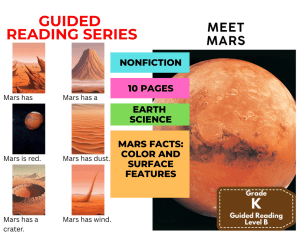
Guided Reading Level B: Meet Mars
ELA, Resources for Teachers, Reading Comprehension, Reading, Science, Language Development, Pre-Reading, Vocabulary, Earth and Environmental Sciences, Space, Kindergarten, Preschool, Grade 1, Worksheets & Printables, Worksheets, Teacher Tools, Centers, Activities, Literacy Readers, Quizzes, Quizzes and Tests, Assessments
This Guided Reading Book - Meet Mars (Level B) includes: Guided Reading Color Label (front cover x1) This is a quick way to match the book’s demands to what students can generally handle.. The overall goal is to use the level/color to pick books for several smaller groups. To qualify for a certain level, a student is expected to read a book from that level with about 90–94% accuracy. If a student is consistently accurate and understands, move up a level. If the student is struggling at that level, drop down and add more support. Each student will improve at completely different rates, but it is generally one of the best ways to check progress across the class. DOWNLOAD THE CATALOG TO VIEW ALL GUIDED READING BOOKS AVAILABLE (SORTED LEVELS A-Z) COMPANION VIDEO NOW AVAILABLE (EMBEDDED AFTER PREVIEW PICTURES IN PRODUCT DESCRIPTION) Pre-Reading Question (x1) Teacher asks the prompt aloud, can be while showing the cover or first page. Students share what they already know, or make educated guesses from the cover. Prompt them to use the target vocabulary. Write some of their responses on the board to look back at during the reading. Vocabulary Words (x5) Introduce the five words, best doing it one at a time. Start by saying it, while students repeat and then see if anyone knows what it means before reading further. Read through the meaning and try to briefly connect each word to a picture or gesture so it’s meaningful. Ask students to flip through the book pages and point to where they see each of the vocabulary words. While reading the book pause upon coming across one of the vocab words or read the sentence twice to make sure students understand the word has appeared. Optional: Ask students to raise hands whenever they see/hear one of the new words. Guided Reading Pages (x10) Check the book snapshot (below) for: primary topic - do you need to prep extra reading or intro materials on this? what is taught best - decide on 1-2 bullets to focus on, use the prompt or words provided here for best results. learning goals - what you are checking for students to be able to do after the session, elicit answers using prompts or words provided. key vocabulary (see section above). questions overview - so you know what is coming up and if you need to prep extra materials to assist understanding. Run the lesson You may have already looked at a few of the pages together, but you can show them some of the pictures again first to set meaning. Depending on how much time you have and how familiar your students are with guided reading class, you may want to read the book aloud first with the group first. Students whisper or partner read, while you listen in. If time, do it as a group, one student reading a page each. Use the guided page’s prompts to coach: “Check the picture / does it make sense?” “Point under the words / try the first sound” “Reread the sentence smoothly”. Try to focus more on one student per session (rotating every time), so you can work out if they are ready to move up or need to move down a level. Comprehension Questions (back cover x3) This is your way to check that students didn’t just say the words, but actually understood the text. First, let students answer by pointing to the page/picture and saying a short sentence. After any answer, follow with: “Show me where you found that in the text.” In bigger groups, have partners answer first (10–20 seconds), then call on 2–3 students to share. Differentiation tips: Emerging speakers/struggling readers: oral + pointing On-level: oral in a full sentence Higher: one written sentence or draw + label Book Snapshot Title: Meet Mars Genre: Nonfiction (simple informational) Subject: Science Primary Topic: Mars facts: color and surface features Estimated Guided Reading Level (A–Z): B What This Book Teaches Best Identifying basic facts about Mars (e.g., “Mars is red.” and “Mars is in space.”). Naming features Mars “has” (dust, rocks, a mountain, a crater, wind, ice, moons, the sun). Using repeated sentence patterns (“Mars is…” / “Mars has…”) to support early fluency. Connecting key science words to meaning through simple, concrete statements. Learning Goals Students will state one fact about Mars using evidence from the text. Students will name at least three things Mars has, as described in the book. Students will answer simple who/what/where questions using the book’s sentences. Students will use the repeated sentence frame “Mars has ___” to retell information from the text. Students will explain the meaning of selected Mars words using the context of the sentences. Key Vocabulary From the Text dust — tiny bits of dirt. mountain — a very tall hill. crater — a big round hole. moons — round objects near Mars. space — far above Earth. Discussion Prompts Pre-reading question: What do you think you will learn about Mars in this book? Comprehension questions: What color is Mars? Name one thing Mars has. Where is Mars? Printing Tips 1. Best Printing Method (Recommended) “Booklet” Printing (Best if Available) If your printer or PDF viewer supports Booklet Printing , use this. Settings to use: Print mode: Booklet Paper size: Letter or A4 (either works) Orientation: Landscape Print on both sides: Yes Flip on: Short edge Scaling: Fit to printable area Booklet subset: First test: Front sides only Then: Back sides only This will automatically: Pair pages correctly Put the cover on the outside Align everything for folding After printing, fold in half and staple along the spine . 2. If “Booklet” Printing Is NOT Available You can still print this correctly with manual duplex printing . Step-by-step: Open the PDF. Choose Print . Set: Orientation: Landscape Pages per sheet: 1 Print on both sides: Yes Flip on: Short edge Print all pages . Because each PDF page already contains two facing book pages, the result will still fold cleanly into a book. Thousands of Cored Education products are included with your TeachSimple membership. Download links and encyclopedia index available here.
Author Cored Education
Rating
Tags Vocabulary, Reading Comprehension, Reading Passages, Leveled Reading, Nonfiction, Reading, Guided Reading, Earth Science, Space, Mars

Sensory Words (CCSS RL.1.4): Supplemental Worksheets for the Common Core
ELA, Reading, Common Core, Grade 1, Worksheets, Worksheets & Printables
The Sensory Words (CCSS RL.1.4) is an invaluable teaching resource. Composed of supplementary worksheets, it aligns with the Common Core curriculum. This teaching aid is devised for educators, including public school teachers and homeschoolers. The aim is to provide exit resources to boost their first-grade Language Arts classes, particularly focusing on reading comprehension. List of key features: Designed in synchronization with standard CCSS RL.1.4: Sensory Words. The packet comprises nine meticulous activities to reinforce learners' comprehension and usage of sensory words - a pivotal skill in the journey towards becoming sufficient readers. This education tool offers ready-to-use materials which can be conveniently downloaded and printed for your students. This educational packet provides flexibility to the educators allowing them organise group activity during class or assign independent work during individual study periods or encourage small group discussions; even as assignments that escalate learning outside classroom hours. Add-ons: The e-resource conveniently includes an answer key at its end enabling easy assessment. The digital file format makes it easily accessible on Adobe Reader software (which you can install via provided link). Bonus Feature: We are pleased to add a unique product code tied back onto Teach Simple's extensive library of educational resources for extended benefits and future lesson plans. In sum, is not just another instant addition to your collection but a stepping stone towards continuous professional growth as we jointly nurture bright minds shaping our future.
Author Classroom Complete Press
Tags Sensory Words, Five Senses, Poetry, Reading Strategies, Supplemental Worksheets
Sight Words Coloring pages (6) Worksheet Activities For Morning Work
Creative Arts, Art, ELA, Language Development, Pre-Reading, Reading, Spelling, Kindergarten, Preschool, Grade 1, 2, 3, Coloring Pages, Worksheets, Worksheets & Printables
Cute Sight Words Coloring pages Worksheet Activities For Morning Work (6) / Digital Resources / Cute Sight Word Practice Coloring Pages / Mice Coloring Sheets: ⭐ Introducing our adorable Cute Sight Words Coloring Page, an ideal learning aid for children in preschool through third grade. To attract young learners, this engaging teaching resource smoothly mixes fun and key reading abilities. ⭐ Each page has a selection of crucial sight words embellished with delightful graphics, making learning to read an absolute joy. As youngsters color these amusing creatures and words, they readily grasp and remember important language. Whether it's "cat," "sun," or "tree," our Cute Sight Words Coloring Page fosters a firm foundation in literacy while promoting creativity and the development of fine motor skills. Kids will enthusiastically begin on their reading journey with this bright and engaging learning resource, transforming study time into a wonderful experience. ⭐ Get your kids enthused about reading and writing with our Cute Sight Words Coloring Page, a great resource for both educators and parents. As they color their way through language mastery, your child's reading abilities will blossom. What you Will Get: You will Get A zip File, there are a total of 10 Coloring Worksheets (10 Pages). For similar or other resources, visit my store
Author Lapiiin Art Activities
Tags Sight Words Coloring Sheets, Coloring Pages, Sight Words Practice, Sight Words Worksheets, Sight Words Flash Cards, Kindergarten, 1st Grade, Digital Resources, Morning Work

Reading Response Forms: Evaluating Gr. 1-2
ELA, Reading, Common Core, Grade 1, 2, Worksheets & Printables, Worksheets
Reading Response Forms: Evaluating Gr. 1-2 Ideal for educators seeking to sharpen the reading evaluation skills of first-grade and second-grade students, Reading Response Forms: Evaluating Gr. 1-2 offers comprehensive, skill-based worksheets and engaging hands-on activities rooted in the six levels of Bloom’s Taxonomy. This resource empowers young readers, allowing them to express their thoughts about literature they have consumed or read independently. Its simplicity assures teachers of minimal struggles when incorporating it into an existing reading program or using it as independent student work. Utilizing this resource enhances learners' understanding and grasp of various aspects of reading comprehension, including; Knowledge acquisition, Comprehension building, Application facilitation, Analysis coordination synthesis guidance, Evaluation enhancement . Educator-Friendly Tools The package also comes with: A detailed guide that aids in implementing the material effectively. Inclusion of student assessment rubrics for tracking learners' progress overtime based on initiated interventions. An engaging mix word puzzles aimed at piquing students' interest while reinforcing new vocabulary knowledge. There's also a comprehension quiz appended that serves as reinforcement tool. Presentation & Accessibility Options The product has been designed with clear graphical-learning aids boosting recall functionality among learners. It is delivered in universally accessible PDF format suitable for diverse teaching environments. Integration to Common Core State Standards ensures content relevancy to real-life applications encountered by learners outside their learning environment. Reading Response Forms: An Ultimate Reading Tool Reading Response Forms: Evaluating Gr. 1-2 stands out as more than a mere teaching tool. It plays an instrumental role in nurturing comprehensive reading and comprehension skills among first grade and second-grade learners.
Author Classroom Complete Press
Tags PDF
Sight Words Coloring pages (5) Worksheet Activities For Morning Work
ELA, Creative Arts, Art, Language Development, Pre-Reading, Reading, Spelling, Kindergarten, Preschool, Grade 1, 2, 3, Coloring Pages, Worksheets, Worksheets & Printables
Cute Sight Words Coloring pages Worksheet Activities For Morning Work (5) / Digital Resources / Cute Sight Word Practice Coloring Pages / Mice Coloring Sheets: ⭐ Introducing our adorable Cute Sight Words Coloring Page, an ideal learning aid for children in preschool through third grade. To attract young learners, this engaging teaching resource smoothly mixes fun and key reading abilities. ⭐ Each page has a selection of crucial sight words embellished with delightful graphics, making learning to read an absolute joy. As youngsters color these amusing creatures and words, they readily grasp and remember important language. Whether it's "cat," "sun," or "tree," our Cute Sight Words Coloring Page fosters a firm foundation in literacy while promoting creativity and the development of fine motor skills. Kids will enthusiastically begin on their reading journey with this bright and engaging learning resource, transforming study time into a wonderful experience. ⭐ Get your kids enthused about reading and writing with our Cute Sight Words Coloring Page, a great resource for both educators and parents. As they color their way through language mastery, your child's reading abilities will blossom. What you Will Get: You will Get A zip File, there are a total of 10 Coloring Worksheets (10 Pages). For similar or other resources, visit my store
Author Lapiiin Art Activities
Tags Sight Words Coloring Sheets, Coloring Pages, Sight Words Practice, Sight Words Worksheets, Sight Words Flash Cards, Kindergarten, 1st Grade, Digital Resources, Morning Work

Phonics / Digraphs for 1st -2nd: Ending Sounds: CK, NG, SH, TH, and NK
ELA, Reading, Reading Comprehension, Grammar, Language Development, Phonics, Grade 1, 2, Teacher Tools, Lesson Plans, Activities, Worksheets & Printables, Worksheets
Reading can be made easier with these phonic helps that repeatedly encourage students to practice these Ending Digraph sounds. Learning how to read can be the most challenging activity for many students and for a teacher. A digraph in the English language are two letters put together that represents a single sound or phoneme. Understanding that the combination of letters can make one sound can be difficult to master and requires repetitive practice of reading and writing these words with these sounds. This unit focuses only on the Ending Digraph sounds. There are other phonics units that I sell that focuses on the Beginning Digraph sounds, and one that focuses on all three digraph sounds in the Beginning, Middle and End. Activities include reading comprehension and identifying the digraphs in their reading, writing their answers to questions regarding the paragraph, identifying additional ending digraph words in sentences using a word bank, matching words with pictures, spinning a paperclip activity where students will write the word with the digraph sound, and lastly a fun wordsearch with the ending digraph words. These activities are for each digraph so there is plenty of opportunities for students to practice their comprehension reading skills and phonic sounds. Students will practice the following Ending Digraph sounds: ck, ng, sh, th, and nk. Teachers can use this resource in whole group, individually with students, students can practice with each other in centers, or they can be assigned as homework. Worksheets are also differentiated for each Ending Digraph sound for all young learners which makes it perfect for all 1st - 2nd graders. A total of 33 pages full of reading and phonic activities. Along with reading and writing, there are matching, cutting, and pasting activities. Word searches and spin and make a word activity are also a part of this packet which make learning to read these phonic sounds entertaining for young learners. For a list of other phonics and grammar activities, click on the following links: CVC Word Families for Beginning Readers: Stamp it, Make it, Trace it, and Write it CVC Words | Short Vowel Phonics | Word Families for K- 2nd Grade Phonics for 1st and 2nd Grade: Help Students Learn Long A Words: AY, AI, A_E, EIGH, EY, and EA Phonics for 1st and 2nd Grade: Help Students Learn Long E Words: EE, EA, E_E, and Y Phonics for 1st and 2nd Grade: Help Students Learn Long I Words: I_E, IE, IGH, and Y Phonics for 1st and 2nd Grade: Help Students Learn Long O Words: O_E, OA, OW, OE, and OUGH Phonics for 1st and 2nd Grade: Help Students Learn Long U Words: U_E, EW, OO, UE, UI and OU Phonics / Digraphs for 1st and 2nd Grade: Beginning, Middle, and Ending Sounds Phonics / Digraphs for 1st -2nd: Ending Sounds: CK, NG, SH, TH, and NK Phonics / Digraphs for 1st and 2nd Grade: Beginning Sounds: SH, TH, WH and PH Phonics: R-Controlled Words for 1st and 2nd Grade and Early Readers
Author K-5 Treasures
Tags Ending Sounds, Phonics, Reading, Sh Words, Th Words, Ck Words, Nk Words, Digraphs, Digraph Words, First Grade Phonics

TH Phonics Worksheets - Consonant Digraphs
Special Resources, ELA, Language Development, Phonics, Reading, Spelling, Kindergarten, Preschool, Grade 1, 2, Activities, Games, Worksheets & Printables, Worksheets
This is a pack of 27 phonics worksheets for the sound TH (as in this and cloth) with a variety of exercises to help build phonemic awareness and reading fluency.. Great for Kindergarten/EYFS/Y1 and older pupils with special needs, including those with dyslexia or suspected dyslexia. SOR aligned. These worksheets also align with the most popular phonics programmes, including RWI and Letters and Sounds. What is included? 26 worksheets for the sound TH, taking pupils from hearing the sounds in words to reading and spelling them at the word and sentence level. All following my special method devised as I privately tutor children of all ages with profound special needs. Your phonics lessons are covered! Tracking, fluency triangles, spelling, reading, games, comprehension exercises....and more! 1 colour-by-code picture for added fun! Who are these worksheets for? Written for very young learners of any age who are just starting in reading Written to make sure that all children succeed. I learned early in my teaching career that if you teach the whole class as if they are dyslexic, those who are not make excellent progress, while those with any slight tendency are caught early, ensuring they avoid the horrors that come in later years from failure. Each worksheet covers a TINY necessary STEP. The worksheets are: ·are highly structured - one tiny step at a time, building on the one before, using only a limited number of words to start with and only using words that the child has already learnt to sound out, with no nasty surprises. ·Have only a little on each pageas young/special needs older pupils tire easily. What makes these worksheets special? I have a powerful three-step process which I use with my pupils, which is worked out over the course of the 23 worksheets: 1. See it!where we focus on becoming aware of the new sound in words. This involves first hearing the new sound in words and then seeing it in words (tracking). 2. Sound-it-out!Having learnt to see the new sound in words, we learn to sound out these words to read and write them. 3. Write it! Incorporated into the above two steps, we constantly write the new sound. This adds a multi-sensory dimension to our work - we see with our eyes, we say each word with our voice and mouth parts, hear it and then we move by writing. All three steps work together to help the child feel in control of his/her learning and to become a successful, confident learner. Flashcards are included of some common TH words. What is included? 1 PDF with flashcards and 26 worksheets
Author Lilibette's Resources
Rating
Tags Phonic Worksheets, Special Needs, Dyslexia, Learn To Read TH Words, Spelling TH Words, TH Words, Learning TH, Consonant Digraphs

Sight Words Dot to Dot (5) Worksheet Activity For Morning Work
ELA, Creative Arts, Art, Language Development, Pre-Reading, Grammar, Reading, Spelling, Kindergarten, Preschool, Grade 1, Dot To Dots, Worksheets, Worksheets & Printables
Sight Words Dot to Dot Worksheet Activity (5) / Sight Words Practice / Morning Work / Sight Words Connect the Dots / Digital Resources: ⭐ Introducing our adorable Cute Sight Words Dot-to-Dot activity book, which has been particularly developed to fascinate young learners from preschool to third grade. This engaging workbook, jam-packed with educational pleasure, turns learning basic sight words into a thrilling journey. ⭐ Each page has endearing and loving pictures that urge youngsters to join the dots and uncover a hidden sight word. These Sight Words Dot to Dot Worksheets, which has over 50 puzzles, not only improves vocabulary but also fine motor skills and hand-eye coordination. ⭐ Our Cute Sight Words Dot-to-Dot book is an excellent tool for educators and parents alike, and is suitable for both home and classroom usage. Make learning fun with this charming activity book, where connecting each dot puts kids one step closer to reading achievement. Watch as your child's reading confidence grows while having fun! What you Will Get with this Sight Words Dot to Dot Worksheet: You will Get A zip File, there are a total of 10 Coloring Worksheets (10 Pages). For similar or other resources, visit my store.
Author Lapiiin Art Activities
Tags Sight Words, Sight Words Practice, Sight Words Worksheet, Sight Words Flash Cards, Digital Resources, Kindergarten, Morning Work, 1st Grades

Zoo Animal Research Writing Project on TIGERS for K-2nd Grade
Life Studies, ELA, Writing, Creative Writing, Reading, Science, Life Sciences, Animals, Research, Kindergarten, Grade 1, 2, Teacher Tools, Worksheets & Printables, Lesson Plans, Worksheets, Writing Prompts, Coloring Pages
This Animal Research Project on Tigers is for Kindergarten, 1st Grade and 2nd Grade. This 19-page informational writing resource guide will enhance student's learning about these amazing zoo animals: Tigers! Differentiated materials make it perfect for various ability levels. Students will read tiger facts, color tiger pictures, examine photos, draw a habitat, organize information, and write using scaffolded writing pages. Higher-level students can write paragraphs while struggling writers use sentence frames. When complete, pages can be compiled into a printed book. This engaging project promotes creativity, reading, writing, and science skills. Pair with other animal units or use independently to motivate young learners. Check out companion resources on hippos, elephants, monkeys, pandas, giraffes, dolphins, octopus, orcas, seals, shellfish, sea turtles, and whales. For more Zoo Animal reports, click on the following links below: Animal Research Writing Project on TIGERS for K-2nd Grade Animal Research Writing Project on MONKEYS for K-2nd Grade Animal Research Writing Project on PANDAS for K-2nd Grade Animal Research Writing Project on HIPPOS for K-2nd Grade Animal Research Writing Project on ELEPHANTS for K-2nd Grade Animal Research Writing Project on GIRAFFES for K-2nd Grade Want to teach your students all about Ocean Animals? Check out all these interesting facts about these favorite Ocean animals. With the same great photos, facts, habitat drawings, and more. It is a great way to help students to get interested in writing. Here are even more informational resources on report writing for OCEAN ANIMALS. Click on the links below: Animal Research Writing Project on WHALES for K-2nd Grade Animal Research Writing Project on the OCTOPUS for K-2nd Grade Animal Research Writing Project on SEA TURTLES for K-2nd Grade Animal Research Writing Project on ORCAS for K-2nd Grade Animal Research Writing Project on the SHELLFISH for K-2nd Grade Animal Research Writing Project on DOLPHINS for K-2nd Grade Animal Research Writing Project on SEALS for K-2nd Grade
Author K-5 Treasures
Tags Animal Research, Informational Writing, Writing Report, Zoo Animals, Report On Animals, Report On Zoo Animals, 1st Grade Writing, 2nd Grade Writing, Tigers, Report On Tigers

Guided Reading Level M - Hidden World of Viruses (with Lesson Plan)
ELA, Resources for Teachers, Reading Comprehension, Reading, Science, Life Sciences, Health, P.E. & Health, Pre-Reading, Language Development, Grade 1, 2, 3, Worksheets & Printables, Worksheets, Teacher Tools, Centers, Activities, Literacy Readers, Quizzes, Quizzes and Tests, Assessments
This Guided Reading Book - The Hidden World of Viruses (Level M) with lesson plan includes: Guided Reading Color Label (front cover x1) This is a quick way to match the book’s demands to what students can generally handle.. The overall goal is to use the level/color to pick books for several smaller groups. To qualify for a certain level, a student is expected to read a book from that level with about 90–94% accuracy. If a student is consistently accurate and understands, move up a level. If the student is struggling at that level, drop down and add more support. Each student will improve at completely different rates, but it is generally one of the best ways to check progress across the class. DOWNLOAD THE CATALOG TO VIEW ALL GUIDED READING BOOKS AVAILABLE (SORTED LEVELS A-Z) Pre-Reading Question (x1) Teacher asks the prompt aloud, can be while showing the cover or first page. Students share what they already know, or make educated guesses from the cover. Prompt them to use the target vocabulary. Write some of their responses on the board to look back at during the reading. Vocabulary Words (x5) Introduce the five words, best doing it one at a time. Start by saying it, while students repeat and then see if anyone knows what it means before reading further. Read through the meaning and try to briefly connect each word to a picture or gesture so it’s meaningful. Ask students to flip through the book pages and point to where they see each of the vocabulary words. While reading the book pause upon coming across one of the vocab words or read the sentence twice to make sure students understand the word has appeared. Optional: Ask students to raise hands whenever they see/hear one of the new words. Guided Reading Pages (x10) Check the book snapshot (below) for: primary topic - do you need to prep extra reading or intro materials on this? what is taught best - decide on 1-2 bullets to focus on, use the prompt or words provided here for best results. learning goals - what you are checking for students to be able to do after the session, elicit answers using prompts or words provided. key vocabulary (see section above). questions overview - so you know what is coming up and if you need to prep extra materials to assist understanding. Run the lesson You may have already looked at a few of the pages together, but you can show them some of the pictures again first to set meaning. Depending on how much time you have and how familiar your students are with guided reading class, you may want to read the book aloud first with the group first. Students whisper or partner read, while you listen in. If time, do it as a group, one student reading a page each. Use the guided page’s prompts to coach: “Check the picture / does it make sense?” “Point under the words / try the first sound” “Reread the sentence smoothly”. Try to focus more on one student per session (rotating every time), so you can work out if they are ready to move up or need to move down a level. Comprehension Questions (back cover x3) This is your way to check that students didn’t just say the words, but actually understood the text. First, let students answer by pointing to the page/picture and saying a short sentence. After any answer, follow with: “Show me where you found that in the text.” In bigger groups, have partners answer first (10–20 seconds), then call on 2–3 students to share. Differentiation tips: Emerging speakers/struggling readers: oral + pointing On-level: oral in a full sentence Higher: one written sentence or draw + label Book Snapshot Title: The Hidden World of Viruses Genre: Nonfiction (informational science text) Subject: Life Science Primary Topic: What viruses are and how they spread Estimated Guided Reading Level (A–Z): M What This Book Teaches Best Viruses are extremely tiny and require powerful microscopes to study. Viruses come in different shapes (round, rod-like, and multi-sided). A virus is not considered fully living and must find a living cell to begin its work. Viruses carry genetic material (DNA or RNA) that provides instructions for how the virus functions. How viruses infect cells, make copies, leave the cell, and how antibodies and vaccines help protect the body. Learning Goals Students will explain why scientists use microscopes to study viruses. Students will describe at least two shapes viruses can have, based on the text. Students will explain why a virus needs a host cell and what happens when it attaches to one. Students will describe how a cell becomes a “biological factory” that produces new viruses. Students will describe how new viruses leave a cell and spread into the surrounding environment. Students will explain how antibodies and vaccines help the body recognize and stop viruses. Key Vocabulary From the Text microscopic — so tiny you need a microscope to see it. particles — very small bits or pieces of something. genetic — related to information inside living things. antibodies — proteins the body makes to help stop viruses. vaccines — help train the body to recognize and stop invaders. Discussion Prompts Pre-reading question: Why might something too small to see still matter a lot to people? Comprehension questions: What does the book say viruses do that makes microscopes necessary for scientists? Comprehension questions: After a virus pushes its genetic material into a cell, what does the message tell the cell to do? Comprehension questions: How do antibodies help keep viruses from entering any more cells? Printing Tips 1. Best Printing Method (Recommended) “Booklet” Printing (Best if Available) If your printer or PDF viewer supports Booklet Printing , use this. Settings to use: Print mode: Booklet Paper size: Letter or A4 (either works) Orientation: Landscape Print on both sides: Yes Flip on: Short edge Scaling: Fit to printable area Booklet subset: First test: Front sides only Then: Back sides only This will automatically: Pair pages correctly Put the cover on the outside Align everything for folding After printing, fold in half and staple along the spine . 2. If “Booklet” Printing Is NOT Available You can still print this correctly with manual duplex printing . Step-by-step: Open the PDF. Choose Print . Set: Orientation: Landscape Pages per sheet: 1 Print on both sides: Yes Flip on: Short edge Print all pages . Because each PDF page already contains two facing book pages, the result will still fold cleanly into a book. Thousands of Cored Education products are included with your TeachSimple membership. Download links and encyclopedia index available here.
Author Cored Education
Rating
Tags Reading Comprehension, Reading Passages, Reading, Guided Reading, Guided Reading Lesson Plan, Guided Reading Activity, Pre-reading, Vocabulary, Science Lesson Plans, Life Science
First Grade Sight Words - 100 Words to Practice and Learn
ELA, Language Development, Pre-Reading, Reading, Spelling, Vocabulary, Grade 1, 2, Worksheets & Printables, Worksheets, Lesson Plans, Teacher Tools
This list includes 10 take home sight word sheets for a total of 100 First Grade words. 100 FIRST GRADE FRY Sight Words! 10 PAGES INCLUDED! For children to learn how to read, sight words are important for kids to master. Practicing and reading sight words account for seventy five percent of words that children read. The Fry Sight words are words that are most often used and begins with the first one hundred words for Kindergarten.Using these words often to practice reading is essential to their skills and to improve in their reading comprehension. These words are often not easy to sound out like most CVC words, so recognizing them and memorizing these words is the most helpful to enhance a child's reading skills. You can find the first 100 words here which include some of the following words as an example: over knew take only little me work back give most very after things our man good think help where great say This list includes the second one hundred words for First Grade. There are different sight words for each grade level and the words build on each other. Students will recognize the previous words and continue to add more words to their memory as they practice them over and over. This list is mainly used for first and second grade students. It is intended to be used not only in the classroom, but to be used at home for practice with an adult. Then, it can be signed by a parent or guardian of the child and passed off at school. A total of 13 pages for students to practice and pass off once the students have mastered each word. Have parents sign the page once students are ready to pass them off with their teacher.
Author K-5 Treasures
Tags Sight Words, List Of Words, Reading, 1st Grade Reading, First Grade Sight Words, First Grade Reading, 1st Grade Sight Words, FRY Sight Words, 2nd Grade Sight Words, Second Grade Sight Words

Ocean Animal Research Writing Project on WHALES for K-2nd Grade
Life Studies, ELA, Writing, Creative Writing, Reading, Science, Life Sciences, Animals, Research, Kindergarten, Grade 1, 2, Teacher Tools, Worksheets & Printables, Lesson Plans, Worksheets, Writing Prompts, Coloring Pages
Whales Animal Research Writing Project for K-2nd Grade. This 19-page informational writing unit on whales is perfect for kindergarten, 1st grade, and 2nd grade students. It includes differentiated reading passages, data collection organizers, and writing pages about whales so all students can successfully complete the project. Students will read illustrated information about whale appearances, habitats, eating habits, and more. Then they will organize the facts using color-coding and graphic organizers. Finally, students will draw, color, and write their own informative paragraphs about these amazing ocean mammals. The whale unit can be used for whole-class, small-group, or individual assignments. It promotes reading comprehension, creative writing, and drawing skills. Display the finished whale books in your classroom or compile them into a classroom book for all to view. For more animal research projects, see our units on dolphins, seals, sea turtles, and other ocean creatures. Visit my store: -K-5 Treasures to discover more engaging resources for K-2 students. Here are even more informational resources on report writing for OCEAN ANIMALS. Click on the links below: Animal Research Writing Project on WHALES for K-2nd Grade Animal Research Writing Project on the OCTOPUS for K-2nd Grade Animal Research Writing Project on SEA TURTLES for K-2nd Grade Animal Research Writing Project on ORCAS for K-2nd Grade Animal Research Writing Project on the SHELLFISH for K-2nd Grade Animal Research Writing Project on DOLPHINS for K-2nd Grade Animal Research Writing Project on SEALS for K-2nd Grade Want to teach your students all about Zoo Animals? Check out all these interesting facts about these favorite zoo animals. With the same great photos, facts, habitat drawings, and more. It is a great way to help students to get interested in writing. For Zoo Animal reports, click on the following links below: Animal Research Writing Project on TIGERS for K-2nd Grade Animal Research Writing Project on MONKEYS for K-2nd Grade Animal Research Writing Project on PANDAS for K-2nd Grade Animal Research Writing Project on HIPPOS for K-2nd Grade Animal Research Writing Project on ELEPHANTS for K-2nd Grade Animal Research Writing Project on GIRAFFES for K-2nd Grade
Author K-5 Treasures
Tags Informational Writing, Writing Report, 1st Grade Writing, 2nd Grade Writing, Ocean Animals, Ocean Animal Research, Whales, Report On Whales, Learn About Whales, Ocean Animal Report