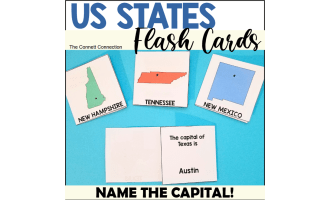
Quiz-Quiz-Trade Game: 50 US State Capitals




About This Product
This sheltered instruction strategy is great for both ELLs and native English speakers. Sometimes people also refer to these types of strategies as siop strategies.
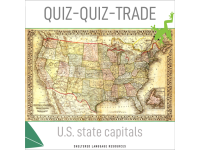
This sheltered instructional activity will have students up and moving around while they quiz each other on the 50 U.S. capitals for each state.
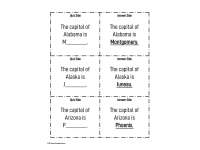
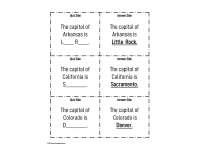
Sheltered language strategies are teaching strategies that focus on teaching academic vocabulary at the same time as academic content. These types of strategies have been researched and shown to improve student learning, especially for ELLs. This Quiz-Quiz-Trade (QQT) game combines both academic vocabulary building and student interaction. It is different from many other Quiz-Quiz-Trade games because it provides sentence starters and asks students to read the complete sentence and fill in the answer as an embedded part of the activity. Because of this, students are explicitly required to interact with both academic language and content at the same time.
This resource contains
•51 ready to use QQT cards with no background (3 cards per page, 17 pages)
How to play Quiz-Quiz-Trade
1.Cut out the playing cards, making sure that one horizontal pair (Quiz Side/Answer Side) is cut as one card.
2.Fold each card in half down the middle, following the dashed line.
3.Give each student one card.
4.Students should hold the card with the Answer Side facing them and the Quiz side facing their partner.
5.Person 1 starts and reads the sentence frame from the Quiz Side of their partner’s card, verbally saying the complete sentence, filling in the blanks. Person 2 checks the answer from the Answer Side of their card, affirming correct answers, or coaching if needed.
6.With the same partner, reverse roles.
7.Trade cards, find a new partner and repeat, switching partners until the teacher stops the game.
Teacher tips
•Play along side your students. Have fun!
•Enforce the use of the sentence frames, that is one of the most important parts!
•Model the game before students play for the first time, focusing on…
•Kind and friendly interactions
•Giving friendly feedback such as “nice work!” or “exactly right!”
•Giving coaching feedback such as “try reading it again and double check your answer”.
•Keeping an appropriate distance from your partner.
•Not too close; no need to hold the card 1 inch from their face.
•Not too far away; they need to be able to see the card.
What's Included
1 PDF file.
Resource Tags
0 Reviews
Check out these other great products