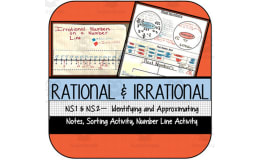
Rational & Irrational Numbers MAZE Activities & Test Practice


- Grades
- Grade 8, Middle School
- Pages
- 7
- File type
- Answer key
- Included


- Subject
- Math
- Topic
- Rational numbers, Irrational numbers
- Resource types
- Worksheets, Worksheets & Printables, Mazes
- Answer key
- Included
Product description
From the author
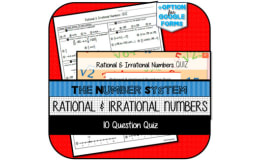
Practice approximating and comparing rational and irrational numbers with two mazes and a ten-question multiple-choice page. The seven-page PDF includes a teacher letter and keys for all three activities.
The resource supports parts of 8.NS.A.1 and 8.NS.A.2, including classification, approximation, comparison and number-line placement. It does not teach converting repeating decimal expansions into fractions. The teacher recommends no calculator for the approximation maze and a calculator for the comparison maze.
Related resources
More resources teachers may find useful
24 related resources were found using this product's title, contributor, categories and tags.
In the classroom
Teaching tips & learning objectives

Learning objectives
Approximate irrational values such as √2, √50, ∛28 and π³ closely enough to choose the nearest decimal from the supplied choices
Distinguish rational from irrational numbers, including cube roots of perfect cubes, square roots of perfect squares and non-terminating decimals
Locate irrational values on a number line, including √50, π + 2, ∛30 and π/2

Teaching tips
Follow the teacher letter’s calculator distinction: avoid a calculator for approximation practice and use one for the comparison maze
Have students highlight the route and attend to equality versus inequality signs
Use the ten-question page after selected practice, then consult the supplied keys

Skills covered
Approximating irrational numbers - students judge whether √2 is nearer 1.4 or 1.5, √50 nearer 7.0 or 7.1, and π³ nearer 31.0 or 31.1, working the first maze without a calculator.
Comparing rational with irrational values - the second maze asks which of √9, 10, ∛343, √50, 6.28 or 2π satisfies each printed statement, putting surds, cube roots, multiples of pi and decimals side by side.
Classifying numbers - test-practice items 1, 2, 3 and 8 ask which value is irrational, which is rational, which has the greatest value, and which set contains all rational numbers.
Good to know
Questions teachers ask about this resource
How does calculator use differ between the two mazes?
Page 1 sets it out per maze. The approximating maze is designed to be done without one - the letter calls it great practice for the no-calculator section of a state test - while the comparing maze is meant to be worked with one, for practice with the exponent, radical and pi functions.
Which parts of the Grade 8 Number System standards does the resource work on?
Page 1 names 8.NS.A.1 and 8.NS.A.2 in full and marks one clause of the first as outside its scope: converting a repeating decimal expansion into a rational number. The two mazes and ten questions provide practice in several components - identifying irrational numbers, approximating them, comparing their sizes and locating them on a number line.

No reviews yet
Downloaded this resource? Tell other teachers how it went.
Curriculum
Standards, concepts & topics
Standards
 Standards
- 8.NS.A.1
- 8.NS.A.2
Core concepts
 Core concepts
Rational numbers
Irrational numbers
Square and cube roots
Approximation
Number line
 Topics
Explore more
Categories this resource belongs to
Explore related searches
More to explore
You may also like