Solving Logarithmic Equations Pixel Art: Solve, Check and Color
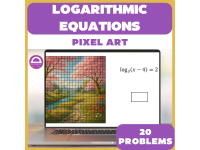
Algebra 2 and precalculus students solve 20 logarithmic equations with log rules and exponential form, check every root against the domain, and use the answers to color a pixel-art picture.




- Grades
- Grades 9–12, High School
- Pages
- 4
- File type
- Answer key
- Included


- Subject
- Math, Algebra
- Topic
- Matemaths, printable
- Resource types
- Worksheets & Printables, Activities, Task Cards, Games
- Answer key
- Included
- Standards
- HSF-BF.B.5
About this resource
What's inside this resource
Twenty logarithmic equations, each answer checked in the original before it counts, color a 12 by 12 grid until a hidden picture appears. Page 1 gives three moves: rewrite a single log in exponential form, combine two logs with the same base using the product, quotient or power rule, and set the insides equal when log equals log. A worked example, log₃(x + 2) + log₃ x = 1, shows the check that rejects x = −3, and the directions tell students to reject any x that makes the inside of a log zero or negative.
Problems 1 to 20 cover exponential form with bases 2, 3, 4, 5, 7 and 10, the product, quotient and power rules, equal logs, natural logs and log₁₆ x = 3/4. Problems 5, 9 and 10 each produce a second root that has to be rejected, and that root is never in the color key.
The color key, the numbered grid, a name-the-picture question and two check-the-work items share page 3. The key page shows each solution with its key step and color, why each rejected root fails, the finished grid and a note on why kept roots never match a color.
Related resources
More resources teachers may find useful
24 related resources were found using this product's title, contributor, categories and tags.



In the classroom
Teaching tips & learning objectives

Learning objectives
- Rewrite a logarithmic equation in exponential form and solve it.
- Combine logarithms with the product, quotient and power rules before solving.
- Solve equations where two logarithms with the same base are equal.

Teaching tips
- Work through the page 1 example aloud, stressing the check step that throws out x = −3.
- Expect questions on problems 5, 9 and 10: each gives a second root that fails the check, and the key states why.
- Use problem 23 to discuss the most common log error, adding the insides, and problem 6 for the quotient rule.

Skills covered
- Exponential form — students rewrite equations such as log₅(2x + 3) = 2 as 2x + 3 = 5².
- Log rules — students combine sums, differences and multiples of logs before solving.
- Quadratics from logs — students factor equations such as x² − 5x − 6 = 0 that come from the product rule.
Good to know
Questions teachers ask about this resource
What happens if a student keeps a rejected root?
It will not match any answer in the color key. Problems 5, 9 and 10 each have a second root (−1, −4 and −3) that makes a log argument negative, and the key explains each rejection.
How does the picture work on paper?
Every square of the 12 x 12 grid carries a problem number from 1 to 20. Students find each answer in the color key and color every square with that problem’s number, so the picture appears only once the answers are matched.
Which log rules do students need?
The product, quotient and power rules, plus switching between log and exponential form, all summarized on page 1. Problem 11 uses natural logs, and problem 12 needs 16 raised to the 3/4 power.

No reviews yet
Downloaded this resource? Tell other teachers how it went.
Curriculum
Standards, concepts & topics
Standards
 Standards
- HSF-BF.B.5 — Understand the inverse relationship between exponents and logarithms and use this relationship to solve problems involving logarithms and exponents.
Core concepts
 Core concepts
- Logarithmic equations
- Properties of logarithms
- Exponential form
- Extraneous solutions
- Domain of a logarithm
 Topics
Explore more
Categories this resource belongs to
Explore related searches
More to explore
You may also like