Spanish Vocabulary Crossword about Easter - La Pascua
- Grades
- Grades 9–11, High School
- Pages
- 2
- File type
- Answer key
- Included


- Subject
- Foreign Languages, Spanish
- Topic
- Easter, Pascua
- Resource types
- Crosswords Puzzles, Worksheets, Worksheets & Printables
- Answer key
- Included
Product description
From the author
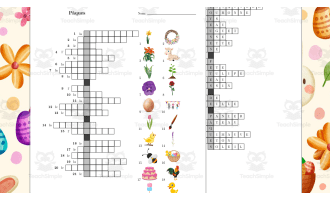
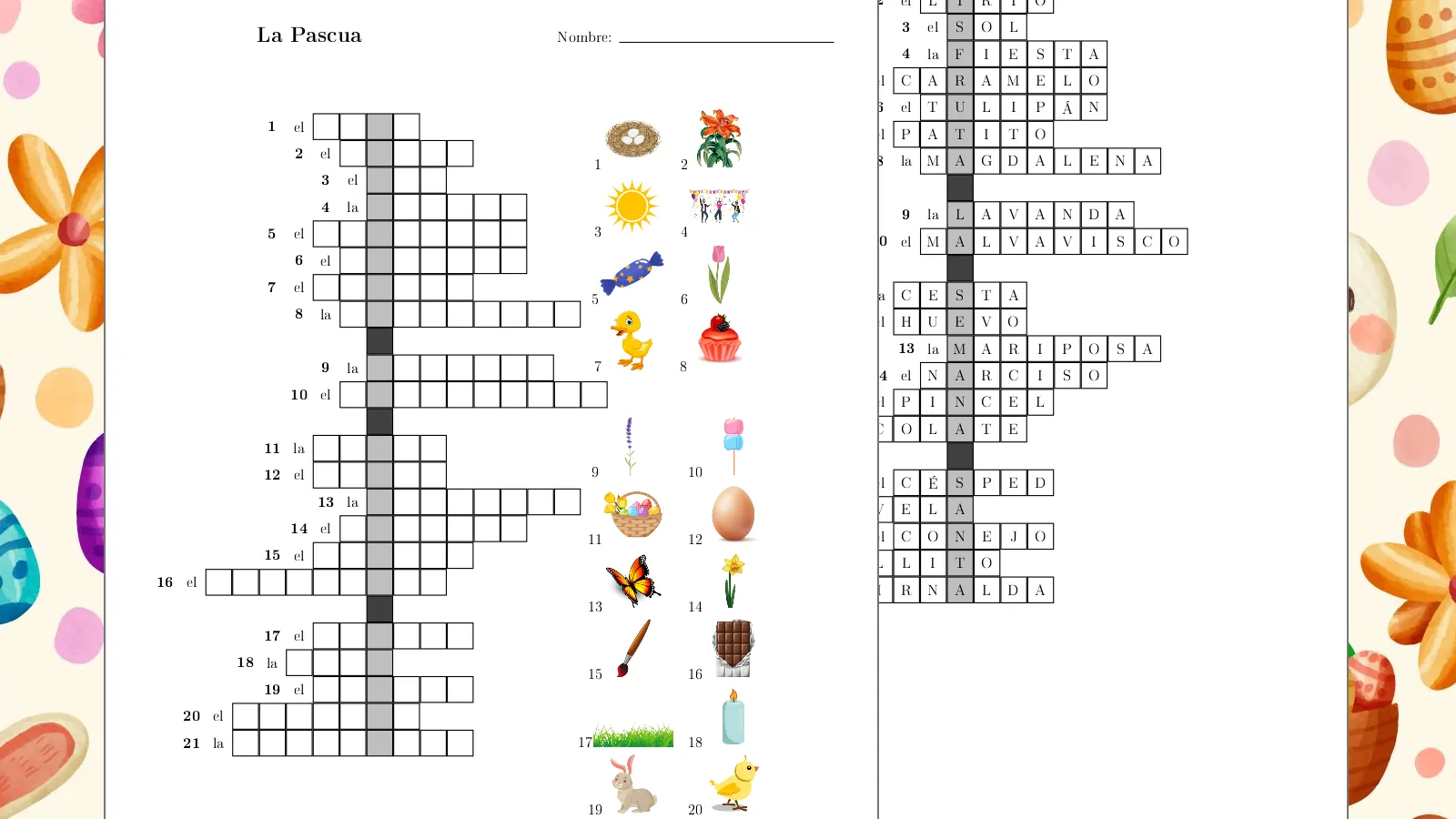
This crossword is about Easter (Pascua) vocabulary in Spanish! The words in this crossword are secular/nonreligious. Students have to recognize the things in the pictures and write their name in Spanish in order to find the hidden message.
This crossword puzzle is a print-and-go and ready-to-use pdf that includes answers.
The words in this crossword are related to Easter, spring or party in general. There are 21 vocabulary words: nido, lirio, sol, fiesta, caramelo, tulipán, patito, magdalena, lavanda, malvavisco, cesta, huevo, mariposa, narciso, pincel, chocolate, césped, vela, conejo, pollito y guirnalda.
After filling the crossword, you will find a hidden message from the grey vertical row! The hidden message in this crossword is: Disfruta la Semana Santa, a common wish for a happy Easter in Mexico.
With Spanish vocabulary, you have to consider if the word is feminine or masculine. In this crossword I’ve solved this issue by printing the definite article ready for the crossword. This makes it easier for younger students to understand the crossword (meaning exactly one letter for each square) while still introducing the gender of each word.
Filling the crossword: Students look at the pictures on the right side of the page. Each picture has a number. When they recognize the word in Spanish, they should write the word into the corresponding horizontal row in the crossword one letter at a time. Don’t forget the accents!
This resource is suitable for individual work or small groups. Students may need some vocabulary or online search to support their work.
This resource is at its best with students
-9 years and older, if Spanish is a foreign language
-For younger students, if they have a strong background in Spanish (like Spanish spoken at home etc.)
There are also other crosswords like this in my Teach Simple page: https://teachsimple.com/contributor/thebrightestkid
Answers are included.
Related resources
More resources teachers may find useful
24 related resources were found using this product's title, contributor, categories and tags.


In the classroom
Teaching tips & learning objectives

Learning objectives
Name twenty-one Easter and spring objects in Spanish from a picture alone, without an English word to translate
Spell Spanish nouns letter by letter into a fixed grid, including accented forms such as tulipán and césped
Recognise vocabulary that crosses several fields at once - flowers, baby animals, sweets and party items - within a single seasonal theme

Teaching tips
The article is printed for the solver rather than asked for, so the puzzle can be extended by covering the el and la column and having students supply the gender themselves
Use both the picture and the available spaces to identify a word. Tulipán and narciso have the same number of letters, so length alone cannot distinguish them
The word set reaches well beyond the obvious Easter nouns into malvavisco, guirnalda, césped and pincel, which makes a useful pre-teaching list before the sheet goes out

Skills covered
Spanish noun vocabulary - students produce twenty-one seasonal nouns, from el nido and el lirio to la guirnalda and el malvavisco.
Spanish spelling with accents - answers include tulipán and césped, both of which must be entered letter by letter into the grid.
Picture-to-word recall - no English or Spanish clue text appears, so each answer is retrieved from the image alone.
Good to know
Questions teachers ask about this resource
Does the puzzle deal with noun gender?
It shows it rather than testing it. Every entry has its article printed in front of the answer space - fourteen masculine (el nido, el sol, el huevo, el conejo and others) and seven feminine (la fiesta, la magdalena, la lavanda, la cesta, la mariposa, la vela, la guirnalda).
What kind of Easter vocabulary does it use?
Spring and celebration objects rather than religious terms. The list runs to nests, lilies, tulips, daffodils, lavender, butterflies, rabbits, ducklings, chicks and grass on one side, and sweets, cupcakes, marshmallows, chocolate, eggs, baskets, candles, paintbrushes and garlands on the other.

No reviews yet
Downloaded this resource? Tell other teachers how it went.
Resource details
Concepts & topics
 Core concepts
 Topics
Explore more
Categories this resource belongs to
Explore related searches
More to explore
You may also like