Springtime Alliteration Worksheets
- Grades
- Grades 2–4, Elementary
- Pages
- 9
- File type
- Answer key
- Included


- Subject
- ELA, Creative Arts, Grammar, Language Development, Art
- Topic
- Alliteration, ELA
- Resource types
- Activities
- Answer key
- Included
- Standards
- L.2.1
Product description
From the author
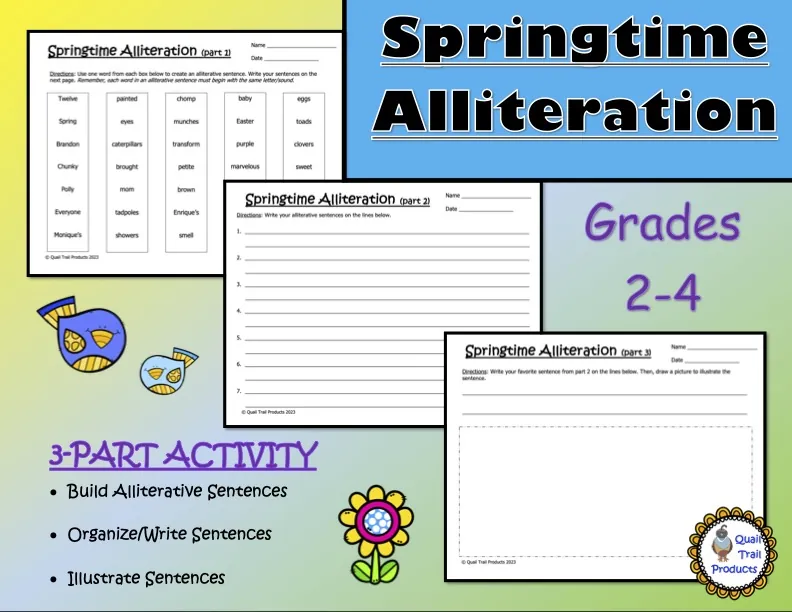
Elementary school-age learners have a great time practicing alliteration skills and these worksheets will have them buzzing with the excitement of Spring. This 3-part ELA activity is sure to engage your grade 2, grade 3, or grade 4 learners. These activities could span over a 3-day period and be easily integrated into your English/Language Arts curriculum. The best part is that all 3 worksheets are print and go. As your learners work their way through each worksheets, they will practice both grammar and writing skills involved in arranging sentences and using repeated beginning sounds. Use this activity in whole group instruction, small group settings, or as individual assignments. The final writing piece can also be used to display Springtime writing and art in your educational environment. Along with the worksheets, an answer key is also provided.
When you purchase this product, you will receive:
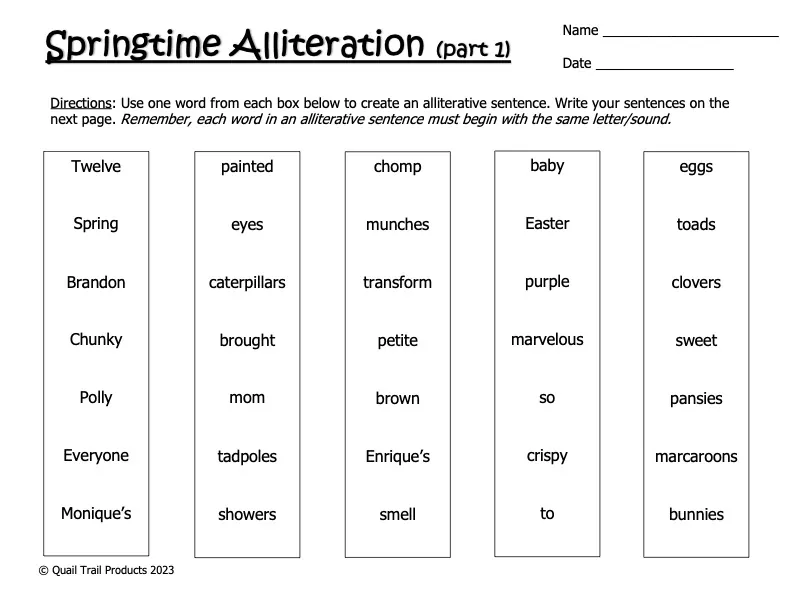
WORKSHEET 1: learners will draw lines between the provided words to create alliterative sentences with a Springtime theme.
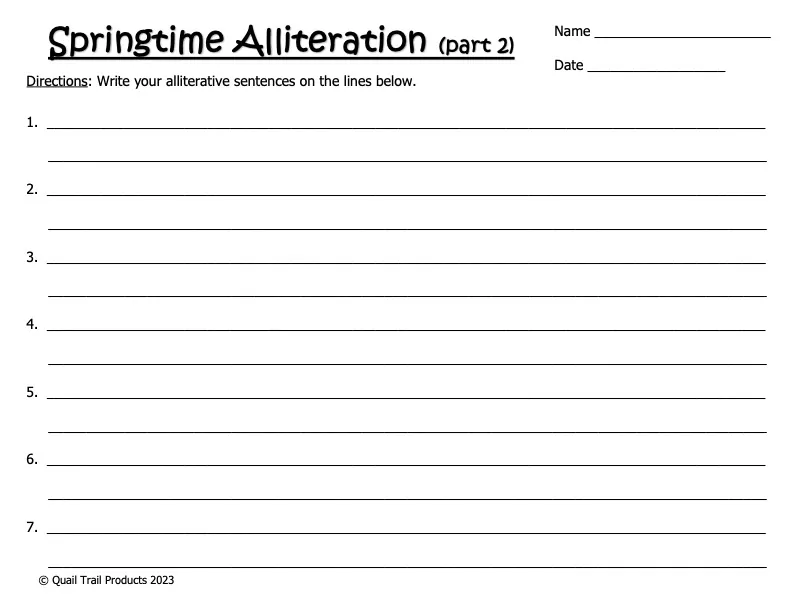
WORKSHEET 2: learners will write the alliterative sentences from worksheet 1 in the space provided. A total of 7 sentences will be written.
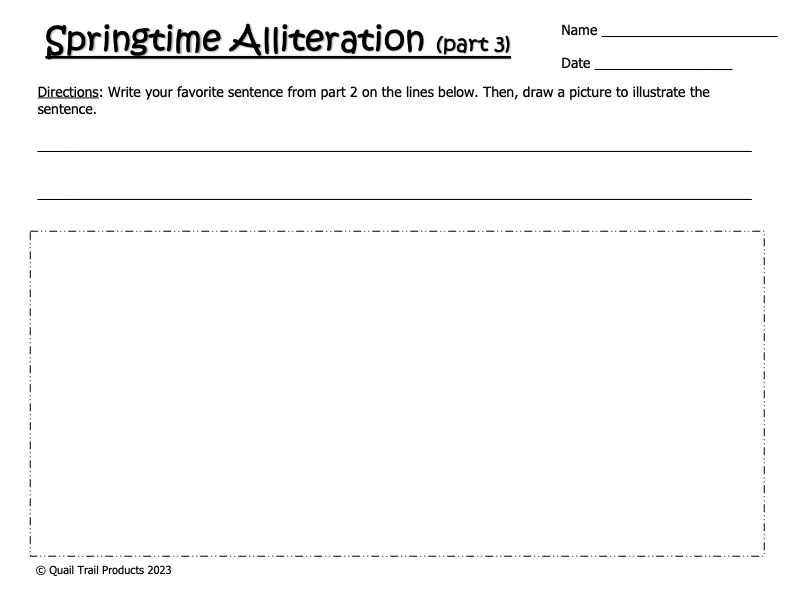
WORKSHEET 3: learners will choose their favorite alliterative sentence from worksheet 2, write it on the lines provided, and illustrate the sentence in the space provided.
Answer key
If you like this product, please also check out two additional alliteration products in my store, Quail Trail Products. "Autumn Alliteration Worksheets" and "Fun with Alliteration" are now available.
Related resources
More resources teachers may find useful
24 related resources were found using this product's title, contributor, categories and tags.

In the classroom
Teaching tips & learning objectives

Learning objectives
Build sentences in which every word begins with the same letter or sound.
Select and combine words from a word bank into grammatical, meaningful sentences.
Illustrate a self-written sentence to show its meaning.

Teaching tips
Read a few word boxes aloud first and have students listen for matching beginning sounds before they start combining words.
Model choosing one word from each column and arranging the choices into a meaningful sentence.
Display the Part 3 illustrated sentences as a spring bulletin board.

Skills covered
Alliteration — students construct seven sentences whose words share a beginning letter/sound, such as 'Spring showers smell so sweet.'
Sentence construction — students order a name, verb, adjectives, and noun from the word boxes into a complete sentence.
Responding through drawing — students illustrate their favorite sentence to show comprehension.
Good to know
Questions teachers ask about this resource
How do students build the sentences?
They use one word from each of the five columns to create an alliterative sentence, then record their seven sentences on the writing page.
What happens after the sentences are written?
Students pick their favorite of the seven, copy it onto the Part 3 page, and draw a picture illustrating it.

No reviews yet
Downloaded this resource? Tell other teachers how it went.
Curriculum
Standards, concepts & topics
Standards
 Standards
- L.2.1
Core concepts
 Core concepts
Alliteration
Sentence building
Beginning sounds
Spring theme
 Topics
Explore more
Categories this resource belongs to
Explore related searches
More to explore
You may also like