Square & Cube Roots Notes, Practice, Quick Drill, Flash Cards


- Grades
- Grade 8, Middle School
- File type
- Preparation
- Print ready


- Subject
- Math, Numbers
- Topic
- square roots, cube roots
- Resource types
- Flashcards, Worksheets & Printables
- Preparation
- Print ready
About this resource
What's inside this resource
This resource was developed to meet the requirements of the 8th Grade Expressions & Equations Standard below:
Use square root and cube root symbols to represent solutions to equations of the form x2 = p and x3 = p, where p is a positive rational number. Evaluate square roots of small perfect squares and cube roots of small perfect cubes. Know that √2 is irrational.
Related resources
More resources teachers may find useful
24 related resources were found using this product's title, contributor, categories and tags.


In the classroom
Teaching tips & learning objectives

Learning objectives
Evaluate square roots of perfect squares 1 through 25 and cube roots of perfect cubes 1 through 10.
Justify a square or cube root using multiplication (for example, explain that the square root of 25 is 5 because 5 x 5 = 25).
Solve equations of the form x^2 = p and x^3 = p, recognizing when two real solutions exist versus one.

Teaching tips
Treat the grid-paper coloring activity as optional groundwork -- it is designed to build conceptual understanding before the more abstract notes pages, per the resource's own instructions.
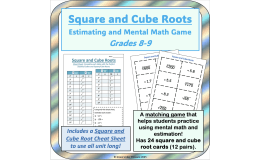
Print the flash cards on cardstock and have students write each answer on the back themselves before laminating and shuffling for partner quizzing.
Use the 21-slide Quick Drill deck for a timed whole-class warm-up, displaying one radical expression per slide for students to evaluate.

Skills covered
Perfect square/cube evaluation -- students recall and justify square roots of 1-25 and cube roots of 1-10 using multiplication facts.
Radical equation solving -- students isolate x in equations like sqrt(x^2)=144, distinguishing positive-and-negative from single-solution cases.
Vocabulary application -- students complete fill-in definitions for radical expression, perfect square and perfect cube in the guided notes.
Good to know
Questions teachers ask about this resource
Why does solving x^3 = p typically produce only one real solution, while x^2 = p produces two?
The notes walk through this directly: squaring a negative number still gives a positive result, so both roots work, but cubing a negative number stays negative, so only one real cube root satisfies the equation -- shown with x = 3 as the sole solution for x^3 = 27.
What is the optional coloring activity meant to build toward?
Students construct grid squares from 1x1 up to 12x12, label each side and area, then draw a square-root symbol around each one to see concretely that the square root of an area equals its side length, before moving into the more abstract notes pages.

No reviews yet
Downloaded this resource? Tell other teachers how it went.
Resource details
Concepts & topics
Core concepts
 Core concepts
Square roots
Cube roots
Perfect squares and perfect cubes
Radical equations
 Topics
Explore more
Categories this resource belongs to
Explore related searches
More to explore
You may also like