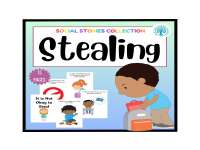
Stealing Social Story


- Grades
- Not Grade Specific
- Pages
- 15
- File type
- Preparation
- Print ready


- Subject
- Special Education Needs (SEN), Social Skills
- Topic
- Stealing, Property boundaries
- Preparation
- Print ready
Product description
From the author
Social story to support children who have been stealing from others to help them understand that it is inappropriate, it encourages them to ask others if they can borrow things that they like the look of but helps them understand that it must be returned and that they cannot just take things without asking first.
The point of a social story is to use a patient and reassuring tone to teach children about social situations in a way that can be easily understood. Social stories can be useful for any child who is struggling to understand a situation or concept or needs help to understand a social skill or social cue, expectations, perspectives, common responses or is troubled about an upcoming event but social stories are particularly useful for children on the autistic spectrum for whom social cues can be challenging and who often suffer anxiety if they do not know what to expect from a situation.
These books should be used over and over to reinforce the point so I would suggest either putting the pages into a display book or laminating and binding them.
Included is a 15 page PDF social story
Clipart images courtesy of Kari Bolt Clip Art
Related resources
More resources teachers may find useful
24 related resources were found using this product's title, contributor, categories and tags.


In the classroom
Teaching tips & learning objectives

Learning objectives
Recognize that taking something that does not belong to you is called stealing.
Identify borrowing (asking first, returning after use) as an alternative to taking something without permission.
Understand that items in a shop must be paid for rather than taken.

Teaching tips
Read the story repeatedly over time rather than once, in keeping with the social-story format's design for reinforcement — consider laminating or binding the pages for repeated use.
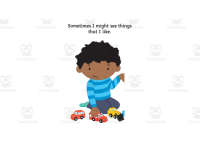
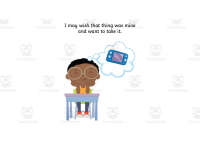
Use the story's own three-part structure (wanting something / stealing vs. borrowing / the shopping context) as natural pause points for discussion.
Pair with a real or role-played borrowing scenario so the child can practice the story's suggested alternative (asking, then returning the item).

Skills covered
Recognizing the concept and consequences of stealing.
Distinguishing between stealing and borrowing with permission.
Applying the same concept specifically to a shopping/store context.
Good to know
Questions teachers ask about this resource
What can students practice after reading?
Role-play asking to borrow a classroom object, waiting for permission and returning it when finished. Discuss what to do if the owner says no.

No reviews yet
Downloaded this resource? Tell other teachers how it went.
Resource details
Concepts & topics
Core concepts
 Core concepts
Social story
Stealing vs. borrowing
Social-emotional learning
 Topics
Explore related searches
More to explore