search
user.png
vertical menu

Two-Way Frequency Table Notes and Practice with Relative Frequencies

Two-Way Frequency Table Notes and Practice with Relative Frequencies preview

Look Inside · 8 pages · answer key included

Teacher introduction listing the two-way table lessons, relative frequency practice, test practice, and keys
Teacher introduction and packet contents
Introductory notes on two-way tables with a chores and curfew class poll and a math preference and band example
First page of introductory notes and practice
Two-way table practice interpreting fruit and vegetable preferences, pizza orders, reading, and school lunches
Introduction continued: trends and practice problems
Relative frequency notes using lunch choices and food restrictions to calculate decimals and percentages
Relative frequency notes and worked-example prompts
Relative frequency practice on video games and reading, audiobooks, coffee and tea, and commuting podcasts
Five relative frequency practice problems
Test practice questions 1–6 on two-way tables, survey trends, and percentages using driving and preference data
Test practice, questions 1–6 of 10
Test practice questions 7–10 on pizza order relative frequencies and fiction versus nonfiction reading surveys
Test practice, questions 7–10 of 10

Answer key included

Answer key included
Attributes
Grades

Grade 8

Types

Activities

File

PDF

Editable
No
Rating
Add To Collection
Add to collection Add to collection

About This Product

This resource was developed to meet the requirements of the 8th Grade Statistics & Probability standards below:

CCSS.MATH.CONTENT.8.SP.A.4
Understand that patterns of association can also be seen in bivariate categorical data by displaying frequencies and relative frequencies in a two-way table. Construct and interpret a two-way table summarizing data on two categorical variables collected from the same subjects. Use relative frequencies calculated for rows or columns to describe possible association between the two variables. For example, collect data from students in your class on whether or not they have a curfew on school nights and whether or not they have assigned chores at home. Is there evidence that those who have a curfew also tend to have chores?

What's Included

It contains the following resources:

1) Introduction to Two-Way Tables NOTES & PRACTICE

· What is a Two-Way Table?

· Constructing a Two-Way Table

· Understanding Trends in a Two-Way Table

2) Two-Way Tables & Relative Frequencies NOTES & PRACTICE

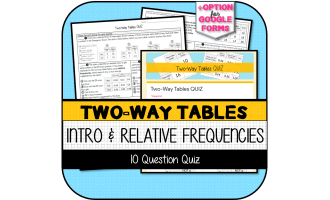
3) Two-Way Tables TEST PRACTICE

4) Answer Keys to All Parts

0 Reviews

Explore related searches
you may also like...

Check out these other great products