Area of Triangles, Parallelograms & Trapezoids: lower secondary Geometry




- Year groups
- Years 7–9 (Key Stage 3)
- Pages
- 5
- File type
- Preparation
- Print ready


- Subject
- Measurements, Geometry, Maths
- Topic
- Jigsaw, Hands-On Maths
- Resource types
- Teacher Tools
- Preparation
- Print ready
From the author
About this resource
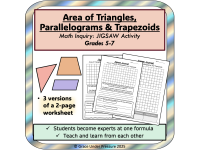
Using the JIGSAW grouping strategy, your students can master the geometric formulas for the area of triangles, parallelograms, and trapezoids.
Jigsaw is a great way to encourage your students to work collaboratively and take control of their own learning. Students become experts at one skill, teach it to others, and also learn from their peers. This lesson uses the jigsaw strategy and an inquiry approach to help students understand the explanation for three area formulae.
Teacher Instructions:
Print two-page handouts (a third with each page 1, and all with the same page 2).
Split your class into three groups.
Each group is asked to master finding the area of one shape.
Students collaborate, using the grid, to prove/explain the formula.
THEN JIGSAW: Make trios with one expert from each group.
The three students teach each other about each formula.
This is a great lesson to reinforce the learning in a geometry unit, or it could be used an initial inquiry before you teach the formulas.
Grades to Use With:
This lesson is specifically designed for students in Year 7 and meets the following standard:
Common Core Standard: Year 7 Geometry: Find the area of triangles and special quadrilaterals
British Columbia, Canada: Learning Standard Year 7 Maths: Determine the Area of Triangles, Parallelograms, and Trapezoids
However, it could also work with slightly older or younger students depending on split classes or your area's learning standards.
What's Included: 5-Page PDF: Ready to Print and Use
Title Page/Teacher Instructions
3 Unique Worksheets: One for each JIGSAW Group
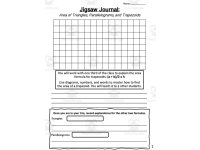
A final worksheet you give to every student
Year 7 Maths: Statistics and Probability
Nutrition Label Maths: Real-World Percentages
lower secondary Maths Stations for Place Value
Related resources
More resources teachers may find useful
More resources on the same subject and topic.


In the classroom
Teaching tips & learning objectives

Learning objectives
Students derive and explain the area formula for one shape (triangle, parallelogram, or trapezoid) using diagrams, numbers, and words.
Students teach their derived formula to two peers who each mastered a different shape, and in turn learn the other two formulas from them.
Students record and retain all three area formulas (triangle, parallelogram, trapezoid) on a shared final page.

Teaching tips
Follow the jigsaw structure exactly as instructed on page 1: split the class into three formula groups first, then regroup into trios with one expert from each group, rather than mixing the two steps.
Have students keep their expert-group worksheet (pages 2-4) on hand during the trio teaching phase, since it holds the diagrams and explanation they need to teach their formula to peers.

Skills covered
Formula derivation — each expert group uses diagrams and written explanation to prove why their shape's area formula works, rather than being given the formula directly.
Peer teaching — students explain their derived formula to two classmates and must understand it well enough to teach it clearly.
Cross-shape synthesis — the final shared page (page 5) has each student record all three formulas after learning them from peers, consolidating the full formula set.
Good to know
Questions teachers ask about this resource
How does the jigsaw grouping work?
The class splits into three groups, each mastering one shape's area formula using their own two-page handout, then regroups into trios with one expert from each group so students teach each other all three formulas.

No reviews yet
Downloaded this resource? Tell other teachers how it went.
Resource details
Concepts & topics
Core concepts
 Core concepts
Area of a triangle
Area of a parallelogram
Area of a trapezoid
 Topics
Explore more
Categories this resource belongs to
Explore related searches


More to explore