



Brain Teasers Part 3 – Hidden Meaning Puzzles




- Year groups
- Years 5–9 (Key Stages 2–3)
- File type
- Preparation
- Print ready


- Subject
- Vocabulary, Language Development, English
- Topic
- Brain Teaser, Hidden Meaning
- Resource types
- Worksheets
- Preparation
- Print ready
From the author
About this resource
Brain Teasers: Hidden Meaning Part 3 is an engaging language arts resource for lower secondary students. This third installment in the brain teasers series challenges students to decode expressions with hidden meanings. Each teaser features a square filled with letters. Students must carefully analyse the positioning of the letters to uncover popular expressions embedded within. Teachers can utilise these brain teasers during vocabulary instruction to build analysis skills. They also work well for individual practice or collaborative small group work. The brain teasers strike an enjoyable balance between education and entertainment. Students will delight in the search to reveal each concealed expression. This printable PDF packet provides an engaging way to reinforce vocabulary comprehension.
In the classroom
Teaching tips & learning objectives

Learning objectives
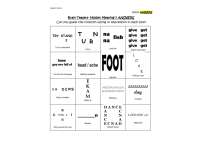
Interpret visual and textual clues — letter arrangement, spacing, and word repetition — to identify the common English idiom or saying each rebus represents.
Build familiarity with figurative-language idioms such as "splitting headache," "forgive and forget," and "two-faced" by connecting them to their visual rebus form.
Practice lateral thinking by working backward from a picture-word puzzle to the phrase it encodes.

Teaching tips
Use the three puzzle pages (Hidden Meaning 7, 8, 9) individually as warm-ups or brain-teaser breaks, since each stands alone as a self-contained page.
Have students attempt the blank puzzle page first, then reveal the matching answer page to self-check their guesses.
Preview a few of the more unconventional clues, such as the stacked-letter "EKAM" or the repeated "thanks" grid, since these rely on visual/positional reading rather than straightforward text.

Skills covered
Idiom and figurative-language recognition — students decode rebus clues (letter arrangement, word repetition, symbols) to identify sayings such as "splitting headache" and "forgive and forget."
Visual-verbal reasoning — students interpret the spatial arrangement of text, such as stacked "2"s over "day" standing for "Tuesday," as a coded clue.
Everyday expression building — the puzzles introduce a range of common English idioms, from "coffee break" to "two-faced" to "millionaire."
Good to know
Questions teachers ask about this resource
Are the puzzle and answer pages combined or separate?
Each puzzle page is a standalone blank grid, and its solutions appear on the very next page, labelled "ANSWERS," with every idiom written out beside its matching rebus.

No reviews yet
Downloaded this resource? Tell other teachers how it went.
Resource details
Concepts & topics
Core concepts
 Core concepts
Idioms
Rebus puzzles
Figurative language
 Topics