Food Chain Reading Comprehension

- Year groups
- Years 3–5
- Pages
- 7
- File type
- Answer key
- Included


- Subject
- Spelling, Biology, Reading Comprehension, Life Sciences, ESL, Science, Reading, Language Development, English
- Topic
- Science, Primary
- Resource types
- Tests, Quizzes and Tests, Assessments, Teacher Tools, Worksheets, Worksheets & Printables
- Answer key
- Included
From the author
About this resource
Free Reading Passage on Food Chains and Food Webs for Life Science
What's inside this free product?
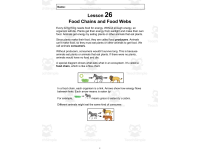
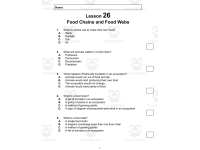
Science Reading Comprehension Passage 26 : Food Chains and Food Webs
Independent PDF Version:
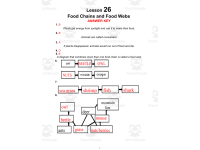
This is the independent PDF version containing one lesson with full answer keys.
Product Info:
7 PAGES (US English with Answers) PDF Version
Teaching Duration: Approximately 90 Minutes
Science Reading Comprehension Outline:
Each passage comes with a variety of questions in different formats, including multiple-choice formats, data analysis, and fill-in-the-blanks. The topics covered strike a balance between engaging content and core curriculum-based science subjects.
Versatile in application, these lessons are suitable for a variety of settings such as whole-class instruction, morning activities, independent desk work, small group discussions, contingency plans for substitute teachers, homework assignments, or even special holiday-themed tasks.
FULL CATALOG OF DOWNLOAD LINKS HERE
Grade 3/4 Links:
Physical Science Part 1 - Properties of Objects and Materials
Google Docs/Slides/Forms
PPT
Word
Free Supplementary Pack
Accompanying Videos
Physical Science Part 2 - Position and Motion of Objects
Google Docs/Slides/Forms
PPT
Word
Free Supplementary Pack
Accompanying Videos
Physical Science Part 3 - Light, Heat, Electricity, Magnetism
Google Docs/Slides/Forms
PPT
Word
Free Supplementary Pack
Accompanying Videos
Life Science Part 1 - Characteristics of Organisms
Google Docs/Slides/Forms
PPT
Word
Free Supplementary Pack
Accompanying Videos
Life Science Part 2 - Life Cycles of Organisms
Google Docs/Slides/Forms
PPT
Word
Free Supplementary Pack
Accompanying Videos
Life Science Part 3 - Organisms and Environments
Google Docs/Slides/Forms
PPT
Word
Free Supplementary Pack
Accompanying Videos
Earth Science Part 1 - Properties of Earth Materials
Google Docs/Slides/Forms
PPT
Word
Free Supplementary Pack
Accompanying Videos
Earth Science Part 2 - Changes in the Earth and Sky
Google Docs/Slides/Forms
PPT
Word
Free Supplementary Pack
Accompanying Videos
Earth Science Part 3 - Objects in the Sky
Google Docs/Slides/Forms
PPT
Word
Free Supplementary Pack
Accompanying Videos
For similar products and other frees, do check out Cored Group on TeachSimple.
Related resources
More resources teachers may find useful
10 related resources were found in the released localized catalogue using shared categories and topics.


In the classroom
Teaching tips & learning objectives

Learning objectives
Identify producers and consumers in a food chain based on how each organism obtains energy.
Explain what happens to an ecosystem's animals when its plant producers are removed.
Sequence a set of given organisms into a correct food chain or food web using directional arrows.
Spell key ecosystem vocabulary such as producer, consumer, and ecosystem.

Teaching tips
Introduce the food chain diagram on page 1 before the food web on page 2, since the passage builds the food-web concept directly on top of the food-chain one.
Assign the spelling activity before the diagram-completion questions, since several tested terms (producer, consumer, ecosystem) reappear in the diagram word banks.
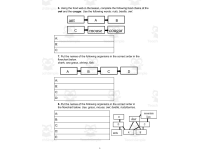
Have students work in pairs on the three diagram-completion exercises, since each uses a different organism set (forest, ocean, and grassland).
Use the multiple-choice questions as a quick formative check before moving to the more open-ended diagram sequencing.

Skills covered
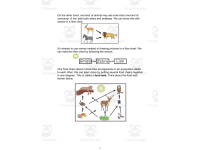
Food chain and food web analysis — students trace producer-to-consumer energy flow through diagrams built from organisms such as owl, cougar, shark, and shrimp.
Reading comprehension — five multiple-choice questions require identifying supporting details from the passage about producers, consumers, and ecosystems.
Science vocabulary spelling — students fill in missing letters for 14 domain-specific terms such as ecosystem, consumer, and sunlight.
Diagram sequencing — students order given organism names into food-chain and food-web flowcharts using directional arrows.
Good to know
Questions teachers ask about this resource
How are the food-chain and food-web diagrams on page 4 meant to be completed?
Students write organism names into blank arrow sequences using the word bank given for each of three sets: an owl/cougar forest web, a shark-based ocean chain, and a five-organism owl food web starting with grass.
How does the passage use multiple ecosystems?
After building a grassland food chain and food web with grass, zebra, lion, and antelope on pages 1-2, the practice diagrams apply the same concepts to a forest set (owl, cougar, beetle, nuts) and an ocean set (shark, sea grass, shrimp, fish).

No reviews yet
Downloaded this resource? Tell other teachers how it went.
Resource details
Concepts & topics
Core concepts
 Core concepts
Food chains
Food webs
Producers and consumers
Ecosystems
 Topics
Explore more
Categories this resource belongs to
Explore related searches


More to explore