


Search results for Body
Results use exact search terms from the released United Kingdom inventory.

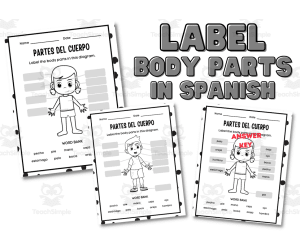
Partes del Cuerpo – Spanish Body Parts Worksheet
, Not Grade Specific,
A body-part diagram labelled Partes del Cuerpo has students write the correct Spanish word at each pointer, using a ten-word bank and a duplicate practice copy.
Author Primary 206 Mix
Rating
Tags Spanish, Body Parts, Vocabulary, Spanish Vocabulary, Labeling

Printable Body Parts of Animals Activity Worksheets for Year 3, 3, 4
, Not Grade Specific,
The sequence begins by pairing familiar animals with distinctive parts, then asks learners to choose or supply the appropriate structure in context. A sorting page separates parts used mainly for movement from those used for sensing. Later clue and labelling tasks shift attention from simple recall toward how a body feature helps an animal move, feed, sense, or protect itself.
Author Clever Crafters
Rating
Tags Animal Body Parts Worksheets, Animal Biology Activities, Learning About Animal Anatomy, Early Science Worksheets, Animal Structure For Kids

Science Game: Guess Who? Cells Unit
, Not Grade Specific,
A grid of term cards covering human body systems and cell organelles supports a print-and-cut guess-who style vocabulary game.
Author Resource Garden
Rating
Tags Science Education, Cellular Biology, Interactive Game, Digital Learning, Organelle Concepts

Senses Smell Worksheet
, Not Grade Specific,
Sense of Smell asks learners to connect familiar objects with information gathered by the nose. Students inspect each picture and circle those whose odor can help identify or describe them. The choice format reinforces that not every object is primarily investigated with the same sense. A follow-up discussion can introduce words such as fragrant, smoky, fresh, or unpleasant and can address safe smelling practices. The page serves as a concise component of a broader five-senses lesson.
Author Have Fun Teaching
Rating
Tags Have Fun Teaching

Senses Taste Worksheet
, Not Grade Specific,
Sense of Taste builds an early science classification around how people gather information. Children look across the pictured items and decide which can appropriately be learned about by tasting. The task requires connecting the sensory organ and action with relevant object properties such as flavour. It also creates an opportunity to distinguish what is theoretically tasted from what is safe to put in the mouth. Students can explain each choice using the sentence frame “I can taste…” and name a likely flavour.
Author Have Fun Teaching
Rating
Tags Have Fun Teaching

Sheep Heart Dissection Lab ~ Anatomy and Physiology
, Not Grade Specific,
A sheep heart dissection lab has students locate and identify 15+ heart structures, answer 20 procedural questions about blood flow and anatomy, and complete a partner structure-and-function checklist, with full answer keys for both.
Author The Teacher Team
Rating
Tags Science Lab, Anatomy, Physiology, Biology, ELL, Labeled Sheep Heart Dissection, Heart Dissection Lab, Sheep Heart Dissection Guide, Sheep Heart Dissection Lab, Sheep Dissection Lab, Heart
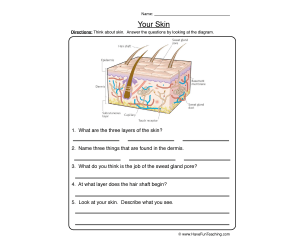
Skin Structure: Diagram and Questions
, Not Grade Specific,
Use a labelled skin cross-section to answer five questions about layers and structures, then connect the diagram with observations of your own skin.
Author Have Fun Teaching
Rating
Tags

Private Body Time – Social Story for Kids
, Not Grade Specific,
A nine-page illustrated social story sets out one privacy rule in plain first-person language: private time belongs somewhere private, not at school or in front of others. Each of nine illustrated pages restates one plain rule in first-person language, so a young reader learns that private time belongs somewhere private and alone.
Author SEN Resource Source
Rating
Tags Social Story, Social Story About Touching Yourself, Touching Self, Public Masturbation Story, Public Masturbation Stories
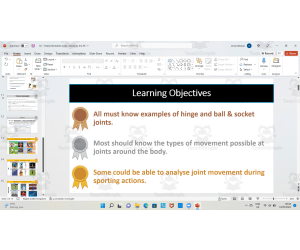
Types of Freely Movable Joints
, Not Grade Specific,
A GCSE PE lesson presentation teaches the two types of freely moveable joints — hinge and ball-and-socket — along with the five joint movements and how each occurs during specific sporting actions.
Author The PE Tutor
Rating
Tags Joints, Skeleton, Human Biology, Anatomy, Ball And Socket, Most Freely Movable Joint, Movable Joints