Crash Course Memory


- Year levels
- Years 9–12
- Pages
- 2
- File type
- Zip


- Subject
- Psychology, Social Studies
- Topic
- Memory, Psychology
- Resource types
- Worksheets
From the author
About this resource
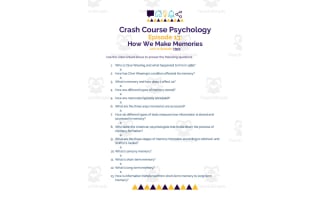
Pair Crash Course Psychology Episode 13, How We Make Memories, with fifteen questions on Clive Wearing, recall, recognition, relearning, encoding, storage and retrieval. The final question asks students to reflect on memory and relationships.
The download includes a two-page student worksheet and two-page teacher key in PDF and editable Word formats. The Word copies repeat the four PDF pages. Access to the linked video is needed; check the link before class.
Related resources
More resources teachers may find useful
More resources on the same subject and topic.


In the classroom
Teaching tips & learning objectives

Learning objectives
Summarise Clive Wearing's amnesia case and explain how it illustrates the role of memory in daily life.
Identify the three ways memories are accessed: recall, recognition, and relearning.
Explain the Atkinson-Shiffrin model's three stages of memory formation: encoding, storage, and retrieval.
Distinguish sensory, short-term, and long-term memory, including short-term memory's four-to-seven-item capacity.

Teaching tips
Play the linked Crash Course episode in class or assign it for homework before distributing the worksheet, since every question is built around content from the video.
Use question 15 (how memory shapes relationships, using Clive Wearing as a starting point) as a discussion prompt or short written reflection, since the answer key notes responses will vary.
Assign the Word version if you want students to type answers directly into the document, or the PDF version for printed responses.

Skills covered
Video-based note-taking and comprehension — students extract specific facts and explanations from a psychology video to answer 15 sequential questions.
Cognitive-model application — students explain memory formation using the Atkinson-Shiffrin encoding-storage-retrieval framework.
Case-to-concept reasoning — students connect Clive Wearing's specific amnesia case to general principles of memory and its role in relationships.
Good to know
Questions teachers ask about this resource
Does the worksheet ask students to reflect on memory beyond the Clive Wearing case?
Yes — the final question asks students to think about how memory shapes their own relationships and friendships, using Clive Wearing's story as a starting point for a more personal, open-ended response.

No reviews yet
Downloaded this resource? Tell other teachers how it went.
Resource details
Concepts & topics
Core concepts
 Core concepts
Memory formation
Encoding, storage, retrieval
Short-term and long-term memory
Recall and recognition
 Topics
Explore more
Categories this resource belongs to
Explore related searches


More to explore