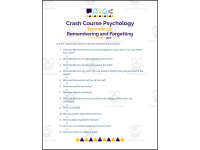
Crash Course Psychology #14: Remembering and Forgetting

- Year levels
- Years 9–12
- Pages
- 2
- File type
- Zip


- Subject
- Psychology, Social Studies
- Topic
- Memory, Psychology
- Resource types
- Worksheets
From the author
About this resource
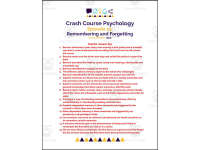
The package includes a digital worksheet with 15 critical thinking questions about the Crash Course video on remembering and forgetting. Learners will gain insight into fascinating psychological concepts like serial position effects, interference theory, and issues with eyewitness testimony. An answer key is also provided for instructors. This versatile resource works well for whole-class instruction, small groups, homework, and more. It is formatted to integrate easily into Google Classroom and other digital platforms.
Related resources
More resources teachers may find useful
More resources on the same subject and topic.


In the classroom
Teaching tips & learning objectives

Learning objectives
Distinguish implicit memory from explicit memory, with an example of each.
Explain how priming and context-/state-dependent cues can trigger memory retrieval.
Describe the primacy effect using the grocery-list example from the video.
Summarise how an eyewitness account can be shaped by memory processes such as encoding, storage, and retrieval.

Teaching tips
Play the linked Crash Course Psychology video and pause at each relevant point, since all 15 questions follow the eyewitness story and concepts in sequence.
Note before assigning question 15 that the answer key marks it as open-ended ("answers will vary"), so plan to accept multiple valid responses rather than one fixed answer.
Use the separate teacher answer key to confirm that student responses to the definition questions (6, 7, 9-11) capture the same core idea, since answers are short written responses rather than fill-in-the-blank recall.

Skills covered
Memory-concept vocabulary — students define implicit memory, explicit memory, priming, and context-/state-dependent memory (questions 6, 7, 9-11).
Applied case analysis — students trace how Bernice's eyewitness account was formed and later challenged, connecting a narrative to memory-process vocabulary (questions 1-5, 8).
Pattern explanation — question 14 asks students to explain the primacy effect using a concrete grocery-list example.
Video-based synthesis — the closing question asks students to name as many memory-and-forgetting factors from the video as they can recall.
Good to know
Questions teachers ask about this resource
How do I use the remembering-and-forgetting guide with the video?
Open the separate Crash Course episode through the supplied link. The download provides student questions and teacher responses in Word and PDF.

No reviews yet
Downloaded this resource? Tell other teachers how it went.
Resource details
Concepts & topics
Core concepts
 Core concepts
Memory encoding and retrieval
Implicit vs. explicit memory
Priming
Primacy effect
 Topics
Explore more
Categories this resource belongs to
Explore related searches


More to explore