



Search results for Printables
Results use exact search terms from the released Australia inventory.


Crash Course Psychology #14: Remembering and Forgetting
, Not Grade Specific,
Memory and forgetting are explored through fifteen short-answer questions accompanying the Crash Course Psychology episode, following an eyewitness-testimony story to explain implicit and explicit memory, priming, and the primacy effect.
Author Ed Dynamic
Rating
Tags Memory, Psychology, Crash Course, Critical Thinking

Crash Course Psychology #15: Cognition (How Your Mind Can Amaze and Betray You)
, Not Grade Specific,
Fifteen short-answer questions accompany the Crash Course Psychology cognition episode, walking students from a basic definition of cognition through concepts, prototypes, problem-solving strategies, and the framing effect on risk perception.
Author Ed Dynamic
Rating
Tags Psychology, Crash Course, Problem Solving, Video Guide, Comprehension Questions, Critical Thinking
Crash Course Psychology #16: Language
, Not Grade Specific,
Fifteen short-answer questions follow Crash Course Psychology's language episode from Kanzi the bonobo through phonemes, morphemes and babbling to Chomsky's universal grammar, with a teacher key supplying a full written response for every item.
Author Ed Dynamic
Rating
Tags Language Development, Crash Course, Video Companion, Comprehension Questions, Answer Key

Crash Course Psychology #18: The Growth of Knowledge
, Not Grade Specific,
Piaget's cognitive development theory drives this Crash Course Psychology worksheet, with fifteen short-answer questions and a full teacher answer key. Fifteen short-answer questions follow one psychology video through Piaget's account of cognitive development, from schemas and object permanence to egocentrism, theory of mind and the criticisms of his model.
Author Ed Dynamic
Rating
Tags Cognitive Development, Piaget, Vygotsky, Psychology, Crash Course

Crash Course Psychology #20: Adolescence
, Not Grade Specific,
A teacher answer key gives full model answers for 15 numbered items keyed to Crash Course Psychology's "Adolescence" episode, moving from Erik Erikson's identity-versus-role-confusion crisis in the teenage years through his intimacy-versus-isolation crisis in young adulthood and his eight-stage model of lifelong psychosocial development. Later items extend into adulthood and aging: the difference between fluid intelligence, which peaks in adolescence, and crystallised intelligence, which grows with experience; the physical changes of aging such as declining reaction time and hormone production; and the distinction between normal memory changes, dementia, and Alzheimer's disease. One item connects the material to the film The Breakfast Club as an illustration of the adolescent struggle between standing out and belonging.
Author Ed Dynamic
Rating
Tags Adolescence, Crash Course Psychology, Erikson's Stages, Psychosocial Development, Supplemental Resource

Crash Course Psychology #36: Biomedical Treatments
, Not Grade Specific,
A video-guide worksheet follows Crash Course Psychology's Biomedical Treatments episode with fifteen sequenced open-response questions, from measuring psychotherapy's effectiveness to specific brain-stimulation treatments.
Author Ed Dynamic
Rating
Tags Psychology, Mental Health, Crash Course, Video Guide
Crash Course Psychology #8: Consciousness
, Not Grade Specific,
Fifteen open-ended questions tied to Crash Course Psychology's Episode 8 on Consciousness cover its definition, brain-imaging research, the dual-process model, and change blindness, with a matching teacher answer key.
Author Ed Dynamic
Rating
Tags Crash Course, Psychology, Worksheet, Questions, Attention, Brain

Crash Course Psychology #9: Sleep & Dreams
, Not Grade Specific,
Fifteen short-answer questions guide students through the Crash Course Psychology episode on sleep, from the four sleep stages to REM's discovery by an eight-year-old test subject.
Author Ed Dynamic
Rating
Tags Psychology, Video, Worksheet, Comprehension, Critical Thinking
Crash Course Psychology Episode Worksheet | 13 - How We Make Memories
, Not Grade Specific,
Fifteen short-answer questions follow Crash Course Psychology episode 13, moving from the case of Clive Wearing to Atkinson and Shiffrin's three stages of memory formation and the capacity limits of short-term memory, with a teacher answer key supplying the expected response to each.
Author Ed Dynamic
Rating
Tags Crash Course Videos, Crash Course Psychology, Psychology Video, Memories, Consciousness, Vocabulary, Independent Work, Comprehension
Crash Course Psychology Worksheet | 18 - The Growth of Knowledge
, Not Grade Specific,
Piaget's theory of cognitive development anchors fifteen viewing questions for Crash Course Psychology Episode 18, delivered as an editable Word worksheet with a completed teacher key.
Author Ed Dynamic
Rating
Tags Cognitive Development, Vocabulary, Independent Work, Psychology, Crash Course
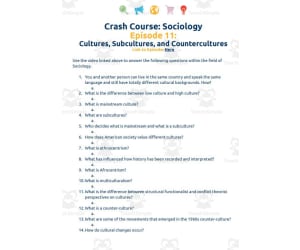
Crash Course Sociology #11: Cultures, Subcultures, and Countercultures Worksheet
, Not Grade Specific,
The worksheet follows a sociology episode across concepts including high and popular culture, mainstream norms, subcultures, theoretical perspectives, countercultures, assimilation, multiculturalism, and cultural diffusion. Learners record written responses as they view. The packet contains duplicated student sheets and teacher checking pages, useful for alternate classroom copy arrangements. The record summarises the thematic coverage while withholding exact prompts and all provided responses.
Author Ed Dynamic
Rating
Tags Sociology, Culture, Subculture, Counterculture, Video, Worksheet

Crash Course Sociology #2: Major Sociological Paradigms Student Worksheet
, Not Grade Specific,
Fifteen short-answer questions follow Crash Course Sociology episode 2 from the definition of a paradigm through macro and micro levels of analysis to structural functionalism, conflict theory and symbolic interactionism.
Author Ed Dynamic
Rating
Tags Social Studies, Sociology, Crash Course, Video Guide

Crash Course Sociology Episode | 24 Social Class and Poverty in U.S.
, Not Grade Specific,
Marx's two-class model and Weber's income-based definition anchor fifteen video-response questions on Crash Course Sociology's episode about social class and poverty in the US.
Author Ed Dynamic
Rating
Tags Social Class, Poverty, Sociology Education, Crash Course Sociology, Critical Thinking
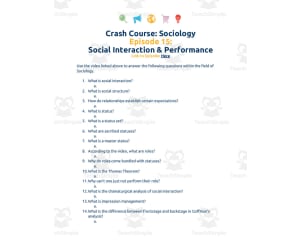
Crash Course Sociology Episode Worksheet | 15 - Social Interaction & Performance
, Not Grade Specific,
The guided questions move from basic social interaction and structure toward the expectations attached to relationships and roles. Later prompts address a theatrical model of social life, including how people manage impressions and behave differently before an audience or away from it. The final open response invites personal reflection on performed roles. A parallel completed version supports checking,.
Author Ed Dynamic
Rating
Tags Crash Course Videos, Crash Course Worksheets, Social Interaction, Social Performance, Sociology Worksheet, Sociology Course, Comprehension

Crash Course Sociology Episode Worksheet | 16 - Social Groups
, Not Grade Specific,
A video-companion worksheet guides students through fifteen short-answer questions on the Crash Course Sociology episode about social groups, from group types to the Milgram Experiment, with a full answer key included.
Author Ed Dynamic
Rating
Tags Crash Course Videos, Crash Course Worksheet, Sociology Worksheet, Sociology Video, Comprehension Questions

Crash Course Sociology Episode Worksheet | 2 - Major Sociological Paradigms
, Not Grade Specific,
Fifteen prompts follow the episode’s introduction to paradigms and ask learners to distinguish several ways sociologists frame social life. The sequence moves from the purpose of a paradigm to structural-functional, conflict, and symbolic-interaction perspectives, including the levels and social features each emphasises. Learners respond while viewing, then use the separate completed pages for review.
Author Ed Dynamic
Rating
Tags Crash Course Videos, Crash Course Worksheet, Culture, Diversity, Comprehension Questions, Sociology Worksheet, Sociology Video

Create Your Own Emoji!
, Not Grade Specific,
Students sketch up to seven original emoji designs, pick their top two, then write a case for why the Unicode Consortium should adopt each one.
Author Brave Education
Rating
Tags Emoji Design, Digital Art, Creativity, Critical Thinking, Visual Communication, Make Your Own Emoji Shirt, How To Create Your Own Emoji
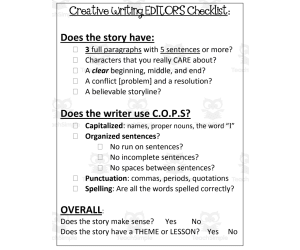
Creative Writing Checklists
, Not Grade Specific,
A single page repeats the same story-structure and C.O.P.S. proofreading checklist four times for cutting into individual strips.
Author The Language of Learning
Rating
Tags Creative Writing, Student Editing, Peer Editing, Writing Checklist, Language Arts, Writing Checklist For Students, Writing, Creative, Editing Checklist

Crossword Puzzle about Vehicles
, Not Grade Specific,
Fifteen vehicle names, from car and bus to excavator and forklift, fill a numbered crossword-style grid on page one, with every word spelled out on a completed answer grid on page two.
Author TheBrightestKid
Rating
Tags Crossword, Puzzle, Vocabulary, Spelling, Writing, Vehicles

Periodic Table Crossword Puzzle – 20 Elements
, Not Grade Specific,
Twenty periodic-table chemical symbols serve as the only clues in this crossword, so students must recall and spell each element's full name.
Author DIGITAL SCHOOL OF LIFE
Rating
Tags CROSSWORD, PUZZLES, CHEMISTRY, CHEMICAL ELEMENTS, Periodic Table
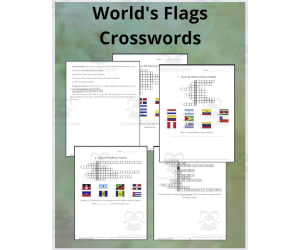
Crossword Puzzles about World Flags
, Not Grade Specific,
Fifteen region-by-region crosswords have students identify countries from their flags — South America through Africa, Europe, Asia, and Oceania — with hidden bonus words and full answer grids.
Author TheBrightestKid
Rating
Tags Flags, Continents, Countries

Cursive Letter Connections
, Not Grade Specific,
Cursive letter connections — joining a capital to a small letter, and one small letter to the next — are practised on 30 reproducible tracing pages for Foundation–Year 3.
Author Classroom Complete Press
Rating
Tags Writing Worksheet, Handwriting

CUT AND GLUE | 6 FREE WORKSHEETS
, Not Grade Specific,
Cut-and-glue practice is distributed across six visual worksheets. Learners separate the printed pieces, compare their images or shapes with the target spaces, and attach each choice in its corresponding location. The repeated hands-on response method stays stable while the page visuals change. Testing every loose piece before gluing adds a deliberate visual-comparison step to the fine-motor worksheet activity on each page.
Author EDITORIAL LAURA EDUCA
Rating
Tags HEALTH, BODY, BODY PARTS, CUT, FREE, FREE RESOURCES

CVC Words - Short A - QR Code Task Cards & Response Sheets - EBOOK
, Not Grade Specific,
Short a CVC words such as bag, ham, van and wax appear on 20 QR code picture cards, with bat in two versions. Students name each picture, scan to check, then write the word on a response sheet.
Author Knowledge Box Central
Rating
Tags CVC Words, Short 'a', Phonics, QR Code, Task Cards